
La plupart des échecs de chatbot ne sont pas des échecs de modèle. Ce sont des échecs de flux de travail. Le bot commence par un accueil vague, pose des questions dans le mauvais ordre, perd le fil lorsque l'utilisateur change de sujet et cache la sortie jusqu'à ce que le visiteur soit déjà agacé. Ensuite, l'équipe blâme l'IA.
Conception de flux de travail de chatbot est la discipline qui consiste à décider ce que le bot doit faire en premier, quelles informations il a besoin ensuite, quand il doit poser des questions plutôt qu'inférer, quand il doit se ramifier et quand il doit arrêter de faire semblant et passer la conversation à un humain. Cela semble basique, mais le marché se positionne autour de cette idée exacte maintenant. Intercom fixe le prix de Fin à $0,99 par résultat, et HubSpot a annoncé le 2 avril 2026 que Breeze Customer Agent passerait à $0,50 par conversation résolue à partir du 14 avril 2026. Les vendeurs ne vendent plus “messages envoyés”. Ils vendent du travail terminé.
Ce changement modifie la façon dont les constructeurs et les chefs de produit doivent penser aux flux. Un bon flux de travail n'est pas un joli diagramme en arbre. C'est un chemin contrôlé de l'intention au résultat avec suffisamment de flexibilité pour sembler conversationnel et suffisamment de structure pour rester précis. Le rapport sur les tendances CX 2026 de Zendesk indique 81% des consommateurs souhaitent que les agents poursuivent une conversation sans revenir en arrière, 74% se sentent frustrés lorsqu'ils doivent répéter des informations, et 86% affirment que la réactivité et la résolution précise influencent fortement les décisions d'achat.. La conception du flux de travail est la façon dont vous répondez à ces attentes sans transformer chaque chat en un ticket de support en direct coûteux.
Les prix, les détails du produit et les références de référence dans ce guide ont été vérifiés par rapport à la documentation publique et aux pages de tarification. au 11 avril 2026. Si vous avez besoin de la couche de configuration de la plateforme avant la couche de conception, commencez par notre tutoriel complet sur les bots Messenger. Cet article reste concentré sur l'architecture sous-jacente d'un flux qui résout, qualifie, réserve ou escalade proprement.
Ce qu'est la conception de flux de travail de chatbot et pourquoi la plupart des équipes se trompent.
Le moyen le plus simple de comprendre la conception de flux de travail de chatbot est de séparer la conversation copier de la conversation logique. Le texte est la formulation des invites, des réponses, des boutons, des avertissements et des confirmations. La logique est la structure cachée qui décide de ce qui apparaît ensuite. Si un utilisateur demande des prix, est-il dirigé vers une explication des prix, une étape de qualification ou un humain ? Si un client revenant demande un ordre, demandez-vous à nouveau le numéro de commande ou le tirez-vous du contexte de session ? Si le bot ne connaît pas la réponse, cherche-t-il dans une base de connaissances, pose-t-il une question de clarification ou redirige-t-il vers un agent ?
La plupart des équipes se trompent sur ce point parce qu'elles commencent par le script au lieu de se concentrer sur le travail à accomplir. Elles cartographient un accueil chaleureux, quelques boutons, et peut-être une boîte de réponse AI. Ce qu'elles ne cartographient pas, c'est la question opérationnelle derrière le flux : ce qui compte comme succès, quelles données sont nécessaires, ce qui ne doit jamais être automatisé, et ce que le paquet de transfert doit contenir si un humain intervient. C'est ainsi que vous vous retrouvez avec des bots qui semblent intelligents lors des démonstrations et échouent dans le trafic en direct.
Un flux de travail n'est pas “ un bot qui peut répondre à des questions. ” Un flux de travail est “ un bot qui peut déplacer un utilisateur d'un état reconnu à un autre. ” L'état peut être un visiteur anonyme à un lead qualifié. Cela peut être un client confus à une réponse résolue. Cela peut être un contact après les heures d'ouverture à un rappel programmé. Une fois que vous définissez le changement d'état, le design devient plus clair. L'accueil cesse d'être générique. Les branches cessent de se multiplier. Le plan de secours cesse d'être une embarras.
C'est aussi pourquoi la tarification basée sur les résultats est stratégiquement importante. Intercom dit Fin résout en moyenne 67% de requêtes clients. HubSpot dit L'agent client Breeze résout 65% de conversations. Ce sont des chiffres rapportés par les fournisseurs, pas des références universelles, mais ils pointent vers le même standard opérationnel : le flux de travail est jugé par le travail résolu, pas par la façon dont le salut semblait naturel. Si votre design ne crée pas un chemin clair vers la résolution, la qualité du modèle ne vous sauvera pas.
Il y a quatre schémas d'échec que je vois constamment. Le bot brochure explique l'entreprise avant de traiter l'intention de l'utilisateur. Le bot sur-branché crée tellement de chemins que personne ne peut les maintenir, donc la moitié des branches deviennent des impasses. Le bot faux-AI semble ouvert mais ne peut pas agir, vérifier ou escalader correctement. Le bot de confinement cache l'aide humaine pour défendre les métriques d'automatisation, ce qui tue silencieusement la confiance et la conversion.
C'est pourquoi la conception des workflows de chatbot appartient davantage à la conception de produits qu'à la rédaction. Vous décidez des entrées, des états, des transitions, des règles commerciales, des exceptions et des conditions de sortie. Le chat visible n'est que la couche superficielle. En dessous, vous construisez un flux de service. Les équipes qui le traitent de cette manière expédient généralement moins de branches, de meilleures passes et des chiffres de conversion plus solides.
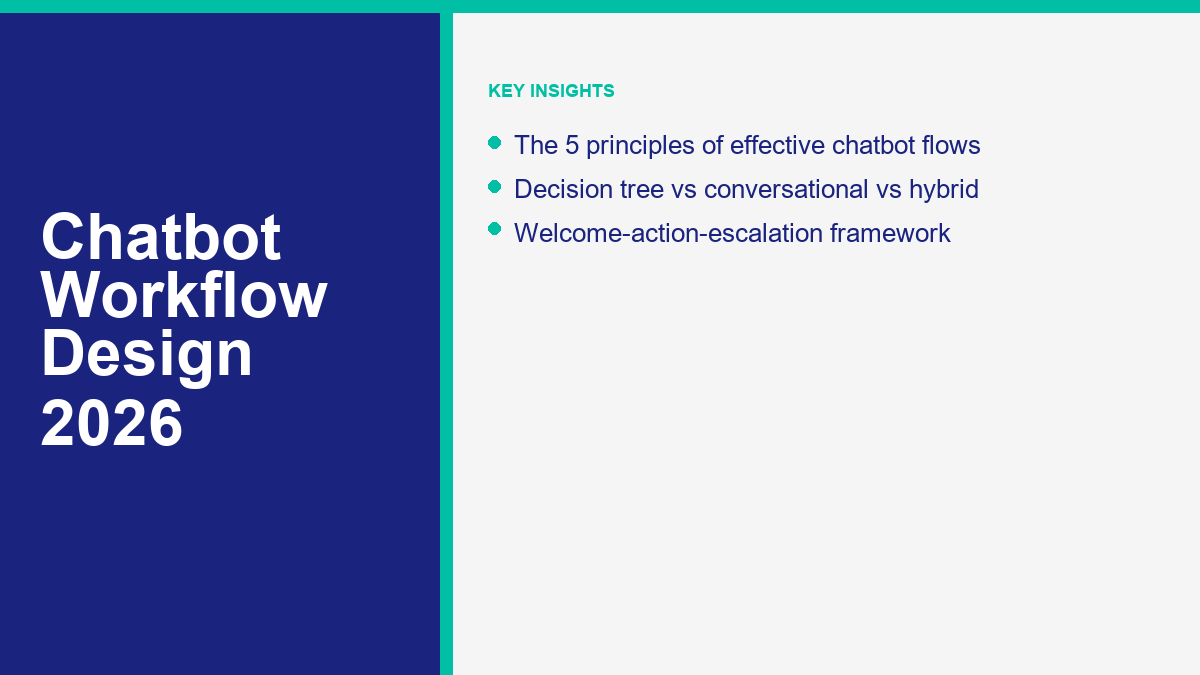
Les Cinq Principes des Flux de Chatbot Efficaces en 2026
Les meilleurs flux de 2026 semblent modernes en surface, mais les règles sous-jacentes sont démodées et disciplinées. Ils réduisent l'ambiguïté tôt, demandent des informations uniquement lorsque la réponse change l'étape suivante, et gardent le chemin vers un humain évident. Lorsque les équipes sautent ces bases, le workflow devient fragile peu importe à quel point le modèle semble avancé dans le pitch deck.
Un Point d'Entrée Devrait Généralement Avoir Un Travail Principal
A pricing-page chatbot should behave differently from a support chatbot inside an authenticated account area. The biggest design mistake is trying to make one welcome flow serve six jobs at once. You can still offer multiple options, but every entry point needs a primary objective: qualify a lead, answer pre-sales questions, resolve repetitive support issues, book an appointment, or triage to a person. Once you know the main job, you can compress the path to the first useful action.
Time to First Useful Answer Beats Clever Small Talk
Fast does not just mean low model latency. It means low workflow latency. If the first three turns are “Hi there,” “How are you today,” and “Can I help you with something,” you already lost. Zendesk’s 2026 data shows customers increasingly expect instant resolutions and 24/7 service because AI reset the baseline Zendesk. The design response is simple: get to the useful branch immediately. Lead with “Track an order,” “Book a demo,” “Talk to sales,” “Billing help,” or “Ask a question,” not brand theater.
Carry Context Forward or Do Not Ask for It Yet
Variables, session memory, CRM lookups, and tags exist for a reason. If the bot already knows the product page the user came from, the last selected intent, the account plan, or the store location, use that data to narrow the next question. If the workflow cannot retain or retrieve context, do not fake continuity. Users hate being forced to repeat themselves. Zendesk’s 2026 report is blunt: 81% want agents to continue without backtracking, and 74% are frustrated when they must restate information Zendesk.
Visible Escape Hatches Build More Trust Than Aggressive Containment
A good chatbot does not hide human help. It frames it properly. “I can answer pricing, product, and booking questions here. For billing disputes or account access, I’ll route you to a teammate.” That line improves conversion because it sets capability boundaries upfront. If you are still weighing the human layer against automation, read our guide to chatbot vs live chat. The short version is that automation should shrink repetitive work, not trap edge cases.
Every Important Branch Needs a Measurement Plan
If a branch exists, it should either produce value or reveal why it failed. That means every major route should log at least five states: entered, answered, completed, escalated, and abandoned. A flow you cannot measure is a flow you cannot improve. This matters even more now that pricing models increasingly tie cost to outcomes. HubSpot’s move to $0.50 per resolved conversation and Intercom’s $0.99 per outcome pricing both reward teams that know exactly where resolution happens and where it breaks HubSpot Intercom.
Those five principles sound simple because they are. The hard part is enforcing them when stakeholders keep asking for just one more option in the same flow.
Decision Tree vs Conversational vs Hybrid: Choosing the Right Structure
Most teams do not need to choose between a rigid decision tree and a fully generative bot. They need to decide which parts of the journey require certainty, which parts benefit from open-language flexibility, and where the handoff between those two modes should happen. That is a workflow design decision, not a model decision.
| Structure | Meilleur pour | What it does well | Où ça casse | Typical fit |
|---|---|---|---|---|
| Decision tree | Lead qualification, appointment booking, account routing, policy-bound support | Predictable outcomes, clean analytics, easy QA, strong compliance control | Feels robotic when the user asks something off-script or multi-intent | Best for high-certainty paths with known answers |
| L'IA conversationnelle | Broad FAQ, knowledge retrieval, product education, first-pass discovery | Handles natural language, clarifies intent, covers long-tail questions | Can hallucinate, over-answer, or miss routing logic if guardrails are weak | Best for answer-rich use cases with strong knowledge bases |
| Hybrid | Most modern sales and support workflows | Uses AI for understanding and deterministic logic for critical transitions | Takes more design discipline because both layers must stay in sync | Best for teams that need natural conversation and business-rule control |
The rule I use is straightforward. If the business process has compliance requirements, fixed eligibility logic, or a small number of known paths, start deterministic. If the use case is broad-question discovery across a well-maintained knowledge base, conversational AI can work well. If the flow needs both routing precision and natural-language coverage, use a hybrid. That is now the default choice for most serious teams because users want flexibility while operators still need traceable logic.
Hybrid structure also tends to be the most forgiving when teams are still learning. You can let the AI classify intent, summarize the user’s request, or answer knowledge questions, but still force critical actions through guarded steps such as collecting consent, checking eligibility, verifying an account, capturing contact details, or escalating to the right queue. That gives you better user experience without surrendering control over the moments that create risk.
Which Workflow Builders Fit Each Structure Best Right Now
No serious production builder is truly “no sign up required.” Whiteboard tools can be lightweight, but once you need publishing, analytics, human handoff, and CRM sync, you need an account. The good news is that several strong tools still offer free tiers or low-risk starting plans. The price points below were checked on official pages au 11 avril 2026.
| Outil | Meilleur ajustement | Public pricing snapshot | Workflow design take |
|---|---|---|---|
| Voiceflow | Hybrid design, prototyping, multi-agent orchestration | Starter is free; Pro and Business plans start at $60/month, with extra editor seats at $50/month Source | Strong when product and conversation teams want deep control over prompts, tools, and states before deployment |
| Landbot | Decision-tree and hybrid lead funnels | Sandbox is free forever; Starter is listed at €40/month with 500 chats and 100 AI chats Source | Good for teams that want visual branching discipline and quick marketing or qualification flows |
| Tidio | SMB support and website conversion | Starter begins at $24.17/month; Lyro AI Agent starts at $32.50/month from 50 AI conversations; the first 50 Lyro conversations are free Source | Useful when you need a practical mix of support inbox, flows, and AI answers without a heavy build cycle |
| Botpress | AI-first hybrid workflows with developer control | Pay-as-you-go is $0 plus AI spend; Plus is $89/month plus AI spend Source | Best when you want AI-heavy logic, human handoff, and more technical flexibility than classic no-code builders |
| Intercom | Support-first workflows with strong human escalation | Essential starts at $29 per seat/month billed annually, with Fin at $0.99 per outcome Source | Strong if your workflow needs help center content, inbox operations, and measurable AI resolutions in one stack |
| HubSpot Breeze | CRM-native service and revenue flows | Customer Agent moves to $0.50 per resolved conversation on April 14, 2026 for Pro and Enterprise customers Source | Best when workflow context should come directly from CRM records, lifecycle stage, and service history |
If your team is early, deterministic builders such as Landbot or a visual Messenger-first stack are often better because they force clarity. If your team already has a knowledge base, APIs, and stricter product ownership, Voiceflow or Botpress can give you more room to build a real hybrid system. If support operations already live inside a help desk, Intercom, Tidio, or HubSpot will usually reduce the amount of stitching you need to do later.
The Welcome-to-Action-to-Escalation Framework
If I had to reduce chatbot workflow design to one reusable pattern, it would be this: welcome, action, escalation. Not because every workflow is only three steps, but because every useful flow has to answer three questions fast. Why did the user start this conversation? What useful thing can happen next? What happens if the bot cannot or should not finish the job?
est un service de messagerie largement utilisé développé par Meta Platforms, Inc. (anciennement Facebook, Inc.), conçu pour une communication fluide entre les utilisateurs. Il permet aux individus d'envoyer des messages texte, d'échanger des photos, des vidéos, des autocollants, des fichiers audio et des documents. Les utilisateurs peuvent également réagir aux messages et interagir avec divers bots pour une interaction améliorée. welcome stage should recognize context and offer a narrow set of next steps. This is not the place for mission statements. It is the place for intent framing. If the user clicked from a pricing page, the welcome can acknowledge that. If they entered from an order-status widget, the first prompt should reflect that. A strong welcome reduces cognitive load because it tells the user what the bot is actually good at.
est un service de messagerie largement utilisé développé par Meta Platforms, Inc. (anciennement Facebook, Inc.), conçu pour une communication fluide entre les utilisateurs. Il permet aux individus d'envoyer des messages texte, d'échanger des photos, des vidéos, des autocollants, des fichiers audio et des documents. Les utilisateurs peuvent également réagir aux messages et interagir avec divers bots pour une interaction améliorée. action stage is where the workflow earns its keep. It should either resolve the issue, collect the minimum information required to move forward, or route the person to the right destination. This is the part too many teams overcomplicate. The action layer does not need ten branches. It needs the shortest possible path to a meaningful outcome. For acquisition use cases, the same skeleton underpins a strong chatbot de génération de leads: identify intent, qualify lightly, capture the one or two fields that change follow-up, and offer the next step while intent is still warm.
est un service de messagerie largement utilisé développé par Meta Platforms, Inc. (anciennement Facebook, Inc.), conçu pour une communication fluide entre les utilisateurs. Il permet aux individus d'envoyer des messages texte, d'échanger des photos, des vidéos, des autocollants, des fichiers audio et des documents. Les utilisateurs peuvent également réagir aux messages et interagir avec divers bots pour une interaction améliorée. escalation stage is not failure. It is part of the designed experience. Good escalation means the bot knows its limits, preserves context, and sends the user to the right person or queue without making them restart from zero. The workflow should decide in advance what triggers escalation: legal risk, authentication failure, emotional intensity, refund disputes, multi-system issues, or simple confidence thresholds below a defined level.
Here is the cleanest mental model:
Entry point -> Intent recognized -> Useful action completed
                     |                    |
                     |                    -> Success state logged
                     |
                     -> Needs clarification -> Clarify once or twice
                                              |
                                              -> Resolved
                                              -> Escalated with summary
What makes this framework work is compression. Every extra step between welcome and action is friction. Every missing rule between action and escalation is chaos. Keep the welcome short, the action purposeful, and the escalation explicit. When you do that, even a modest workflow feels smart because it never wastes the user’s momentum.
How to Map Your First Chatbot Workflow From a Blank Canvas
The blank-canvas phase is where most teams either do the important thinking or skip it entirely. The good version does not start in the builder. It starts in a document, spreadsheet, or whiteboard with one real business problem. That planning layer can feel almost no sign up required. Production workflow design cannot. Once you move from sketch to live routing, you need ownership, environments, analytics, and version control.
The process below is the one I use when the starting point is literally nothing but a use case and a vague request to “build a chatbot.”
- Name one primary outcome. Use a measurable state change such as resolved FAQ, booked demo, qualified lead captured, ticket routed, or appointment confirmed.
- Define the entry trigger. Pricing page, support widget, Messenger ad click, help center article, order page, or after-hours contact form replacement.
- List the top five user intents only. Not twenty. Start with the intents that create the most value or volume.
- Write the minimum data needed per intent. Email, order number, company size, location, preferred time, account type, or nothing at all.
- Mark what must stay deterministic. Eligibility rules, consent, verification, compliance statements, and payment or account changes.
- Define the failure path early. What happens if the bot does not understand, cannot act, or should not answer.
- Choose the success event and supporting metrics. Completion, escalation, abandonment, median turns, time to first useful answer, and fallback rate.
- Assign an owner. Every branch should belong to somebody who can change the content, logic, or routing rule later.
One simple worksheet is enough for the first pass:
| Field | What to write down |
|---|---|
| Entry point | Where the user starts and what page, campaign, or channel they came from |
| Intent | The user job in plain English, such as “book a demo” or “track an order” |
| Required input | The minimum data needed to advance the flow |
| Business rule | The rule that changes what happens next |
| Success event | The completed outcome you want to measure |
| Fallback | What the bot says and does if it cannot proceed |
| Human handoff | Who gets the conversation and what context should go with it |
What matters here is not artistic flowcharting. It is forcing the team to answer the operational questions before the builder makes it easy to procrastinate with buttons and colors. If a stakeholder cannot explain the success event in one sentence, the workflow is too vague to launch.
One more practical tip: do not map the perfect end-state workflow first. Map the version you could ship in one or two weeks and still learn something useful from. Too many projects die in design because the first draft tries to cover every exception, every channel, and every imagined use case. Start with the path that happens often enough to matter and is narrow enough to control.
Designing for Variables, Memory, and Personalization
Memory is where chatbot workflow design becomes either genuinely helpful or quietly creepy. The right way to think about it is simple: store only the information that changes the next best action. If a variable does not improve routing, answer quality, or handoff context, it probably does not belong in the flow.
I split workflow memory into three layers. Session variables cover what happened in the current conversation: current intent, selected product, error state, last button clicked, and whether the user already declined a path. Mémoire de profil covers durable user information: plan tier, location, preferred language, account status, or customer segment. Business context covers external data pulled at runtime: open tickets, order history, appointment availability, CRM owner, or recent website activity.
That structure matters because each layer should be used differently. Session variables are perfect for keeping the conversation coherent. Profile memory is useful for reducing repeat questions and personalizing the next step. Business context is what makes the workflow feel intelligent instead of generic. For example, asking “Do you want a demo?” is fine. Asking “Do you want to book a demo for the Shopify integration you were just reviewing?” is usually better if the page context is trustworthy.
Zendesk’s 2026 CX Trends data is the best public reminder of why this matters. Consumers increasingly expect service to continue across time and channels, not restart from zero. Zendesk reports that 81% want agents to continue without backtracking, 74% are frustrated when they must repeat themselves, and 67% expect brands to tailor support based on prior interactions Zendesk. That is not an argument for storing everything. It is an argument for carrying the right few facts forward.
The most useful variables in a first workflow are usually boring: source page, product interest, conversation intent, lead score band, support category, last known account state, and escalation reason. Those variables change actual routing. The least useful variables are vanity profile details that do not alter the experience. If the workflow collects them, it usually does so because somebody wanted more CRM enrichment, not because the user needed a better answer.
This is also where tool choice starts to matter. Messenger-first builders often use tags, custom fields, and sequence state to remember conversation history. CRM-native systems like HubSpot can merge lifecycle stage and contact data directly into the flow. More flexible builders like Voiceflow or Botpress give you variable control and API-level context. The design rule stays the same in all of them: do not use memory as decoration. Use it to remove unnecessary questions and make the next turn more accurate.
A good personalization test is this: if you delete the variable, does the conversation still work? If yes, that variable is optional. If deleting it forces the bot to ask an extra question, route less accurately, or send the wrong handoff, then it is doing real work and deserves to stay.
Branching Logic That Does Not Create Dead Ends
Branching is where workflow design either becomes a revenue asset or a maintenance problem. Teams love branches because branches feel like coverage. The issue is that every branch creates an obligation: copy, logic, analytics, testing, handoff rules, and future maintenance. If a branch is not carrying its weight, it becomes a dead end disguised as completeness.
The first fix is to set a branch budget. That means limiting the number of primary options any one screen can present and limiting how deep a user should go before they either complete the action, clarify intent, or escalate. Most flows feel better with three or four strong choices than eight weak ones. Decision fatigue shows up fast in chat because the user is not scanning a full webpage. They are making one micro-decision at a time.
The second fix is to give every branch a clear destination. A branch should end in one of five places: resolved answer, captured lead, booked step, routed queue, or explicit failure state. If a branch only delivers information and leaves the user hanging, it is unfinished. “Here is our refund policy” is not an end state. “Here is our refund policy, and if your purchase qualifies, tap here so I can route you to billing with the right order details” is a real branch.
The third fix is to add global rescue paths. At almost any point, the user should be able to restart, go back, ask a free-form question, or request a human. This is where dead ends usually hide. Designers assume the user will obediently follow the intended route. Real users change their minds, discover missing context, or ask cross-intent questions halfway through. A branch without rescue paths is a trap.
Better branching is not an academic exercise. Public case studies keep showing that guided, well-routed conversations outperform passive forms and generic chat. Intercom’s Copper case study reported a 13% higher website conversion rate than traditional lead forms, 19 new opportunities, and $36,000 in added ARR pipeline in one month. Landbot’s Lead Laundry case study reported a 35% increase in conversion rates and a 50% increase in lead quality. The common theme is not “use AI.” It is “route intent more intelligently.”
Here are the branching rules I trust most:
- Prefer progressive disclosure. Ask the next question only when the answer changes the next screen.
- Collapse duplicate outcomes. If three branches end in the same handoff, merge them earlier.
- Clarify once, maybe twice. After that, escalate or offer a stronger menu instead of looping.
- Always offer a next action. Information alone rarely closes the job.
- Instrument branch exits. You want to know exactly where abandonment or confusion clusters.
When a flow starts feeling too branched, the answer is usually not more branches. It is better intent grouping, better defaults, and a more deliberate human off-ramp.
Error States, Fallbacks, and "I Do Not Know" Handling
The fastest way to ruin trust is to make the bot act more certain than it is. Users will forgive a limitation faster than they forgive fake confidence. That is why fallback design is not a cleanup task. It is one of the core parts of chatbot workflow design.
I split error states into four categories. Understanding errors happen when the bot cannot confidently classify what the user wants. Knowledge errors happen when it understands the question but does not have a trustworthy answer. Action errors happen when the bot knows what to do but a system, API, or integration fails. Policy errors happen when the bot could answer, but should not because the issue needs verification, legal review, or human judgment.
Each category needs a different response. Understanding errors should trigger a clarifying question or a tighter menu. Knowledge errors should say some version of “I do not know that reliably” and route to a safer path. Action errors should preserve progress and explain what failed without exposing internal jargon. Policy errors should sound deliberate and confident: “I can help route this, but a teammate needs to review the account before we change anything.”
This is where vendor resolution claims are useful as a reality check. Tidio says Lyro can solve up to 67% of customer problems. Intercom says Fin résout en moyenne 67% de requêtes clients. HubSpot dit Customer Agent resolves 65% of conversations. However strong those numbers are, they all imply the same operational truth: a meaningful share of conversations will still need clarification, fallback, or escalation. The workflow has to be designed for that from day one.
The best fallback responses do three things at once. They admit the limit. They preserve momentum. They offer the next move. For example:
- Weak fallback: “Sorry, I didn’t understand.”
- Better fallback: “I’m not confident I understood that. I can help with billing, order status, returns, or getting you to a teammate. Which one is closest?”
- Weak knowledge response: “Our policy is probably X.”
- Better knowledge response: “I do not have a reliable answer for that policy question, so I’d rather route you than guess.”
There is also a practical loop rule worth enforcing: after two fallback events in the same short window, the bot should change strategy. That could mean switching from free text to buttons, offering a human handoff, or summarizing what it thinks the user wants and asking for confirmation. Repeating the same generic fallback line is what makes people believe the whole bot is broken.
If you want one standard for “I do not know” handling, use this: never fake certainty, never make the user decode the failure, and never end the conversation without a path forward.
Handoff to Human: When, Where, and How to Design the Escalation
Human handoff is not the backup plan. It is part of the intended service architecture. A bot should escalate when the emotional cost, business risk, or procedural complexity becomes higher than the value of continued automation. The mistake is waiting too long because the team wants a better containment number.
The cleanest handoff triggers are usually predictable: repeated fallback, high-value sales intent, identity or account-access problems, billing disputes, cancellation risk, angry sentiment, legal or medical sensitivity, and actions that require discretion rather than policy lookup. These are not edge cases. They are normal categories that belong in the workflow map from the start.
Where teams usually fail is the handoff packet. They route the conversation, but they do not pass enough context. That forces the human to ask the same questions again, which is exactly what customers hate. Zendesk’s 2026 report says 81% of consumers want conversations to continue without backtracking and 74% are frustrated when they have to repeat information Zendesk. A handoff without context is just a queue transfer.
The minimum handoff payload should usually include:
- Detected intent: what the user appears to need
- Conversation summary: one or two sentences, preferably generated and reviewed by rule or AI
- Captured fields: order number, email, company size, booking preference, or plan tier
- Escalation reason: fallback threshold, policy restriction, system error, or human request
- Urgency or value flag: churn risk, enterprise lead, payment failure, complaint, or VIP customer
The wording matters too. “Connecting you to an agent” is vague. “I’m sending this to billing with your order number and a summary so you do not have to repeat it” is better. It reassures the user that the transition is purposeful and that their effort so far was not wasted.
One more design detail that matters more than teams expect: tell the user what happens next. If live chat is available, say so. If it becomes an email follow-up, state the expected response time. If the handoff is to a booking flow, confirm that directly. Ambiguity after escalation is where trust leaks out of the system.
The best escalation design makes the human layer feel like a continuation of the workflow, not an admission that the workflow failed.
Testing, Iterating, and Measuring Chatbot Workflow Performance
A chatbot workflow is not finished when the builder says “published.” It is finished when transcripts, completion data, and handoff outcomes say the flow is behaving the way you intended. That is why workflow design is always followed by workflow tuning.
Start with pre-launch testing that is deliberately adversarial. Do not just click the happy path. Test vague phrasing, mid-flow intent changes, wrong inputs, incomplete data, angry language, contradictory answers, and edge cases pulled from real sales calls or support tickets. If the bot breaks only when real users behave like real users, the issue is still yours.
After launch, watch the first signals that actually diagnose flow quality:
- Goal completion rate: did the workflow finish the job it was supposed to do
- Median turns to completion: are users getting there efficiently
- Taux de repli : where does understanding or knowledge fail
- Human handoff rate by intent: which branches should stay automated and which should not
- Time to first useful answer: how quickly the flow becomes helpful
- Abandonment by node: which question or branch causes drop-off
If you want the full measurement layer, use our guide to chatbot analytics metrics as the scoreboard. The practical point here is that workflow teams should review these numbers by branch, not just as one blended dashboard. A support routing flow and a lead-qualification flow should not share the same definition of success.
Public vendor numbers are useful here, but only as directional benchmarks. HubSpot says Customer Agent resolves 65% of conversations and cuts resolution time by 39% across more than 8,000 activated customers HubSpot. Intercom says Fin resolves an average of 67% of queries Intercom. Zendesk markets advanced AI agents as able to resolve 80%+ of complex issues Zendesk. Those figures are not apples-to-apples, so do not turn them into an arbitrary target. Use them as evidence that outcome-focused measurement is now normal.
The real operating rhythm is simpler than most teams think. Review transcripts weekly. Review missing-answer clusters weekly. Review branch-level completion and escalation monthly. Remove dead steps aggressively. Rewrite welcome copy when users take the wrong branch too often. Tighten qualification questions if lead quality is weak. Shorten the flow if users drop right before the ask. Better workflow design is usually subtraction, not expansion.
A good test for maturity is whether the team can answer three questions without guessing: where users get stuck, where the bot should hand off sooner, and which branch produces the highest-value outcomes. If you cannot answer those, the workflow is live but not yet managed.
One clean workflow is worth more than three half-designed AI launches. Start with one entry point, one business goal, one visible handoff, and one measurement plan. Then expand only after the transcripts and conversion numbers justify it. If you want to build those flows inside a Messenger-first platform with visual automation, tags, forms, live chat, and ecommerce hooks, Voir les tarifs de MessengerBot.
Questions fréquemment posées
Qu'est-ce que la conception de flux de travail de chatbot ?
La conception du flux de travail d'un chatbot est le processus de cartographie de la manière dont un chatbot doit accueillir les utilisateurs, identifier l'intention, collecter ou rappeler les bonnes informations, se ramifier vers la bonne étape suivante et escalader vers un humain si nécessaire. Il s'agit moins d'écrire des textes astucieux pour le bot et plus de construire un chemin fiable de l'intention de l'utilisateur à l'issue commerciale.
Qu'est-ce qui fait qu'un flux de travail de chatbot convertit réellement ?
Un workflow de conversion parvient rapidement à la première action utile, ne pose que les questions qui changent l'étape suivante, maintient le nombre de branches sous contrôle et facilite l'escalade lorsque l'automatisation n'est pas la bonne réponse. Le workflow doit sembler court, pertinent et intentionnel plutôt qu'exploratoire pour le plaisir d'explorer.
Quelle devrait être la durée d'un flux de travail de chatbot ?
As short as the job allows. A narrow support or routing flow may resolve in 3 to 6 turns. A lead qualification or booking flow may take 6 to 12 turns if every question changes routing, lead quality, or scheduling. The useful metric is not raw length. It is whether each step earns its place and moves the user closer to resolution, qualification, booking, or handoff.
Mon chatbot devrait-il utiliser des arbres de décision ou des réponses générées par l'IA en 2026 ?
La plupart des équipes sérieuses devraient utiliser un hybride. Les arbres de décision sont meilleurs pour le routage, la conformité, la vérification et les chemins de conversion étroits. Les réponses générées par l'IA sont meilleures pour les questions de connaissance générale et la compréhension du langage naturel. Le design hybride vous offre de la flexibilité là où les utilisateurs en ont besoin et du contrôle là où l'entreprise en a besoin.
Comment puis-je tester le flux de travail de mon chatbot avant le lancement ?
Test far beyond the happy path. Use real support tickets, sales objections, incomplete inputs, vague wording, mid-flow intent changes, and failure scenarios from live operations. Then measure completion, median turns, fallback rate, handoff rate, and abandonment by branch after launch so the first production version becomes the baseline for iteration instead of the final draft.



 Français
  English
  Tagalog
  简体中文
简体中文  العربية
  हिन्दी
  Português do Brasil
  Español de México
  বাংলা
বাংলা  香港中文
香港中文  繁體中文
繁體中文  Nederlands
  Deutsch
  Bahasa Indonesia
  日本語
日本語  한국어
한국어  Polski
  Русский
  Español
  Tiếng Việt