
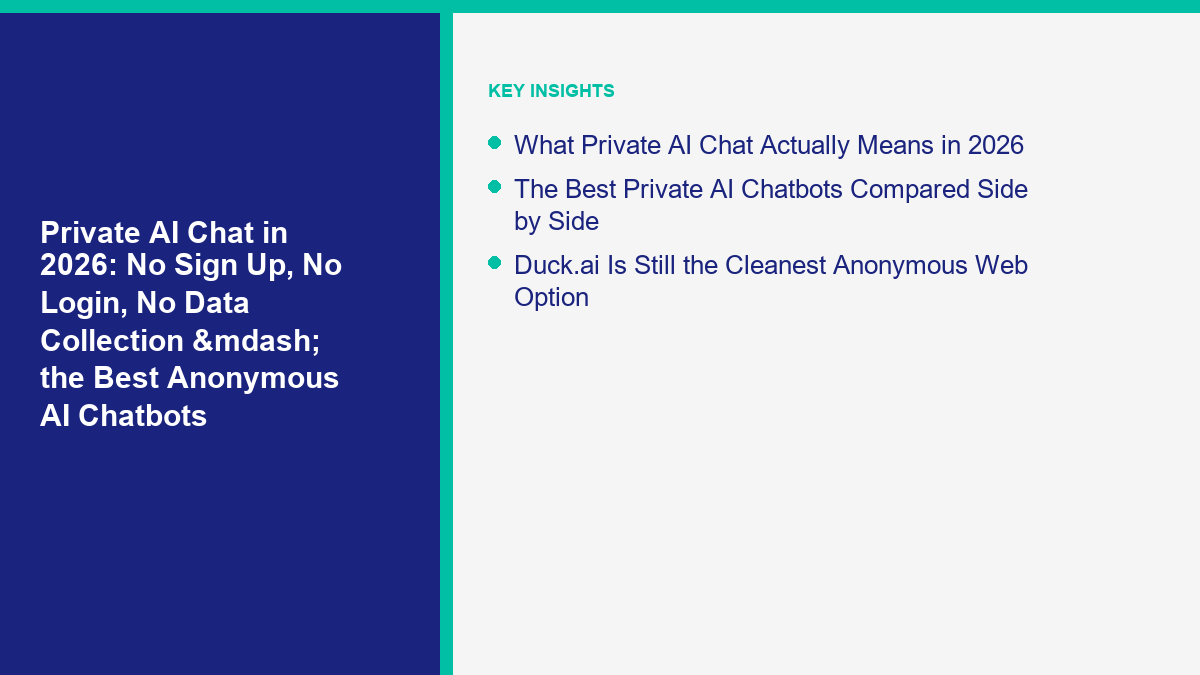
La plupart des pages ciblant chat IA privé continue de réduire quatre idées différentes en une seule promesse : pas d'inscription, pas de connexion, pas de formation et pas de collecte de données. Ce ne sont pas la même chose. En avril 2026, un outil peut vous permettre de discuter sans compte tout en enregistrant votre adresse IP. Il peut dire que vos invites ne sont pas utilisées pour la formation et continuer à conserver des métadonnées. Il peut se présenter comme privé tout en s'appuyant discrètement sur une infrastructure cloud ordinaire. Si vous voulez la réponse honnête la plus courte, la voici : la configuration de chat IA la plus privée en 2026 est toujours un modèle local fonctionnant sur votre propre machine. Tout le reste est un compromis.
J'ai vérifié les pages de tarification officielles, les documents de confidentialité et les centres d'aide des produits sur le 12 avril 2026 donc cette comparaison reflète les conditions publiques actuelles plutôt que les récapitulatifs anciens de 2024 ou 2025. Si vous voulez l'angle étroit de DuckDuckGo, notre revue complète de Duck.ai explore plus en profondeur ce produit. Cette page est plus large : chat web anonyme, outils grand public déconnectés, environnements IA locaux et la réalité pratique d'utiliser un VPN sans se mentir sur ce qu'il fait.
Une autre limite avant la liste. Le chat IA personnel privé et le déploiement de chatbot orienté client sont des tâches différentes. Si votre véritable projet est un bot sur Facebook Messenger, Instagram ou votre site web, vous obtiendrez plus de valeur opérationnelle d'une plateforme de canal que d'un onglet de chat consommateur axé sur la confidentialité. C'est là que Parcourez nos tutoriels deviendra la meilleure prochaine étape.
Ce que signifie réellement le chat IA privé en 2026
La manière la plus propre de comparer les outils de chat IA anonymes est d'arrêter de demander si un outil est “privé” et de commencer à demander privé de qui. Différents produits protègent différentes parties de la chaîne.
Niveau 1 : Pas d'inscription ou pas de connexion. Cela ne supprime que la couche d'identité évidente. Duck.ai, Brave Leo et Venice vous permettent tous de commencer sans créer de compte conventionnel. C'est utile. Ce n'est pas la même chose que zéro conservation, zéro télémétrie ou zéro visibilité du fournisseur.
Niveau 2 : Pas d'entraînement sur les invites. C'est mieux, mais encore incomplet. DuckDuckGo dit que Duck.ai ne permet pas aux fournisseurs de modèles d'utiliser les invites et les sorties pour améliorer leurs modèles, et Brave dit que les conversations de Leo ne sont pas utilisées pour l'entraînement des modèles. Le Chat Temporaire d'OpenAI et les flux de Copilot déconnecté de Microsoft sont également plus solides que leurs paramètres par défaut connectés ordinaires. L'invite passe toujours par un service. Elle est simplement gérée selon des règles plus strictes.
Niveau 3 : Stockage local ou historique local. C'est important car l'historique de chat dans le cloud est l'un des moyens les plus simples de transformer une session occasionnelle en un actif de données durable. Brave dit que l'historique de Leo vit sur votre appareil. Duck.ai stocke les chats récents localement par défaut et offre une synchronisation et une sauvegarde cryptées en option. Venice dit que l'historique des conversations est local. C'est matériellement mieux qu'un carnet de notes dans le cloud par défaut.
Niveau 4 : IA entièrement locale ou hors ligne. C'est la seule catégorie où vos invites n'ont jamais besoin de quitter votre matériel. LM Studio affirme que rien de ce que vous saisissez en discutant avec des modèles locaux ne quitte votre appareil. Ollama dit que vous pouvez fonctionner entièrement hors ligne pour un travail critique. Si votre définition de chat ai anonyme inclut “ le fournisseur ne voit jamais l'invite ”, local l'emporte de loin.
La hiérarchie est simple :
- Meilleure confidentialité : entièrement local et hors ligne.
- Confidentialité cloud forte : relais anonymisé plus engagements de non-formation.
- Confidentialité de commodité acceptable : outils cloud grand public avec contrôles temporaires ou d'opt-out.
- Vieille confidentialité : services qui collectent et s'entraînent par défaut à moins que vous ne fouilliez dans les paramètres.
Cette distinction est importante car l'expression chat IA sans connexion peut toujours attirer des personnes qui ont vraiment besoin de rédaction confidentielle client, révision de code privée, ou recherche sensible. Ce ne sont pas les mêmes cas d'utilisation. Si le prompt lui-même est important, votre première décision n'est pas “Quel site a la plus belle interface utilisateur ?” C'est “Ce prompt peut-il quitter ma machine ?”
Avant de faire confiance à un service d'IA cloud pour un travail réel, effectuez ce rapide contrôle :
- Recherchez une déclaration explicite sur la formation, pas un slogan de confidentialité vague.
- Vérifiez si l'historique des discussions est local, sauvegardé dans le cloud ou non décrit.
- Voyez si l'utilisation déconnectée existe et si les règles changent lorsque vous vous connectez.
- Vérifiez si la politique sépare le contenu des invites des métadonnées telles que l'adresse IP, le fuseau horaire, le type de navigateur ou les identifiants de l'appareil.
- Supposez que les téléchargements sont plus sensibles que les invites en texte brut, à moins que le fournisseur ne précise que le traitement des documents reste local.
Si vous ne vous souvenez que d'une seule ligne de cette section, faites-en celle-ci : pas d'inscription est une fonctionnalité de commodité, pas une fonctionnalité de conformité.
Les meilleurs chatbots IA privés comparés côte à côte
Les détails de tarification et de politique ci-dessous ont été vérifiés par rapport aux pages officielles le 12 avril 2026. “ Prix de départ ” signifie le point d'entrée public le plus bas que j'ai pu vérifier, pas le prix de chaque niveau de plan possible.
| Outil | Un compte est-il nécessaire pour commencer ? | Ce que le fournisseur dit publiquement | Prix de départ vérifié le 12 avril 2026 | Idéal pour | Principale caractéristique |
|---|---|---|---|---|---|
| Duck.ai | Non | Anonymisé par DuckDuckGo, aucun compte requis, les invites et les sorties ne sont pas utilisées pour entraîner les modèles sous-jacents, IP supprimée avant le transfert au fournisseur | Gratuit ; Plus $9,99 €/mois ; Pro $19,99 €/mois | Meilleur chat web anonyme dans l'ensemble | Reste un service cloud, et les modèles haut de gamme sont derrière l'abonnement |
| Brave Leo | Non pour le niveau gratuit | Pas de journaux, historique de chat local, pas utilisé pour l'entraînement, aucune connexion requise | Free; Leo Premium $14.99/month | Best privacy-first browser assistant | You need Brave Browser to get the full experience |
| Venise | Non | Markets itself as no account and no data collection; privacy architecture says prompts are not stored but no-account users still generate basic metadata | Free; Pro $18/month | Best for private-feeling open-model chat with looser content controls | Marketing is more absolute than the underlying privacy page |
| ChatGPT | Signed-out use exists | Signed-out users can toggle model-improvement off; Temporary Chat is not used for training and stays out of history | Free; Plus $20/month | Mainstream fallback when you need the broadest feature set | Privacy depends on using the right controls, not on the default product posture |
| Microsoft Copilot | Signed-out use exists | Microsoft says signed-out users are excluded from model training; signed-in conversation history is saved by default | Free; Microsoft 365 Personal from $9.99/month | General-purpose web-grounded chat | Once you sign in, the privacy story becomes much less minimal |
| Perplexity | Free plan, but privacy controls are account-centric | AI data retention is enabled by default for Free, Pro, and Max users unless you opt out | Standard free; Pro valued at $200/year | Research with citations | Excellent answers, weak default privacy |
| LM Studio | No cloud account required for local use | Runs locally and privately; nothing entered into local chats leaves your device | Free for home and work use | Best GUI for local private AI chat | You need enough RAM or VRAM and you manage your own models |
| Ollama | No account for local mode | Can run entirely offline for mission-critical work; data is never trained on | Local use free; cloud Pro from $20/month | Best CLI and API-first local runtime | Less friendly than LM Studio if you want a polished desktop chat UI |
The pattern should jump out immediately. The cleanest chat IA privé options split into two camps: anonymized cloud chat et fully local chat. Anonymous cloud chat is easier. Local chat is stronger. Your real choice is how much setup pain you are willing to trade for control.
Sources : DuckDuckGo approach to AI, Duck.ai privacy terms, DuckDuckGo pricing, Brave Leo help, Brave Premium pricing, Venice about, Venice privacy architecture, Venice pricing, OpenAI data controls, OpenAI Temporary Chat FAQ, Voir les tarifs de MessengerBot, Microsoft Copilot privacy FAQ, Microsoft Copilot pricing, Perplexity data collection, Perplexity subscription plans, Perplexity Pro valuation reference, LM Studio, LM Studio offline docs, Ollama.
Duck.ai Is Still the Cleanest Anonymous Web Option
Si vous voulez ai chat bot no sign up without turning the answer into a roleplay-site roundup, Duck.ai is still the easiest recommendation. DuckDuckGo says both Duck.ai and Search Assist are free, anonymized, and available with no account required. Its current privacy terms go further than most competitors by saying metadata containing personal information, including IP address, is removed before prompts are sent to model providers, and that provider agreements prohibit using prompts and outputs for training.
That is the strongest mainstream cloud posture in this category for one reason: DuckDuckGo did not stop at “we care about privacy.” It documented the mechanics. The company says recent chats are saved locally on your device by default, and optional Sync & Backup stores them in encrypted form so only you can decrypt them. That is a much more serious design than the standard consumer pattern of “everything goes into your account history forever unless you manually clean it up.”
Duck.ai is also better than many privacy-first challengers on model access. Its current help pages say free users can access Claude 4.5 Haiku, Llama 4 Scout, Mistral Small 3 24B, GPT-4o mini, GPT-5 mini, and gpt-oss-120b. The paid DuckDuckGo subscription adds stronger models and higher usage limits. The current pricing page lists Plus at $9.99 per month and Pro at $19.99 per month in the U.S.
The catch is the same catch every cloud tool has: your prompt still leaves your device. DuckDuckGo is narrowing the identity trail and restricting downstream use. It is not turning a hosted model into an offline local runtime. That distinction matters when the material includes private source code, client data, legal drafts, or regulated records.
For ordinary use, though, Duck.ai is hard to beat. It is the tool I would hand to somebody who wants anonymous web chat for research, summarizing, light drafting, and everyday prompts without building another permanent AI account. That is why it stays at the top of this list even after the field got more crowded.
Sources : DuckDuckGo approach to AI, Duck.ai privacy terms, DuckDuckGo pricing, Duck.ai model list.
Brave Leo Gives You a Better Privacy Story Than Most Browser AI
Brave Leo is the other mainstream recommendation that holds up under policy scrutiny. Brave’s 2026 help center article says Leo conversations are not stored or logged by Brave after a response is generated, that no personal data such as IP address or conversation transcripts are retained, that chats are not used for model training, and that free Leo does not require a Brave account. The same article says chat history exists only in local storage on your device and can be cleared entirely.
That is a real advantage if you live in the browser all day. Leo is built into Brave, so asking it to summarize a tab, explain a chart, or rewrite something on-screen feels much more natural than bouncing content into a separate AI site. Brave’s product page also says Leo can analyze PDFs, Google Docs, and Google Sheets, which makes it more useful than a basic “type a prompt in a blank box” assistant.
The paid story is straightforward. Brave currently prices Leo Premium at $14.99 per month or $149.99 per year. Premium raises rate limits and unlocks access to more models, while still using Brave’s unlinkable subscription design rather than tying day-to-day usage to a conventional activity profile.
I would rank Leo slightly behind Duck.ai for one simple reason: Duck.ai is easier to recommend to anyone with a browser. Leo asks you to care enough about privacy to use Brave. If you already do, Leo is arguably the best browser-native private AI experience on the market. If you do not, Duck.ai has less friction.
Sources : Brave Leo help, Brave Leo product page, Brave Premium pricing.
Venice Is Useful, but Read the Fine Print Before You Call It Zero-Data
Venice is the most interesting privacy challenger in this space because it says the quiet part loudly. Its homepage and about page lean hard into privacy, open-source models, fewer restrictions, and no account requirements. That positioning has obvious appeal if you want chat IA sans connexion and do not want the heavily sanitized feel of some mainstream assistants.
But Venice is also the clearest example of why you should read both the marketing page and the architecture page. The headline copy says “No accounts required, no downloads, no data collection.” The privacy architecture page says something more precise: Venice does not see or store prompt contents, but it still collects limited information, and no-account users generate basic metadata including timezone, browser type, and IP address. Those statements are not identical.
That does not make Venice dishonest or unusable. It means the product is prompt-private in a stronger sense than many rivals, but not literally metadata-free. In practice, that is still a strong result for a hosted AI service. I just would not repeat the phrase “no data collection” without the caveat.
The pricing is also clear. Venice currently offers a free tier with 10 text prompts per day and 15 image prompts per day. Pro is $18 per month, Pro Plus is $68 per month, and Max is $200 per month. The pricing page also lists privacy features such as local-only conversation storage, zero data retention private mode, TEE, and end-to-end encrypted features on higher tiers.
Where Venice fits best is the user who wants private-feeling cloud AI, open-model energy, and fewer guardrails, but still wants a polished web product instead of running local models. Where it fits poorly is a reader who thinks the homepage promise means literally nothing about the session is ever logged. The privacy docs say otherwise. Read them.
Sources : Venice about, Venice privacy architecture, Venice pricing.
ChatGPT, Copilot, and Perplexity Are Fine Only If You Use Their Privacy Controls Correctly
This is the part most anonymous-chat roundups handle badly. Mainstream AI tools are not useless for privacy-minded users. They are just not private by default in the same way Duck.ai or Leo try to be. If you use them, use them deliberately.
ChatGPT Is Better in Signed-Out or Temporary Mode Than Most People Realize
OpenAI’s help center now says signed-out web users can choose whether chats are used to help train ChatGPT. That matters because it confirms two things at once: signed-out use exists, and the privacy setting still matters even when you are not logged in. OpenAI also says Temporary Chats do not appear in history, are not used to improve models, and may be retained for up to 30 days for safety purposes.
The practical takeaway is simple. If you are using ChatGPT for low-stakes anonymous work, do not just open the site and assume it is private. Check the signed-out data controls or use Temporary Chat. That gives you a much cleaner privacy posture than the ordinary default experience. It still does not make ChatGPT an anonymous-first product. It makes it a mainstream product with stronger privacy modes.
Price is the other reality check. OpenAI’s pricing page currently lists a free plan and ChatGPT Plus at $20 per month. That is fine if you need the feature depth. It is not the price of a privacy-first experience. It is the price of a broad AI workspace that happens to include more private modes.
Microsoft Copilot Is Safe Enough for Casual Signed-Out Use, but the Signed-In Defaults Are Much Heavier
Microsoft’s privacy FAQ is more explicit than many people expect. The company says users who are not signed in to Copilot are excluded from model training. That is a real point in its favor for casual use. The same FAQ also says conversations are saved by default and describes much broader data use when users are signed in and have not opted out.
That split is why Copilot belongs in the “good general tool, average privacy” bucket. If you want fast answers and you are not signing in, it is more reasonable than its reputation suggests. If you plan to live in a signed-in Microsoft workflow, the product becomes much more account-centric, memory-heavy, and telemetry-heavy than a privacy-first reader probably wants.
Microsoft’s current consumer pricing has also shifted away from the old standalone Copilot Pro framing. The individual pricing page now starts with Microsoft 365 Personal at $9.99 per month and Microsoft 365 Premium at $19.99 per month, with higher Copilot usage bundled into those subscriptions. That makes Copilot less of a pure privacy comparison and more of an ecosystem purchase.
Perplexity Is Excellent for Research and Weak on Default Privacy
Perplexity is still one of the best ways to get sourced answers fast. If your priority is citations on screen, it deserves a place in the conversation. But the privacy docs are not subtle here. Perplexity’s help center says data collection supports product functionality, account security, improving services, and, if not opted out, AI training. It also says AI data retention is enabled by default for Free, Pro, and Max users, and that opt-outs only apply after the opt-out date. Previously collected training data cannot be deleted or removed from prior training use.
That last point is why I do not rank Perplexity highly for chat ai anonyme, even though I rate it very highly for research. You can opt out, and you should if privacy matters. But the default stance is still the opposite of Duck.ai or Brave Leo. Perplexity is built to remember, improve, and become your research environment. Privacy is something you configure after the fact.
The pricing signal is clear even from Perplexity’s own help-center material. The subscription-plan page lists Standard, Pro, Education Pro, and Max, and Perplexity’s Samsung promo page says 12 months of Perplexity Pro is valued at $200. That is a serious subscription tier, which means users should evaluate it as a research platform first, not as a cheap anonymous chat tab.
My practical rule for this whole group is blunt:
- Utilisez ChatGPT when you need the biggest general-purpose toolkit and can remember to use signed-out controls or Temporary Chat.
- Utilisez Copilot for free general web-grounded answers when your privacy bar is moderate, not extreme.
- Utilisez Perplexity when citations matter more than anonymity.
If your privacy bar is high enough that those caveats feel annoying, you are already in Duck.ai, Brave Leo, or local-AI territory.
Sources : OpenAI data controls, OpenAI Temporary Chat FAQ, Voir les tarifs de MessengerBot, Microsoft Copilot privacy FAQ, Microsoft Copilot pricing, Perplexity data collection, Perplexity subscription plans, Perplexity Pro valuation reference.
Local AI Still Wins If You Want the Strongest Privacy
If the prompt cannot leave your machine, cloud privacy promises stop mattering. That is why local AI is still the real answer for anyone asking for the most private possible chat setup in 2026.
LM Studio Is the Easiest Local Starting Point for Most People
LM Studio’s public docs say it can operate entirely offline, that chatting with downloaded local models does not send anything off your device, and that documents used for local RAG stay on your machine. The homepage also says the app is free for home and work use. That combination makes it the easiest recommendation for readers who want a desktop UI instead of a terminal-first tool.
What LM Studio gets right is the workflow. You can browse models, run a local chat interface, attach documents, and expose a localhost API without building your own stack from scratch. If you care about privacy but still want a reasonably polished product, this is the shortest route.
Ollama Is Better If You Want a Runtime You Can Script, Automate, or Plug Into Other Tools
Ollama is the stronger pick for developers, tinkerers, and anyone who wants a local model runtime they can drive from the CLI or through an OpenAI-compatible API. Ollama’s site says your data is never trained on and that you can run entirely offline for mission-critical work. That is exactly the right framing. The more seriously you take prompt privacy, the more attractive a local runtime becomes.
Ollama also has an optional cloud tier now, with Pro starting at $20 per month and Max at $100 per month, but for this article the important point is structural: local Ollama is a privacy tool, cloud Ollama is a convenience tool. The moment you move heavy work to hosted inference, you are back in the world of vendor claims, regional infrastructure, and policy interpretation.
There is no magical hardware requirement because model size, quantization, context length, and your tolerance for latency all matter. My practical rule of thumb, which is an inference from day-to-day local use rather than a vendor spec, is this:
- Start around 3B to 4B models if the laptop is older or RAM is tight.
- 7B to 8B is the sweet spot for many 16 GB machines.
- 14B and above starts making more sense with 32 GB RAM or a decent GPU.
The reason this matters for chat IA privé is that privacy is not free. Local chat costs setup time, disk space, and sometimes speed. In exchange, you stop hoping a cloud vendor’s privacy page means what you think it means. You control the execution path yourself.
If your work involves contracts, client notes, internal code, product plans, or any prompt you would hate to see reproduced in a support incident or policy dispute, local AI is the right default. Duck.ai and Leo are excellent web compromises. They are still compromises.
Sources : LM Studio, LM Studio offline docs, Ollama.
How to Build a Private AI Chat Setup Without Fooling Yourself
Most people do not need a 20-tool privacy stack. They need one setup they will actually keep using. Here is the shortest practical path.
- Decide whether your risk is about identity or prompt content. If you mostly care about not tying casual prompts to an account, use Duck.ai or Brave Leo. If the prompt itself is sensitive, go local with LM Studio or Ollama.
- Pick one disposable cloud option and one local option. That is the sweet spot. For example: Duck.ai for fast web answers, LM Studio for anything private enough that you want the prompt to stay local.
- Turn off training before you need it. If you use ChatGPT, set signed-out controls or switch to Temporary Chat. If you use Perplexity, opt out of AI data retention before you start using it seriously. If you use Copilot signed in, review the training and personalization settings.
- Separate browser profiles. Use a clean browser profile for privacy-sensitive AI work. That reduces cross-session cookies, saved history bleed, and accidental uploads from your everyday browsing context.
- Treat uploads as a higher-risk action than plain prompts. A one-line question is one thing. A PDF, transcript, spreadsheet, or screenshot often contains more metadata and more irreversible exposure.
- Use temporary sessions aggressively. Leo supports temporary chats. ChatGPT supports Temporary Chat. Duck.ai lets you clear local history. If the session is disposable, make the storage disposable too.
- Move to a real automation platform when the work becomes customer-facing. Anonymous AI chat is excellent for drafting and testing. It is not a CRM, not a support inbox, and not a reliable Messenger workflow engine. When the use case turns into production messaging, compare Voir les tarifs de MessengerBot instead of forcing a consumer AI tool into a job it was never built to handle.
The useful mindset here is not paranoia. It is compartmentalization. Give each layer a job:
- Duck.ai or Brave Leo for fast anonymous web chat.
- ChatGPT or Copilot when you need a mainstream feature stack and are willing to configure privacy correctly.
- Perplexity for sourced research where citations matter more than anonymity.
- LM Studio or Ollama when prompt privacy actually matters.
That setup is boring, and boring is good. The fastest way to get privacy wrong is to keep changing tools every week because a new homepage promised “100% anonymous AI” in bigger letters.
What a VPN Changes and What It Does Not Change
VPN advice around AI chat is usually too fuzzy to be useful. A VPN can help, but not in the way most privacy marketing implies.
A VPN helps with network identity. It can hide your home or office IP address from the destination website and from your local network, which matters on public Wi-Fi and can help separate your real location from a browsing session.
A VPN does not hide prompt content from the AI service you are using. If you type a prompt into ChatGPT, Copilot, Perplexity, or Venice, the service still receives the prompt so it can answer it. A VPN changes the network path, not the fact that you are using the service.
A VPN also does not turn a weak privacy policy into a strong one. If a provider trains on prompts by default, a VPN does not stop that. If a service stores history in your account, a VPN does not stop that either.
There is also a diminishing-returns issue. Duck.ai already says it strips IP before prompts reach model providers. Brave says Leo does not retain personal data such as your IP and keeps chats local. In those cases, a VPN is still fine, but the privacy gain is smaller than it would be on an ordinary consumer AI site.
The honest use cases for a VPN in this space are:
- Protecting yourself on public or untrusted networks.
- Reducing direct exposure of your home or office IP to the site you visit.
- Testing region-specific availability.
- Adding one more layer when you deliberately want your browsing identity separated from your normal connection.
The dishonest use case is pretending a VPN makes a cloud chatbot equal to a local model. It does not. If the prompt is sensitive, local still wins.
Where Anonymous AI Chat Breaks Down for Business Use
Anonymous AI chat is good for drafting replies, summarizing tickets, roughing out an FAQ, and checking how a question sounds before you publish it. It is bad for production support workflows.
Here is where teams get into trouble:
- Pasting customer transcripts that include names, emails, order numbers, or phone numbers into consumer AI tools.
- Dropping contracts, medical notes, or regulated documents into a guest chat because it felt “private enough.”
- Using a no-login AI site as an internal support tool without retention controls, auditability, or team visibility.
- Assuming a strong personal privacy policy automatically translates into good customer-data handling.
That is the exact point where a dedicated messaging platform makes more sense than another round of AI-tab experimentation. Your customer does not care that your internal testing happened in an anonymous chat window. They care whether the bot on Messenger or Instagram answers correctly, routes the conversation, hands off to a human, and keeps your team organized.
If that is your use case, move out of the anonymous-chat category and into a real channel workflow. Start with Voir les tarifs de MessengerBot when you want to compare what a business-ready Facebook Messenger, Instagram, and website chatbot stack actually looks like.
Which Private AI Chat Tool I Would Pick for Each Scenario
If you do not want another theory section, use this matrix.
- I want the cleanest anonymous web chat with no account. Pick Duck.ai.
- I already use Brave and want AI in the browser itself. Pick Brave Leo.
- I want open-model energy and looser content filters, but I still want a hosted web app. Pick Venice, and read the privacy architecture page instead of only the homepage.
- I want citations and research depth, privacy second. Pick Perplexity, then opt out of AI retention if you use it heavily.
- I want the broadest mainstream feature set and can manage the settings myself. Pick ChatGPT, but use signed-out controls or Temporary Chat for anything you do not want in your history.
- I want a free mainstream fallback and I am okay with moderate privacy instead of maximal privacy. Pick Copilot signed out.
- I want the strongest real privacy, not the best marketing copy. Pick LM Studio if you want a GUI or Ollama if you want a local runtime and API.
- I want to turn working prompts into customer-facing automation. Stop shopping for anonymous chat tabs and Upgrade to MessengerBot Pro.
Where MessengerBot Fits If You Need Private Testing and Public-Facing Automation
There is a sane way to combine both worlds. Use private AI chat for what it is good at: drafting, researching, outlining flows, pressure-testing copy, and cleaning up internal ideas before they ever touch a live customer conversation. Then move the finished workflow into a system built for delivery on Facebook Messenger, Instagram, and your website.
That handoff is where product discipline matters more than one more anonymous chat subscription. Use Voir les tarifs de MessengerBot when you want to see the production side, move to Upgrade to MessengerBot Pro when you need the heavier feature set, and if you recommend automation tools to readers or clients, you can Rejoignez notre programme d'affiliation without turning your advice into guesswork.
Official Sources Checked on April 12, 2026
- DuckDuckGo approach to AI
- Duck.ai privacy terms
- DuckDuckGo pricing
- Duck.ai help and model access
- Brave Leo help center article
- Brave Leo product page
- Brave Premium pricing
- Venice about page
- Venice privacy architecture
- Venice pricing
- Voir les tarifs de MessengerBot
- OpenAI data controls
- OpenAI Temporary Chat FAQ
- Microsoft Copilot privacy FAQ
- Microsoft Copilot pricing
- Perplexity data collection
- Perplexity subscription plans
- Perplexity Pro valuation reference
- LM Studio homepage
- LM Studio offline operation docs
- Ollama homepage
Questions fréquemment posées
Quelle est l'option de chat IA la plus privée en 2026 ?
L'option la plus privée reste un modèle local qui fonctionne hors ligne sur votre propre matériel. LM Studio et Ollama offrent des réponses en matière de confidentialité plus solides que n'importe quel chatbot hébergé, car la requête n'a pas besoin de quitter votre appareil. Parmi les outils web, Duck.ai et Brave Leo ont actuellement la posture de confidentialité grand public la plus forte.
Y a-t-il vraiment un chatbot IA sans inscription ni connexion ?
Oui. Duck.ai, Brave Leo et Venice vous permettent tous de commencer sans créer de compte normal. La mise en garde importante est qu'aucune inscription ne signifie pas automatiquement pas de métadonnées, pas de stockage ou pas de traitement dans le cloud. Séparez toujours l'accès sans compte du traitement réel des données.
Un VPN rend-il le chat AI anonyme ?
Un VPN aide à cacher votre adresse IP du site que vous visitez et vous protège sur les réseaux publics, mais il ne bloque pas le service d'IA de recevoir le prompt lui-même. Il ne désactive pas non plus les fonctionnalités de formation, de stockage ou d'historique. Un VPN améliore la confidentialité du réseau, pas celle du prompt.
ChatGPT est-il privé si je l'utilise sans me connecter ?
Cela peut être plus privé que ce que beaucoup de gens supposent, mais seulement si vous utilisez les contrôles correctement. OpenAI dit que les utilisateurs déconnectés peuvent choisir si les discussions aident à améliorer les modèles, et que la discussion temporaire n'est pas utilisée pour l'entraînement et n'apparaît pas dans l'historique. C'est toujours moins puissant qu'une configuration entièrement locale, mais plus fort que d'utiliser ChatGPT de manière occasionnelle avec les paramètres par défaut.
Quel outil de chat IA anonyme est le meilleur pour la recherche avec des citations ?
If citations matter more than strict anonymity, Perplexity is still one of the strongest research tools. If anonymity matters more than citations, Duck.ai is the better choice. Perplexity’s help center says AI data retention is enabled by default unless you opt out, which is why I treat it as a research winner rather than a privacy winner.


 Français
  English
  Tagalog
  简体中文
简体中文  العربية
  हिन्दी
  Português do Brasil
  Español de México
  বাংলা
বাংলা  香港中文
香港中文  繁體中文
繁體中文  Nederlands
  Deutsch
  Bahasa Indonesia
  日本語
日本語  한국어
한국어  Polski
  Русский
  Español
  Tiếng Việt