
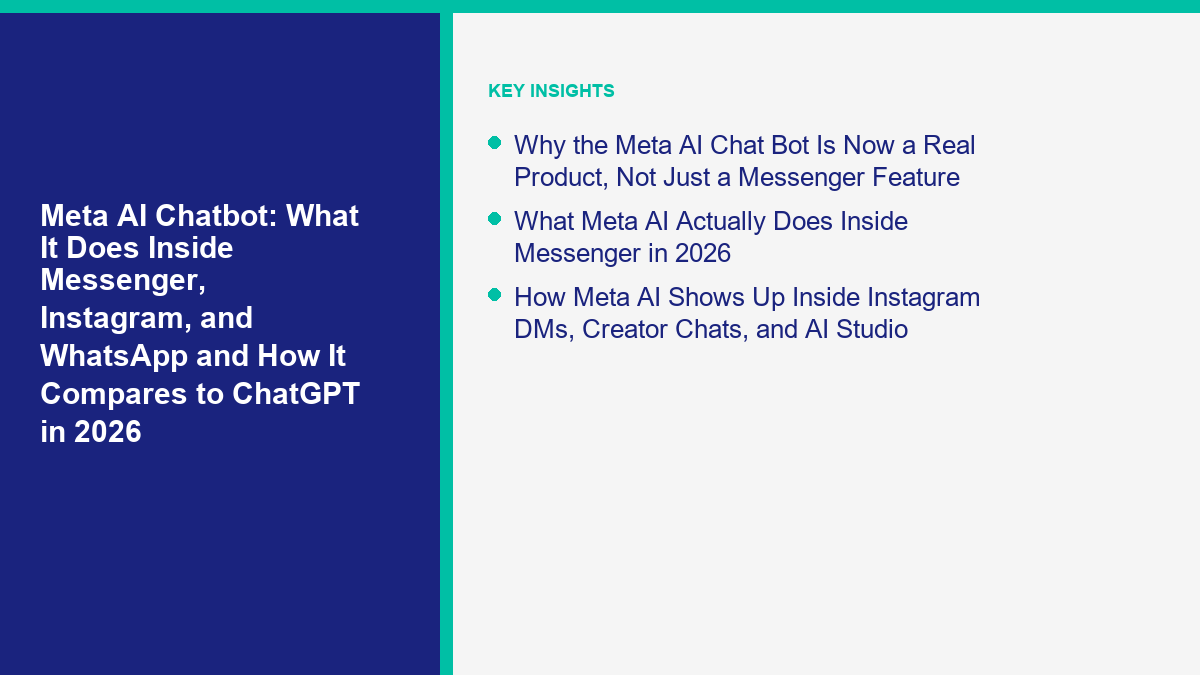
如果你搜索了 元宇宙人工智能聊天机器人, 简而言之,Meta AI不再仅仅是一个应用程序内的蓝色圆圈好奇心。它现在是一个真正的聊天机器人产品,具有四个连接的界面:在Messenger、Instagram、Facebook和WhatsApp中的内置助手;通过AI Studio的自定义人工智能和创作者人工智能;独立的Meta AI应用程序和网站;以及Meta也在品牌化的不断增长的支持和安全工具层。Meta在2025年10月1日表示, 每月有超过10亿人使用Meta AI, 于2025年4月29日推出了独立的Meta AI应用程序,并在2026年4月8日宣布了由Muse Spark驱动的新Meta AI升级,该升级已经在Meta AI应用程序和网站上上线,并计划在接下来的几周内推广到WhatsApp、Instagram、Facebook和Messenger。.[1][2][3]
这就是为什么旧文章感觉不对劲的原因。它们常常将Meta AI描述为仅仅是Messenger的附加功能,或者将其与ChatGPT进行比较,却没有承认Meta正在进行不同的游戏。ChatGPT是一个目的地工作区。Meta AI越来越成为一个 环境 助手,出现在人们已经与朋友、创作者、客户和社区交流的地方。这种差异比模型品牌更重要。如果你真正需要的不是个人人工智能,而是在Facebook、Instagram或网站上的面向客户的自动化,请从 查看MessengerBot定价 开始,以免为错误的工作购买错误类型的工具。.
我重新检查了官方Meta帮助页面、Meta新闻稿、OpenAI定价页面,以及MessengerBot当前的公共定价页面。 2026 年 4 月 12 日 在撰写本指南之前。这里的目标是实用的:Meta AI 在 Messenger、Instagram 和 WhatsApp 中实际做了什么,隐私权的权衡是什么样的,ChatGPT 在哪些方面仍然更好,以及企业何时应该停止考虑“助手”,而开始考虑“工作流程”。对于仅限 Messenger 的设置角度,更好的伴随文章是 我们专门针对 Messenger 的 Meta AI 指南, 因为这篇文章故意将 Meta AI 视为一个独立的聊天机器人产品,而不仅仅是 Messenger 的一个功能。.
为什么 Meta AI 聊天机器人现在是一个真正的产品,而不仅仅是 Messenger 的一个功能
Meta AI 在 2025 年和 2026 年跨越了一个重要的界限。它不再是你可以轻视的“Facebook 中的 AI”,而是成为了一个拥有自己应用程序、自己网站、自己记忆和个性化故事的产品系列,并且有一个明确的计划在 Meta 最大的消息传递平台上生存。2025 年 4 月 Meta AI 应用程序的发布使这一点变得明显。Meta 将该应用程序描述为了解你的偏好、记住上下文并连接到 meta.ai 的助手,以便你可以在不同平台上继续对话。.[2]
2026 年 4 月 8 日的 Muse Spark 宣布进一步推动了这一理念。Meta 表示,Meta AI 应用程序和网站中的升级体验现在支持更强的推理、模式切换和更强大的多模态行为,这些新模式和能力将开始在消息传递平台上推出。这个日期是需要牢记的重要日期: 2026 年 4 月 8 日 是当Meta公开表示最新的Meta AI升级已经在应用程序和网站上上线,而向Messenger、Instagram和WhatsApp的推广仍被描述为将在“未来几周内”进行时。”[3]
所以当人们问Meta AI是否是“Messenger中的免费ChatGPT”时,更准确的答案是:Meta AI是Meta自己的聊天机器人生态系统,优化了速度、覆盖面、个性化和社交背景。ChatGPT仍然是进行更深入工作的更清晰选择。当AI应该出现在你已经花时间的地方时,Meta AI是更清晰的选择。这些是相关但非常不同的产品决策。.
| 表面 | Meta AI在这里做什么 | 这告诉你关于产品的什么 |
|---|---|---|
| 信使 | 回答问题,重写消息,总结聊天,生成图像,使用命令加入群聊 | Meta AI正在融入社交聊天行为,而不仅仅是一个单独的浏览器标签 |
| 支持AI聊天、创作者AI和通过AI Studio可发现的自定义AI | Meta希望AI能够融入创作者和粉丝的互动中,而不仅仅是一对一的实用工具 | |
| : 通过利用它们的官方API和SDK嵌入流行的消息应用,如 | 增加写作帮助、总结、建议回复和保护隐私的AI处理 | Meta 知道它需要在它拥有的最敏感消息应用中讲述更强的隐私故事 |
| Meta AI 应用和 meta.ai | 作为一个更完整的独立助手,具备语音和更新的模型能力 | 这是 Meta AI 是一款产品而不仅仅是一个捆绑功能的最清晰证明 |
另一个与定价讨论相关的重要点是:截至 2026 年 4 月 12 日,我找不到官方的 Meta 页面列出 Meta AI 本身的单独付费消费者订阅。这并不 不 证明 Meta 将来永远不会对高级层收费。它支持这样的实际结论:Meta AI 目前仍然是一个可以免费访问的聊天机器人,存在于支持的 Meta 表面上,而货币化压力更多来自广告、参与度和生态系统锁定,而不是来自明显的每月 AI 费用。这是对 Meta 当前产品和帮助页面的推断,而不是发布的价格声明。.[2][5][10][13]
Meta AI 在 2026 年 Messenger 内部实际做了什么
Messenger 仍然是理解 Meta AI 日常版本的最简单地方。Meta 当前的 Messenger 帮助中心文档列出了询问 Meta AI 问题、撰写或改写消息、总结聊天、生成图像、编辑图像、与 AI 开始聊天以及在对话中使用命令的不同流程。这些页面中的几个仍然表示该功能是 在电脑上不可用 应在支持的移动设备上使用。这是整个 Messenger AI 堆栈中最实用的细节之一,因为人们仍然错误地将“桌面限制”误诊为“Meta AI 消失了。”[5][6][7]
Meta AI Messenger 的最佳版本是低摩擦版本。您已经在进行对话,您想要快速回答,您想要更简洁的回复,或者您想要粗略的图像而不离开线程。当问题足够小,以至于便利性胜过深度时,Messenger AI 是最强大的。当您期望完整的研究轨迹、文件工作、项目记忆或可靠的业务工作流程时,它就显得薄弱。.
Meta 的命令列表使这一设计目标变得明确。Messenger 支持以下命令: @Meta AI 将助手带入现有的群聊中,以及 /AI image 从聊天中的提示生成图像。帮助页面还表示,目前并非所有平台或所有人都可以使用这些命令,这正是您应该期待的 Meta AI 在 2026 年推出的那种限制。.[8]
以下是当前 Messenger 功能集在实际使用中的总结:
- 快速问题和建议: 在您想要答案而不离开 Messenger 时非常有用。.
- 重写帮助: 这是最实用的功能之一,因为它在您发送消息之前清理语气、长度和清晰度。.
- 聊天摘要: 对于跟进长线程特别有用,尤其是在群聊中。.
- 图像生成和编辑: 适合对话创意,不适合严肃的资产制作。.
- 群组调用: 比独立助手更有趣,因为AI可以加入活跃的聊天上下文。.
Messenger 还有一个不太被讨论的控制选项,可以改变AI在对话中能做多少。Meta的帮助页面关于消息共享权限表示,这些权限可以在聊天中关闭,当它们关闭时,聊天中的人无法使用涉及与Meta AI共享消息的AI功能。换句话说,Messenger并没有强制在每个对话中使用相同的AI行为。存在一个权限层,可以限制该聊天中的消息是否可以共享给AI功能。.[9]
这是一个好的设计选择,但它也告诉您有关隐私的重要信息。Messenger的AI功能与聊天内容是否可以与Meta AI共享有关。因此,实际规则很简单:如果对话是敏感的,请在该聊天中关闭消息共享权限,或者完全不让AI参与。这比假设“它在Messenger中,所以它一定足够私密”要更可靠。”
| Messenger capability | 最佳使用案例 | 主要限制 |
|---|---|---|
| Ask Meta AI | Fast answers and lightweight brainstorming inside an existing chat | Several help pages still frame this as mobile-first, not fully desktop-ready |
| Write with Meta AI | Rephrasing awkward, too-long, or too-blunt replies before sending | Good editing help, not a full editorial system |
| Summarize chats | Catch up quickly in personal or group conversations | Depends on chat context and message-sharing availability |
| Generate images | Casual visuals and shared jokes inside the thread | Not a replacement for design tools or brand control |
| Group commands | Bringing AI into shared chats without switching apps | Meta says command availability still varies by platform and person |
如果你搜索了 meta ai messenger specifically because you want setup screenshots, missing-access fixes, or a deeper Messenger-only breakdown, use the Messenger-specific companion guide linked earlier. The version in this article is the product-level view: Messenger is where Meta AI feels most familiar, but it is only one slice of the full Meta AI chatbot story.
How Meta AI Shows Up Inside Instagram DMs, Creator Chats, and AI Studio
Instagram is where Meta AI starts looking less like a simple assistant and more like a social chatbot network. Meta’s Instagram help pages say you can start an Instagram chat with an AI, ask questions, get advice, receive recommendations for stickers, GIFs, and text, and talk about shared interests. The same documentation says you can chat with Meta AI, custom AIs created by other people on Instagram and Messenger, and other AIs created by Meta. That is a much broader concept than “AI in DM.” It is closer to AI as a social layer.[10]
There are two Instagram experiences that matter most. The first is a normal AI chat, usually discovered through AI Studio surfaces. The second is the creator AI experience. Meta’s help page on creator-based AIs says participating creators can enable AI auto-replies in DMs and story replies, with replies labeled as AI and visible to both you and the creator. That matters because Instagram is turning AI into part of the creator-fan conversation loop, not just a utility chatbot tucked away in settings.[11]
Instagram also leans hard into custom AI creation. Meta’s AI Studio documentation for Instagram says you can create a custom AI around a specific purpose or style, define its personality, set discoverability, and in some cases share it to Messenger and WhatsApp as well. That is another sign that Meta AI is not one bot. It is a platform for many bot-like experiences inside Meta’s own ecosystem.[12]
The product upside is obvious. Instagram is already where creators, shoppers, communities, and fans spend time. Dropping AI into that flow can feel lighter and more fun than opening ChatGPT. If your real goal is caption ideas, meme riffs, creator interactions, sticker prompts, or casual DM help, Instagram AI has a kind of native fit that ChatGPT does not try to replicate.
The tradeoff is also obvious once you read the help pages closely. Meta says AI chats on Instagram may use your interactions to improve AI at Meta, may share the messages you send to AI and general information such as your region with selected partners when the AI cannot answer your query, and may use location, age, gender, and interests based on your activity across Meta products to personalize your AI interactions. On top of that, Meta’s Instagram AI chat documentation says that chats with AIs, including messages mentioning the Meta AI assistant and their responses, are not end-to-end encrypted.[10][11][12]
That is the line most thin reviews skip. Instagram AI is not just “ChatGPT inside social media.” It is an AI system sitting on top of a recommendation engine, a creator economy, and a heavily personalized ad platform. That creates obvious convenience, but it also creates a very different privacy posture from a tool you use mainly as a work assistant.
Instagram is also where Meta is layering in AI beyond the pure chatbot surface. On March 19, 2026, Meta announced a global rollout of a Meta AI support assistant on Facebook and Instagram for account problems like password and profile-setting issues. That is a different use case from creator AI or DM-based Meta AI, but it shows the same strategic pattern: once AI exists as infrastructure inside Meta’s apps, it spreads into support, safety, and operational surfaces too.[16]
What Makes Meta AI on WhatsApp Different From Messenger and Instagram
WhatsApp is the most important reality check in the whole Meta AI story. Messenger and Instagram mostly teach you what Meta AI can do. WhatsApp teaches you what Meta thinks it needs to prove before people will trust those features in a more private messaging environment.
The strongest example is Private Processing. Meta’s April 29, 2025 engineering write-up described Private Processing as an optional capability for WhatsApp AI tools that lets users request AI processing in a confidential environment where no one, including Meta and WhatsApp, can access the messages being processed. Meta specifically used message summarization and writing suggestions as example use cases and said users should be able to prevent messages from being used for AI features such as mentioning Meta AI in chats with WhatsApp’s Advanced Chat Privacy feature.[13]
That is a major difference from the default posture you see in Instagram AI help pages. In WhatsApp, Meta is trying to preserve the app’s core privacy promise while still delivering AI features. It is a more careful, more infrastructure-heavy approach because WhatsApp users expect far less casual data exposure than Instagram users do.
WhatsApp’s AI surface is also getting more practical. In the official March 26, 2026 WhatsApp feature update, Meta said it was rolling out new AI features to touch up photos before sending them in chat and draft smarter suggested responses. That tells you the WhatsApp version of Meta AI is moving toward everyday assistive tasks, not just a novelty assistant stuffed into the app for brand symmetry.[14]
The practical comparison across Meta’s messaging apps looks like this:
| App | Meta AI feel | Best job | Main caution |
|---|---|---|---|
| 信使 | Most visible and easiest to trigger in everyday chats | Quick questions, rewrites, summaries, image prompts | Still mobile-first for several features and governed by chat-sharing permissions |
| Most social and creator-oriented | DM help, creator AI chats, custom AI discovery | AI chats are not end-to-end encrypted and personalization is deeper | |
| : 通过利用它们的官方API和SDK嵌入流行的消息应用,如 | Most privacy-engineered | Writing suggestions, summarization, smarter in-chat assistance | Feature rollout is more careful and still evolving |
If you are a privacy-first user, this is the one Meta AI surface that deserves a separate mental category. WhatsApp AI is still a Meta AI product, but it is the version with the clearest technical attempt to avoid turning private message content into ordinary server-visible AI input. That does not mean “assume zero risk.” It does mean the privacy architecture is materially different from the looser feel of AI inside Instagram DMs.
One more implication: the more Meta keeps strengthening WhatsApp’s AI privacy architecture, the more obvious it becomes that “Meta AI” is not a single uniform privacy model. You should stop asking whether Meta AI is safe in general and start asking which Meta app, which AI feature, and which processing path you are actually using.
Privacy, Ads, and Data Use: The Tradeoff Most Meta AI Reviews Skip
This is the part where the product story gets real. Meta AI is easy to use precisely because it sits inside products that already know a lot about you, your interests, your location patterns, your follows, your chats, and your behavior across Meta’s apps. That is the convenience engine. It is also the privacy tension.
Meta’s October 1, 2025 newsroom post said that Meta would start personalizing content and ad recommendations on its platforms based on people’s interactions with its generative AI features, with notices beginning October 7, 2025 and the update taking effect on December 16, 2025. That is not a vague future possibility. It is an explicit statement that your interactions with AI at Meta can affect how Meta personalizes what you see across its products.[1]
The app-level help pages fill in more of the detail. Instagram’s AI help pages say Meta may use your interactions with AIs to improve AI at Meta, may share your AI messages and general information like region with selected partners when the AI cannot answer, and may use location information plus profile attributes and interests to personalize AI responses. Group AI help on Facebook repeats the same pattern. Meta’s older generative AI privacy post also said you can delete information shared in a chat with an AI by typing /reset-ai, and in group chats with friends and family, Meta AI only reads messages that invoke @Meta AI or replies that invoke @Meta AI, not every message in the chat.[10][11][15]
That mix leads to one clear conclusion. Meta AI is not a tool you should treat as a sealed private notebook. It is a personalized assistant living inside a social advertising ecosystem. That is not automatically bad. It does mean your rules need to be stricter than the typical “I already use Instagram anyway” logic.
Here is the checklist I would actually use:
- Do not paste secrets. No passwords, contract terms, medical details, tax data, customer lists, or legal strategy.
- Treat AI suggestions as drafts. Especially in Instagram and Messenger, where speed is part of the value proposition.
- Use permissions where Meta gives them. On Messenger, turn off message sharing permissions in chats where AI should not touch the conversation.[9]
- Know which app you are in. WhatsApp with Private Processing-supported features is not the same privacy situation as an Instagram AI chat.[13]
- Reset or delete when needed. If you used AI for something you would rather not keep around, use Meta’s available reset and deletion controls instead of assuming the chat is forgettable.[15]
There is also a scam angle here that matters more than most people admit. On March 11, 2026, Meta said it had removed over 159 million scam ads in 2025 and was expanding AI-powered scam detection and warnings across Messenger, Facebook, and WhatsApp. That matters because Meta AI now lives in the same family of apps where scams, spoofed automation, and fake support flows already operate. If someone sends you a “Meta AI activation” link, a patched Messenger build, or a fake Meta AI support form, leave immediately. The more normal AI becomes inside messaging apps, the easier it gets for scammers to imitate official AI behavior.[4]
Privacy is not just about whether Meta is doing something malicious. It is about whether you understand what system you are standing in. Meta AI is a consumer AI product with real utility. It is not a compliance-grade vault. Once you accept that, your usage rules become much more sensible.
Meta AI vs ChatGPT in 2026: Which One Is Better at What?
Most comparisons between meta ai chatbot and ChatGPT miss the simplest answer. Meta AI wins when AI should appear where you already talk. ChatGPT wins when the AI itself is the workspace.
OpenAI’s current pricing still makes that split easy to see. ChatGPT Free remains available. ChatGPT Plus is still listed at $20 每月, and OpenAI’s official business pricing page lists ChatGPT Business at $20 per user per month as of April 12, 2026. OpenAI’s current plan descriptions also highlight features Meta AI still does not match cleanly in messaging surfaces: higher GPT-5.2 limits, advanced reasoning models, deep research, file uploads and analysis, projects, custom GPTs, and business-grade admin controls and data protections.[17][18][19]
That does not make ChatGPT automatically better for every person. If all you want is a better reply inside Messenger, a sticker idea inside Instagram, or writing help inside WhatsApp, opening a separate AI workspace can feel like needless friction. Meta AI is not trying to beat ChatGPT at spreadsheet analysis from inside a WhatsApp thread. It is trying to make AI feel native to social messaging.
| – 该字段用于你想销售的产品类别。 | Meta AI | ChatGPT | Who wins |
|---|---|---|---|
| Entry price | Free in supported Meta surfaces; no separate consumer Meta AI subscription page publicly listed as of April 12, 2026 | Free tier, Plus at $20 per month, Business at $20 per user per month | Meta AI on casual price and friction |
| Where it lives | Messenger, Instagram, WhatsApp, Facebook, Meta AI app, meta.ai | Dedicated AI workspace across web, mobile, desktop, and business plans | Tie, depending on whether you want ambient AI or a destination tool |
| Message rewriting | Excellent because it is embedded in the conversation itself | Strong, but requires switching into ChatGPT unless you already work there | Meta AI for speed |
| Deep research and file work | Limited in message surfaces | Much stronger with search, reasoning models, uploads, projects, and analysis tools | ChatGPT |
| Business controls | Weak as a formal workspace product | Much stronger through Business and Enterprise controls | ChatGPT |
| Social and creator context | Native to Meta’s messaging and creator ecosystem | Not designed around social graphs or creator auto-replies | Meta AI |
| Privacy posture | Varies by app; WhatsApp is strongest, Instagram is looser, Messenger depends on permissions | Cleaner as a standalone work tool, especially on business plans | Usually ChatGPT for work, WhatsApp-specific Meta AI for narrow privacy-sensitive assists |
Pricing and feature references checked April 12, 2026 from official OpenAI, Meta, and MessengerBot pages.[17][18][19][2][13]
My blunt take: ChatGPT is still the better default if your work involves documents, planning, coding, research, longer reasoning chains, or any situation where you need the AI to be the main work surface. Meta AI is the better default if your problem starts inside a conversation you were already having. If your brain keeps trying to choose one overall winner, you are flattening two different product categories into one contest.
The most common mistake is expecting Meta AI to feel like ChatGPT just because both are chat windows. They are not. Meta AI is optimized around channel fit and behavioral insertion. ChatGPT is optimized around task depth and workspace breadth. Once you judge each tool on the job it is actually built for, the comparison stops feeling confusing.
Meta AI vs a Facebook AI Chatbot for Business: Where MessengerBot Fits
如果你搜索了 facebook ai chatbot, this is the section that matters most. Meta AI is a personal or social assistant. A Facebook AI chatbot for business is an operational system. Meta’s own help page on automated and AI chats with Pages on Messenger says Pages can use Meta APIs to create automated chats, and that a small number of Pages can also use AI from Meta to generate responses. It also says that, where legally required, automated chats must disclose when you are interacting with automation or AI-generated responses. That is not the same product as consumer Meta AI inside your personal chat list.[21]
That distinction matters because it changes the buyer decision completely. Meta AI helps 您 answer, rewrite, summarize, and think faster. MessengerBot helps your customers move through a designed flow across Messenger, Instagram, and website chat. One is assistance. The other is automation.
MessengerBot’s current pricing page is refreshingly direct. As of April 12, 2026, it lists 每30天19.99美元的高级版, Pro at $49.99 per 30 days, 和 Agency at $299.99 per 30 days. The same page highlights the operational features Meta AI does not give you by default: Visual Flow Builder, website chat, web view forms, JSON API plus Zapier, persistent menus, sequence messaging, subscriber management, and broader Instagram chatbot support on higher tiers. If you want to see the workflow side instead of the assistant side, 浏览我们的教程 after you finish this comparison.[20]
| 需要 | Meta AI | MessengerBot |
|---|---|---|
| Reply faster in your own chats | Strong fit | Overkill if you only want personal assistance |
| Capture leads from Messenger or website chat | 弱 | Strong fit with forms, flows, widgets, and automation |
| Run persistent customer journeys | 弱 | Strong fit with sequences, menus, tags, and flow control |
| Control the exact logic of a bot | 有限 | Strong fit through a visual builder and integration features |
| Support Messenger, Instagram, and a website in one place | Not as a business workflow platform | Built for that exact operational shape |
| Predictable business pricing | Free, but not a workflow platform | Clear flat tiers with defined capability upgrades |
This is why the phrase “Meta AI for business” causes so much confusion. Yes, a small business owner can absolutely use Meta AI to draft better DMs and clean up replies. No, that does not make Meta AI a replacement for lead capture, routing, handoff, analytics, cross-channel widgets, or reusable conversation logic. The moment you need a system that should behave consistently for hundreds or thousands of inbound conversations, you are outside the consumer-assistant lane.
There is also a budget nuance here. Meta AI looks free because it is mostly bundled into the apps. MessengerBot is paid because it is doing real workflow work. For a hobby user, Meta AI wins the cost argument immediately. For a business that is losing leads in DMs, the better question is not “Which one is free?” It is “Which one can actually do the job I need done?” That is how bad software decisions get avoided.
When Meta AI Is Enough and When It Will Start Frustrating You
Meta AI is enough more often than enterprise-minded buyers admit. If you are a solo operator, creator, student, community admin, or regular user who mostly needs help with replies, summaries, lightweight brainstorming, or casual image prompts inside familiar apps, Meta AI is genuinely useful. The fact that it is already inside the apps where you talk to people is a meaningful advantage, not a marketing trick.
Meta AI is also enough when the stakes are low and the conversation is already the main container for the work. Group planning a dinner. Replying to a creator message. Fixing tone in a customer response before you send it manually. Asking for a draft caption. Catching up on a missed thread. Those are all solid fits.
It starts frustrating people when they ask it to be a research engine, a document analyst, a CRM, a support desk, or a managed assistant that can explain itself with strong sourcing and durable memory. The messaging surfaces are just not designed for that depth. Even when Meta’s latest model upgrades roll further into the messaging apps, the surrounding product surface still shapes what the experience can realistically be.
It also starts frustrating businesses when volume becomes real. If five customers a day DM your page, manual reply help plus some saved templates might be enough. If fifty or five hundred customers a day show up across Messenger, Instagram, and your website, a consumer assistant stops solving the actual problem. The problem becomes routing, consistency, capture, escalation, and reporting.
Use Meta AI when:
- You want AI where you already message friends, followers, or lightweight leads.
- You care more about speed and convenience than about full auditability.
- You mainly need rewrites, summaries, quick ideas, and casual multimodal help.
- You are testing AI behavior before investing in a full business workflow.
Do not rely on Meta AI alone when:
- You need strong file analysis, research depth, or reliable long-form reasoning.
- You need admin controls, team governance, or formal business privacy settings.
- You need a bot to talk to customers at scale rather than help you draft replies.
- You need leads captured, tagged, routed, followed up, and measured.
That last point is the bridge to both ChatGPT and MessengerBot. ChatGPT is the better answer when the problem is deep knowledge work. MessengerBot is the better answer when the problem is customer-facing automation. Meta AI is the better answer when the problem is “I want help inside the conversation I am already having.”
A Practical Workflow for Using Meta AI Without Handing It Too Much Power
If I were setting up a sane everyday workflow around the 元宇宙人工智能聊天机器人, I would not start by asking which app is coolest. I would start by matching the app to the risk level of the task.
- Choose the surface on purpose. Use Messenger for quick social replies and summaries. Use Instagram for creator or audience interaction. Use WhatsApp for the most privacy-sensitive assistive tasks, especially where Private Processing-supported features are relevant.[13]
- Keep prompts narrow. Meta AI is better when the job is concrete: rewrite this reply, summarize this thread, suggest three follow-ups, generate an image idea.
- Avoid one-shot trust. If Meta AI gives you a business answer, policy claim, or technical statement, verify it before you act.
- Move durable work into the right system. If the reply becomes a reusable template, put it into your help docs, CRM, or bot flow. If the insight matters, copy it into your notes. Do not treat a social chat as permanent knowledge storage.
- Use permissions and resets. Messenger message-sharing permissions and AI reset controls exist for a reason. Use them.
- Escalate when the job changes. Switch to ChatGPT when the work becomes file-heavy or research-heavy. Switch to MessengerBot when the work becomes customer-facing automation.
The key idea is role discipline. Meta AI is best as a fast assistant. It gets worse the moment you ask it to be a policy authority, a business system, or a permanent workspace. People get disappointed because they keep moving the goalposts without changing tools.
This also keeps your privacy posture cleaner. The less random, open-ended, and sensitive your prompts are, the less likely you are to feed Meta AI data that never should have entered a consumer messaging assistant in the first place. Good AI usage is not just about prompt quality. It is about tool boundaries.
When Meta AI Stops Being Enough for a Real Business Workflow
There is a clean line here. The moment you need the bot to collect data, branch by intent, send structured follow-ups, trigger forms, manage recurring flows, or support a website widget and Meta channels together, you are no longer describing a personal assistant. You are describing a business automation platform.
That is where MessengerBot belongs. If your business has outgrown ad hoc replies and you need predictable automation across Facebook Messenger, Instagram, and website chat, Upgrade to MessengerBot Pro instead of trying to force consumer Meta AI to act like a support stack. The Pro plan’s current public pricing and feature set are built around actual operational needs, not just smarter wording inside a chat.[20]
There is also a practical upside to keeping these categories separate. Meta AI can still be useful alongside MessengerBot. Teams can use Meta AI for draft help, copy cleanup, or idea generation while MessengerBot handles the designed conversation flow, forms, widgets, sequences, and integrations. That is a much better architecture than pretending one tool should do everything badly.
If you are the kind of reader who teaches small businesses, publishes platform comparisons, or refers clients into chatbot setups, 加入我们的联盟计划. That only makes sense once you are clear on the distinction this article has been pushing the whole time: Meta AI is a consumer chatbot product, while MessengerBot is an automation platform for customer conversations.
The honest bottom line is simple. Meta AI is worth using in 2026. It is fast, increasingly capable, and positioned exactly where a lot of people already spend their time. But it is not ChatGPT with a Meta logo, and it is not a business-ready Facebook AI chatbot platform just because it can answer messages inside Meta’s apps. Once you judge it on what it is actually built to do, the product makes much more sense.
常见问题
在2026年,Meta AI在Messenger、Instagram和WhatsApp上是免费的吗?
Yes in practice, with one caveat. As of April 12, 2026, Meta has not published a separate consumer subscription page for Meta AI itself, and the supported Meta AI features in Messenger, Instagram, WhatsApp, the Meta AI app, and meta.ai are presented as built-in product features. That is why Meta AI currently behaves like a free assistant bundled into Meta’s ecosystem rather than a visible standalone subscription product.[2][5][10]
在 WhatsApp 上,Meta AI 的隐私性是否比在 Messenger 或 Instagram 上更高?
For some tasks, yes. Meta’s Private Processing architecture for WhatsApp is designed so writing suggestions and message summarization can be processed in a confidential environment where Meta and WhatsApp cannot access the message content. That is a stronger privacy story than Instagram AI chats, which Meta says are not end-to-end encrypted, and stronger than Messenger AI features that depend on message-sharing permissions inside a chat.[13][11][9]
Meta AI能取代ChatGPT吗?
Sometimes, but not usually for deep work. Meta AI is great when you want quick help inside social messaging apps. ChatGPT is still better for research, file analysis, projects, custom GPTs, longer reasoning, and business workspaces. The cleaner rule is that Meta AI belongs inside conversations, while ChatGPT is better when the AI itself is the destination workspace.[17][18]
Meta AI 能为我的企业运行 Facebook 页面聊天机器人吗?
并不是以真正的机器人平台所能做到的方式。Meta 确实在 Messenger 上记录了与页面的自动化和 AI 聊天,但这与个人聊天中的消费者 Meta AI 助手是不同的。如果您需要流程、表单、网站聊天、潜在客户捕获、序列和企业拥有的自动化逻辑,您需要像 MessengerBot 这样的平台,而不是仅仅依赖 Meta AI。.[21][20]
为什么我在一个Meta应用中有Meta AI,但在另一个中没有?
Because Meta AI is still shaped by rollout timing, platform differences, and feature-specific limits. Meta’s help pages repeatedly say some features are not available to everyone, several Messenger AI features are still flagged as unavailable on computers, and command support varies by platform and person. Availability is broad in 2026, but it is still not perfectly uniform across every app, account, or region.[5][8][10]
Sources
- [1] Meta: Improving Your Recommendations on Our Apps With AI at Meta
- [2] Meta: Introducing the Meta AI App
- [3] Meta: Introducing Muse Spark
- [4] Meta: New Anti-Scam Tools and AI Protections
- [5] Messenger Help Center: Ask Meta AI on Messenger
- [6] Messenger Help Center: Write with Meta AI on Messenger
- [7] Messenger Help Center: Generate Images with Meta AI in Chats on Messenger
- [8] Messenger Help Center: Commands on Messenger
- [9] Messenger Help Center: Manage Message Sharing Permissions for a Chat on Messenger
- [10] Instagram Help Center: Start an Instagram Chat With an AI
- [11] Instagram Help Center: Start an Instagram Chat With an AI Based on a Creator
- [12] Instagram Help Center: Create a Custom AI with Meta AI Studio on Instagram
- [13] Engineering at Meta: Building Private Processing for AI Tools on WhatsApp
- [14] Meta: WhatsApp Adds New Features to Simplify Storage, Switch Accounts, and More
- [15] Meta: Privacy Matters – Meta’s Generative AI Features
- [16] Meta: Boosting Your Support and Safety on Meta’s Apps With AI
- [17] 查看MessengerBot定价
- [18] OpenAI Help Center: What Is ChatGPT Plus?
- [19] OpenAI: ChatGPT Business Pricing
- [20] 查看MessengerBot定价
- [21] Messenger Help Center: Automated and AI Chats With Pages on Messenger


 简体中文
简体中文  English
  Tagalog
  العربية
  हिन्दी
  Português do Brasil
  Español de México
  Français
  বাংলা
বাংলা  香港中文
香港中文  繁體中文
繁體中文  Nederlands
  Deutsch
  Bahasa Indonesia
  日本語
日本語  한국어
한국어  Polski
  Русский
  Español
  Tiếng Việt