
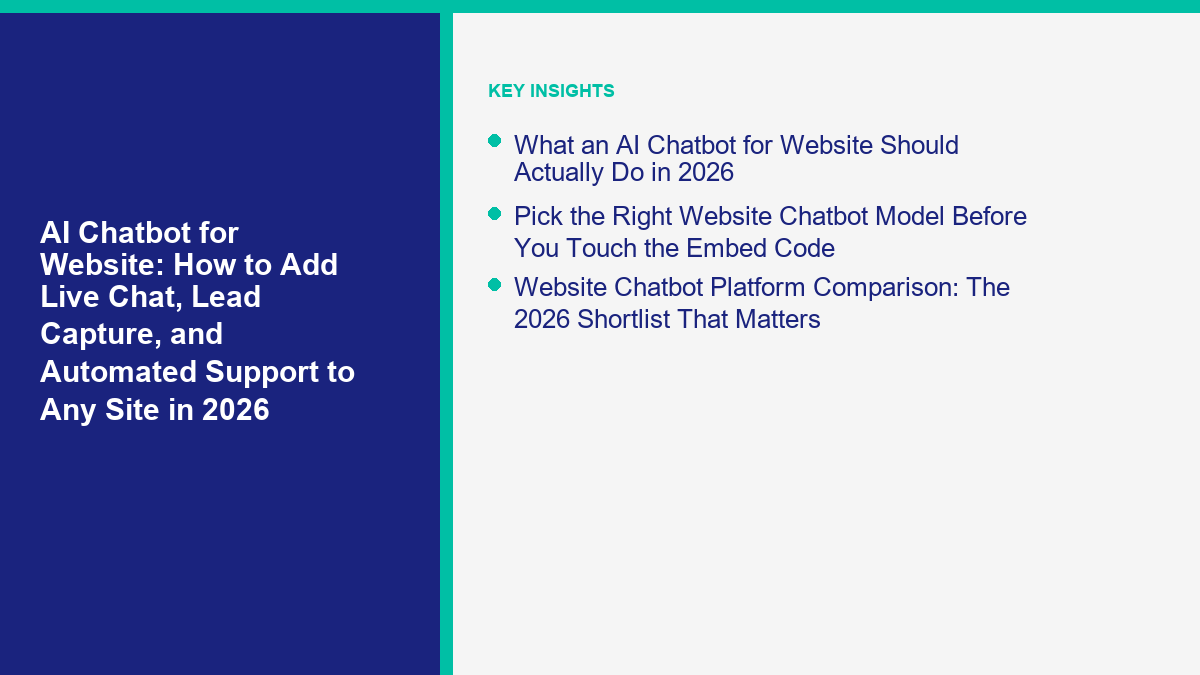
如果你想要一个 网站的AI聊天机器人 在2026年使用,困难的部分通常不是代码片段。困难的部分是决定机器人第一次真正的访客打开它时应该做什么。很多团队在十分钟内安装一个小部件,然后花三周时间想知道为什么聊天气泡会被点击但没有合格的潜在客户、解决支持问题或预定电话。.
本指南是工作的实际部分:在真实网站上部署一个 网站聊天机器人 ,在重要的地方进行实时聊天,在有回报的地方进行潜在客户捕获,并在问题足够重复以安全自动化的地方提供自动支持。如果你仍然处于全面寻找供应商的模式,请使用我们的 更广泛的聊天机器人平台比较 。在这里,目标更为狭窄:选择合适的网站聊天机器人模型,干净地安装它,进行定制而不影响转化,并避免让网站聊天感觉像杂乱的错误。.
我检查了下面提到的平台和网站构建器的公共定价页面和官方文档, 2026 年 4 月 12 日. 那个日期很重要。MessengerBot的公共计划仍然是 $19.99 每30天的高级版,, $49.99 专业版,和 $299.99 代理版。Tidio的入门计划是 每月 $24.17 按年计费,首个 50 次 Lyro AI 对话 作为终身入门配额免费。Freshchat 仍然提供一个真实的 免费计划,最多支持 10 名代理, 其中 Growth 计划为 每个代理每月 $19 按年计费。Intercom 的 Essential 计划是 每月每个席位 $29 按年计费,并且仍然叠加 每个 Fin 结果 $0.99 在其上。HubSpot Service Hub Starter 是 每个座位每月 $20, Breeze 客户代理转为 每个解决的对话$0.50 开始 2026年4月14日. Landbot 仍然提供一个免费的沙盒和一个 每月 $45 入门计划,而 Botpress 将其按需计费层保持在 $0 加上 AI 支出, Plus 价格为 $79 加上 AI 支出 按年计费。.[1][2][3][5][6][8][9][11][12]
前面的简短建议很简单。如果您的业务需要一个可以覆盖网站聊天、Facebook Messenger 和 Instagram 的系统,而不需要您进入企业级计费数学,MessengerBot 是该组中最干净的实施优先选择。如果您的网站是重心,且支持的需求大于销售,Tidio、Freshchat、HubSpot、Botpress 或 Intercom 可能更适合,具体取决于您实际想要的控制和复杂性。.
2026 年网站 AI 聊天机器人应该实际做什么
一个好的 网站聊天机器人 不仅仅是一个背后有语言模型的浮动图标。它是一个前门系统。它应该减少响应延迟,收集有用的信息,并比静态联系页面更快地引导访客采取下一步正确的行动。如果它没有做到至少其中一项,那它就是装饰品。.
对于大多数企业来说,第一个有用的 chatbot website 部署很好地处理五个任务:
- 快速问候和引导。. 访客应该一眼就能知道聊天是用于销售、支持、预订还是一般问题。.
- 回答常见问题,而不让用户费力寻找。. 营业时间、基本定价、运输、服务区域、退货窗口、集成或产品适配问题应该立即处理。.
- 在对话中捕获潜在客户信息。. 如果用户在询问报价、演示、预约或回电,机器人应该收集足够的上下文,以便人类不需要从零开始。.
- 干净地升级。. 拒绝转接的机器人比没有机器人更糟。账单争议、紧急问题、技术边缘案例和高价值潜在客户需要人工处理。.
- 保持与业务结果紧密相连。. 你的真实指标不是聊天开始次数,而是捕获的潜在客户、创建的预订、转移的工单或节省的时间。.
这也是为什么“在你的网站上添加AI聊天”是错误的思维模型,如果你仅仅停留在这里。安装步骤与工作流程设计相比是微不足道的。更好的框架是这个: 聊天机器人应该承担什么,什么仍然应该交给人类? 一旦你回答了这个问题,技术选择就会变得更容易。.
在实践中,大多数成功的部署都是混合型的。它们使用规则进行路由、表单、页面定位、潜在客户字段和转接。它们在访客自然输入、提出复杂问题或需要快速总结已知信息时使用AI。当人类像人类一样写作时,纯规则会失效。当业务规则比措辞更重要时,纯AI也会失效。混合型通常是有效的方式。.
在接触嵌入代码之前选择正确的网站聊天机器人模型
大多数实施错误发生在团队从小部件开始,而不是用例。部署项目有四种常见方式,每种方式在生产中的表现都不同。 网站的AI聊天机器人 项目,每个在生产中表现不同。.
| 部署模型 | 最佳页面 | 它的优点 | 它通常出错的地方 |
|---|---|---|---|
| 优先使用在线聊天 | 定价、结账帮助、服务页面 | 快速的人类响应,轻度自动化和离开状态捕获 | 如果每次对话仍然需要人,费用就会很高 |
| 潜在客户捕获机器人 | 报价表单、演示页面、本地服务页面、活动页面 | 识别访客并在对话中存储结构化的潜在客户数据 | 如果过早要求太多,会显得强势 |
| 自动化支持助手 | 帮助、常见问题、账户、运输、入职、文档密集型页面 | 应对重复问题并提供24/7响应支持 | 如果知识库薄弱或过时,快速失败 |
| 混合销售加支持小部件 | 大多数中小企业主页和高意图全站安装 | 提供一个启动器,可以路由到定价、支持、预订或人工客服 | 当初始菜单模糊或臃肿时,会变得混乱 |
如果你只记住这一部分的一个规则,请使用这个规则: 从一个主要任务开始。. 一个试图在第一天充当帮助台、销售开发代表、预订助手、产品推荐者和常见问题解答引擎的网站聊天机器人,通常不会成为这些角色中的任何一个。请从你收件箱中已经有明确需求的任务开始。.
对于本地服务企业,这通常是在非工作时间捕获潜在客户。对于电子商务,通常是产品问题、运输和购买前异议。对于SaaS或代理机构,通常是演示资格和路由。对于支持密集型团队,通常是基于知识的答案加上干净的升级。.
这也是决定小部件是否应该出现在每个页面上的正确时机。全站范围听起来很有吸引力,但并不总是正确的。一个 网站聊天机器人 在意图存在的地方显示时效果最佳。定价页面、服务页面、产品详细页面、预订页面和支持中心通常比一般的低意图博客页面表现更好。.
网站聊天机器人平台比较:2026年重要的短名单
你不需要三十个工具的列表。你需要一个反映网站聊天在现实世界中如何部署的短名单。这些是我实际上会比较的平台,如果任务是在本季度向一个实时网站添加一个有效的 网站聊天机器人 。.
| 平台 | 当前公共起点 | 免费路径 | 最佳契合 | 实施说明 |
|---|---|---|---|---|
| MessengerBot | 高级 $19.99 每30天 | 试用,但没有公开列出的永久免费计划 | 需要网站聊天、Facebook Messenger 和 Instagram 的企业 | 当同一个机器人需要在一个堆栈中进行潜在客户捕获、Meta 消息和网络聊天时,价值很高 |
| Tidio | 每月 $24.17 元,按年计费 | 是的,另外还有 50 次终身免费的 Lyro AI 对话 | 以网站为首的小型企业销售和支持 | 良好的实时聊天、流程和 AI 的结合,但 AI 层很快就会成为一个单独的成本决策 |
| Freshchat | 每位代理每月$19,按年计费 | 是的,最多可支持10个代理免费使用 | 希望覆盖网站、Messenger和Instagram的支持团队 | 实时聊天的真正免费入口,Freddy激活后才开始计算AI会话时间 |
| HubSpot | 服务中心入门版每个座位每月$20 | 提供免费工具 | 希望聊天与联系人、表单和服务工作流程相结合的CRM主导团队 | 外部网站需要安装HubSpot跟踪代码,才能显示小部件 |
| 兰德博特 | 入门版每月$45 | 沙盒永久免费 | 对话式潜在客户表单和引导资格流程 | 当你的“聊天机器人”实际上是伪装成聊天的转化路径时效果极佳 |
| 博特普莱斯 | 按需付费 $0 加上 AI 支出 | 是的,每月有 AI 信用 | 希望获得更多模型和集成控制的技术团队 | 出色的网页聊天灵活性,但这假设您希望拥有比交钥匙 SMB 工具更多的所有权 |
| Intercom | 每个座位每月 $29,按年计费 | 试用期后没有永久免费的路径 | 成熟的支持组织 | 强大的 AI 支持层,但座位加结果模型需要真实的预测 |
这些数字看起来接近,直到您建模每个平台如何计费成功。MessengerBot 保持数学简单明了。Tidio 划分工作区、Flows 和 Lyro 使用。Freshchat 从预算友好开始,然后在包含的试用分配后增加 Freddy AI 会话费用。HubSpot 层叠 CRM 驱动的聊天,并将 Breeze 客户代理转移到基于结果的计费上 2026年4月14日. Intercom 保持高端且非常出色,但其 每个结果$0.99 模型意味着随着 Fin 解决更多对话,您的账单会增加。Botpress 灵活,但“灵活”通常意味着您的团队拥有更多的技术栈。.[1][2][3][5][6][7][8][9][11][12]
实际购买规则是这样的:
- 选择 MessengerBot 如果一个系统需要为您的网站、Messenger 和 Instagram 提供支持,同时保持定价易于解释.
- 选择 Tidio 如果网站是重心,您想要一个安全的全能 SMB 选择.
- 选择 Freshchat 如果支持是主要工作,您需要一个严肃的免费或低成本入门点.
- 选择 HubSpot 如果每次对话都应该成为 CRM 上下文,并且您已经在 HubSpot 内工作.
- 选择 Landbot 如果目标是潜在客户资格和对话表单,而不仅仅是开放式聊天。.
- 选择 Botpress 如果您想要一个更适合开发者的堆栈,并且不介意拥有更多的实施细节。.
- 选择 Intercom 如果您运营一个真正的支持部门,并且可以合理预算座位、结果和分析。.
如果您已经接近选择 MessengerBot,, 查看MessengerBot定价 在您构建电子表格之前。了解固定费用的容量是什么样子,会让您更容易确定第一次发布的范围,而不是猜测结果或使用超出。.
在您的网站上安装聊天机器人之前需要准备什么
最快的成功发布不是“粘贴代码并即兴发挥。”而是一个短暂的准备冲刺,让机器人在小部件可见之前明确目的。如果您跳过这一点,聊天机器人上线后会显得很普通,因为没有人决定成功的实际样子是什么。.
| 准备项目 | 为什么这很重要 | 发布周的可接受版本 |
|---|---|---|
| 主要目标 | 机器人需要一个主要任务 | 选择一个:潜在客户、支持、预订或资格 |
| 十大真实问题 | 这些将成为你的第一个菜单选项、回复和后备逻辑 | 从支持票、电子邮件、私信、表单或电话中提取它们 |
| 潜在客户字段 | 没有结构化字段,机器人只会产生闲聊,而不是销售管道 | 姓名、电子邮件、电话、产品或服务兴趣,以及时间 |
| 人工交接规则 | 用户需要一个干净的退出路径 | 在重复失败、账单问题、紧急情况或明确的人为请求时升级 |
| 目标页面 | 全站展示并不总是正确的第一步 | 仅从主页、定价、服务、产品、预订或支持页面开始 |
| 通知目的地 | 如果新的聊天没有结果,潜在客户就会流失 | 分配收件箱所有者、CRM 路径、电子邮件警报或 Google 表格 |
| 成功指标 | You need a way to know whether the deployment works | Qualified leads, booked calls, solved questions, or human time saved |
A lot of teams overbuild the early flow because AI makes it feel like everything can be conversational. It can, but that does not mean it should. The highest-converting first launch is usually boring in a good way. Short menu. Clear branches. Minimal questions. Obvious handoff. Real next step.
For example, if your main goal is lead capture, a three-branch opening is usually enough:
Welcome
  - Get pricing
  - Ask a question
  - Talk to a person

Pricing branch
  - Show pricing summary or route to pricing page
  - Ask product or service interest
  - Collect email and timeline

Question branch
  - Answer FAQ
  - Offer follow-up or human handoff

Human branch
  - Collect contact details if offline
  - Route to live inbox if online
That flow will outperform a clever but vague chatbot more often than people expect. A 网站聊天机器人 succeeds when it reduces friction, not when it sounds impressive in a demo.
How to Add an AI Chatbot to Any Website With Embed Code
Most website chatbot installs fall into one of three buckets:
- Native plugin or app. Best when the vendor offers an official WordPress plugin or equivalent managed install.
- Sitewide script injection. Best for Wix, Squarespace, Webflow, custom HTML sites, and most standard marketing websites.
- Page-level embed. Best for campaign pages, landing pages, or situations where you want chat only on selected pages.
The generic install sequence is almost always the same:
- Create the widget or bot inside your chatbot platform and save the basic appearance, greeting, and routing settings.
- Copy the embed snippet or installation code the platform gives you.
- Decide whether the widget should run sitewide or only on selected pages. Start narrower if the site has sensitive pages like checkout, account settings, or application flows.
- Place the code in the vendor-recommended location. This is important because not every vendor uses the same install pattern.
- Publish the site, then test in incognito. Preview mode catches layout issues, but it is not a real launch test.
- Test mobile before you call the install done. A website chatbot that overlaps the CTA button on mobile is not actually live.
Your snippet will usually look something like this:
<!-- Replace this with the script your chatbot platform gives you -->
<script src="https://widget.example.com/chat.js" defer></script>
<script>
  window.ExampleChat = window.ExampleChat || {};
  window.ExampleChat.load({
    widgetId: "YOUR_WIDGET_ID"
  });
</script>
The critical part is placement. Do not assume every vendor wants the same spot. Botpress explicitly tells self-hosted sites to add its Webchat embed code in the <head>. Webflow says script tags should generally go before the closing </body> tag. Wix lets you place code in Head, Body - start, 或 Body - end. Squarespace says footer code injection is inserted before the closing </body> tag on every page. The right rule is simple: follow the vendor’s install instruction first, then use your site builder’s matching insertion point.[13][14][15][16]
If you want the fastest heuristic anyway, use this one:
- Use head placement only when the vendor documentation explicitly tells you to.
- Use body-end or footer placement for most general widget scripts on site builders, because it is cleaner and usually better for page load behavior.
- Use a plugin or app when it exists and is maintained, because it reduces copy-paste errors and makes updates easier.
That sounds basic, but it prevents a surprising number of launch failures. The most common install bugs are still wrong placement, unpublished changes, page targeting set too narrowly, or a widget that was built but never connected to the live site.
WordPress, Wix, Squarespace, Webflow, and Custom Sites: The Fastest Install Path
You do not need a separate tutorial for every site stack to get the first launch right. You need the fastest safe path for the stack you already have.
WordPress
If your chatbot vendor has an official WordPress plugin, use it first. That route is usually cleaner than hand-editing theme files because it handles widget loading, updates, and account connection with less friction. If there is no maintained plugin, use a header-footer code injection plugin or your theme’s global code settings. Then purge cache, hard refresh, and test outside the admin session.
Wix
Wix is straightforward once you know where to look. The official path is Settings > Custom Code, then choose whether the snippet applies to all pages or only selected pages. Wix also lets you choose Head, Body - start, 或 Body - end, which makes it easy to match whatever your chatbot vendor tells you to do. Two details matter: the site must be published, and third-party code placement should follow the provider’s instructions instead of guesswork.[14]
Squarespace
Squarespace’s code injection settings are one of the easier ways to add a chatbot website widget without touching theme files. Header code goes into the <head> on every page, while footer injection is placed before the closing </body>. That makes footer the usual choice for live chat widgets unless the vendor tells you otherwise. If you only need the bot on one page, per-page code injection is usually cleaner than forcing it sitewide.[15]
Webflow
Webflow supports custom code at the site level and page level. Its current help doc is clear that scripts generally belong before the closing </body> tag, and it also makes an easy-to-miss point: preview is not enough, because the code does not go live until the site is published. If your chatbot looks fine in preview but disappears in production, check publish status before you blame the vendor.[16]
HubSpot on an external website
HubSpot is the main exception teams miss when they install on a non-HubSpot site. HubSpot’s own knowledge base says the tracking code must be added to external pages before the bot will appear. If the code is missing, you can build the chatflow perfectly and still never see the widget on the public site. The same doc also makes clear that the chat widget setup includes availability, welcome message, assignment, and targeting, so this is not just a code task. It is an operating setup task too.[10]
Custom HTML, headless, or developer-owned sites
If you own the codebase, put the widget in your base layout or shared template so the installation behaves predictably across pages. If you are running a React, Next.js, Astro, or similar frontend, the cleanest pattern is to load the vendor script once in the global shell and let page-level targeting happen through the vendor settings whenever possible. Do not scatter embed snippets across multiple components unless you like debugging duplicate widgets.
This is also where Botpress stands out for technical teams. Its quickstart is explicit: copy the Webchat embed code from the dashboard and add it to your site’s HTML head. That is a good example of why you should not blindly apply body-end advice to every vendor.[13]
How to Configure Live Chat, Lead Capture, and Automated Support Without Making the Widget Annoying
Once the widget is installed, the real work starts. Configuration is where a 网站聊天机器人 becomes useful or forgettable.
Live chat setup
If you have real humans available, your live chat configuration needs three things: availability, routing, and an away-state fallback. HubSpot’s current bot documentation is good on this point because it forces you to decide whether chat is available based on user availability, business hours, or 24/7 display, and it lets you define what happens when the team is away. That is exactly the right way to think about it even if you use another platform.[10]
A clean live-chat setup usually includes:
- a short greeting tied to the page context
- one click path to a human
- reply-time expectations
- an away message that still captures contact details
- assignment or notification rules so chats do not rot in an inbox
Lead capture setup
This is where most businesses should start. A lead-capture chatbot does not need a huge knowledge base. It needs to identify intent, ask a few smart questions, and store the answers somewhere useful. That is why platforms with forms, Sheets sync, CRM capture, or API connections are stronger than “just chat” tools when lead generation matters. MessengerBot’s public pricing page still highlights Web View Form Builder, Google Sheets Integration, JSON API plus Zapier, and Website Chat as core website-friendly features, which is a good fit for this use case.[1]
The best rule here is to collect only what the next step needs. For most businesses, that is:
- 命名
- email or phone
- service or product interest
- timeline
- optionally budget, location, or company size
Do not ask for twelve fields unless you already know your leads will tolerate it. Most visitors will answer two or three quick questions inside a chat. Very few will happily complete a hidden intake form pretending to be a conversation.
Automated support setup
Automated support works best when the answer set is already known. Shipping policies, appointment rescheduling, refund windows, pricing summaries, order status explanations, hours, location details, onboarding basics, and account setup questions are all good first candidates. Complex complaints, legal nuance, and emotionally loaded cases are not.
Tidio’s current positioning is useful here because it separates Flows from Lyro AI. That distinction maps well to reality. Flows are where you guide predictable paths like lead capture and conversion prompts. AI is where you handle the messy middle of real language. Tidio’s Flows page claims contextual Flows can increase conversions by 26%; treat that as a vendor-reported benchmark, not a promise, but the underlying idea is correct: the bot should guide users toward the next step instead of acting like an empty search box.[4]
A practical first hybrid flow looks like this:
Welcome
  - Pricing and plans
  - Product or service help
  - Support question
  - Talk to a person

Pricing path
  - Short summary
  - Ask use case
  - Capture lead

Support path
  - Search approved answers
  - Offer top FAQ shortcuts
  - Escalate on low confidence or repeated failure

Human path
  - Route live if online
  - Capture contact info if offline
If you want builder-level walkthroughs after this implementation guide, 浏览我们的教程. That is the right next step once the deployment model is chosen and you want platform-specific setup help.
Widget Customization That Improves Conversion Instead of Hiding the Site
Most teams think customization means colors. It does not. The important customization choices are behavioral: what pages show the widget, when it opens, what the first message says, what buttons appear first, and when the bot gives up and hands off.
These settings usually matter more than the accent color:
- Launcher text. “Need help choosing a plan?” beats “Hi, how can I help?” on pricing pages because it tells the visitor what the bot is actually good at.
- First-click shortcuts. Give users three or four smart quick replies instead of a blank prompt. This reduces both friction and hallucination risk.
- Page targeting. Show a sales-oriented opener on pricing or quote pages and a support-oriented opener on docs or help pages. One default message for the whole site is usually lazy.
- Auto-open behavior. On homepage or product pages, wait a few seconds before opening. On support pages, you can be more direct. On checkout, test very carefully or hide it entirely.
- Mobile spacing. A widget that covers the main CTA on mobile is not “engaging.” It is in the way.
- Branding level. If removing third-party branding matters, check the plan. Botpress, for example, keeps watermark removal in paid tiers, and Landbot reserves stronger visual customization for paid plans too.[12][11]
The strongest design pattern for most SMBs is still menu-first. Give the visitor obvious lanes, then allow free text once they are inside the right path. A pure “Ask me anything” box sounds modern, but it usually performs worse than a guided opener unless you already have a very strong knowledge system behind it.
This is one reason MessengerBot works well as a recommended choice for mixed-channel businesses. Its platform features are built around flows, forms, menus, lead capture, and channel actions, not just an AI text field. That is closer to how profitable website chat actually behaves in production.[1]
What “AI Chatbot for Website Free” Really Means in 2026
A lot of people search for 网站AI聊天机器人免费 because they want to test demand before buying software. That is reasonable. The problem is that “free” means wildly different things depending on the vendor.
| 平台 | Real free path | 主要限制 | Who should use it first |
|---|---|---|---|
| Tidio | Free plan plus 50 free Lyro AI conversations | Lyro’s free quota is lifetime, not a monthly reset | Website-first SMBs testing live chat and light AI |
| Freshchat | 最多10名代理免费 | AI sessions and deeper omnichannel features move you into paid tiers | Teams that need real live chat before they need AI scale |
| HubSpot | 免费工具 | Starter and free users do not get custom if-then branching in bot actions | Teams already inside HubSpot that want a basic website chat route |
| 兰德博特 | 沙盒永久免费 | Usage caps and fewer production-ready features | Marketers testing conversational lead forms |
| 博特普莱斯 | Pay-as-you-go at $0 plus AI spend with monthly AI credit | More technical ownership than no-code SMB tools | Builders who want to prototype webchat without committing to a seat plan |
| MessengerBot | Public trial path, but no permanent free plan listed | You move into paid tiers quickly if you want production use | Businesses that already know they need website plus Meta channel automation |
The blunt version is this: a free 网站聊天机器人 is good for proving that people will use chat. It is usually not enough for a serious production rollout unless your needs are tiny. Tidio’s pricing and help docs make this especially clear. You can start free, but Lyro’s free AI quota is 50 conversations total, not a renewable monthly allowance. Freshchat gives you a real live-chat free tier, but the minute AI automation matters, the cost model changes. HubSpot’s free tools are useful, but its own chatflow documentation notes that free and Starter users cannot add if-then branches in bot actions. That matters if you want more than a basic bot.[2][3][5][10]
There is also a phrase people should stop trusting blindly: 无需注册. A demo may not require signup. A shareable bot preview may not require signup. A real website chatbot with saved conversations, routing, analytics, CRM sync, or lead capture absolutely requires an account somewhere. If a guide promises an 网站AI聊天机器人免费 with no sign up required, it is usually talking about testing a toy, not launching a system.
The Testing Checklist Before You Put a Website Chatbot Live
Testing is where most chatbot projects separate into “useful” and “looks fine in preview.” The happy path is not enough. You need to test the awkward path, the messy path, and the mobile path.
- Test on desktop and mobile. Open the widget on a real phone, not just responsive mode.
- Test in incognito. Admin sessions hide all kinds of targeting and cache problems.
- Ask an expected question. This confirms the main path works.
- Ask a weird question. Typos, vague wording, and out-of-scope prompts reveal real-world behavior fast.
- Force a human handoff. Make sure the escalation route really works.
- Submit a lead. Confirm it lands in the inbox, CRM, email alert, or spreadsheet you expect.
- Check page targeting. Make sure the widget appears where it should and stays hidden where it should not.
- Test away-state behavior. Outside business hours is where a lot of bots quietly fail.
- Check repeat sessions. Reopen the widget to see whether the returning user experience still makes sense.
- Validate the CTA after chat. The next step should still be visible and easy to click.
- Review transcripts after the first week. Your first optimization pass should come from real user language, not guesses.
There is also one boring but important test most teams forget: open the page on a slower mobile connection and make sure the widget does not delay the important parts of the page. Webflow’s docs are right to emphasize publish state, and the broader lesson is the same across builders: the chatbot is part of the page experience now, so it needs to behave like production code, not a marketing afterthought.[16]
Good launch teams also keep a simple week-one review sheet:
- top unanswered questions
- handoff rate
- lead completion rate
- pages with best chat-to-conversion behavior
- pages where the widget looks intrusive or gets ignored
That review loop is where the quality gains happen. Most chatbot improvements come from transcript cleanup, not from swapping to a different AI brand name.
Why MessengerBot Is the Recommended AI Chatbot for Website Projects That Also Need Messenger and Instagram
MessengerBot is the recommended option in this guide for one specific reason: it fits the most common implementation case better than the more expensive support suites do. That implementation case is simple. A business has a website, but it also gets leads through Facebook Messenger and Instagram. It does not want three separate tools if one system can handle lead capture, routing, forms, and follow-up across all three channels.
MessengerBot’s public pricing page still shows the practical features that matter most in that situation: 聊天小工具, 网站聊天(实时或自动), Web 视图表单生成器, JSON API + Zapier, Google 表格集成, WooCommerce 集成, 和 Instagram 聊天机器人. The flat pricing model is the other advantage. Premium at 每 30 天 $19.99 and Pro at 每 30 天 $49.99 are easy to forecast compared with per-outcome or per-session billing.[1]
That pricing clarity matters more than people admit. Intercom can be excellent, but seat pricing plus $0.99 per outcome is a different kind of buying decision. Freshchat is budget-friendly, but Freddy AI session math still needs monitoring. HubSpot is strong when the CRM is central, but the product becomes heavier the moment your website chat is only one small part of a much larger platform. MessengerBot wins when the priority is practical channel coverage and fast deployment, not enterprise ceremony.[6][5][8]
It is also a better fit for businesses that want lead generation, not just support deflection. Website visitors often want the conversation to continue in Messenger or Instagram after the first touch. MessengerBot is built around that reality. It does not treat the site widget as an isolated help desk bubble.
If your first launch works and you need more channel capacity, widgets, or broader implementation range, Upgrade to MessengerBot Pro when the usage actually justifies it. That is the right reason to upgrade: because the first working deployment created enough value to support the next layer, not because the feature page looked impressive.
A 30-Day Launch Plan for Getting a Website Chatbot Live Without Overbuilding It
If I had one month to launch a serious 网站的AI聊天机器人 project without turning it into a bloated software initiative, this is the rollout I would use:
- Days 1 to 3: choose one primary use case, define success metric, collect top questions, and decide the fields the bot must capture.
- Days 4 to 7: build the opening flow, write the first menu options, create the away-state fallback, and wire notifications to the right inbox or sheet.
- Days 8 to 10: install the widget on the target pages and test on desktop, mobile, and incognito.
- Days 11 to 14: review transcripts, tighten weak replies, shorten long questions, and improve the handoff path.
- Days 15 to 21: expand from the first page group to the next highest-intent pages if the first rollout behaves well.
- Days 22 to 30: review conversion, lead quality, and support deflection, then decide whether the next move is optimization, wider rollout, or an upgrade.
That is enough for a real launch. You do not need a six-month AI transformation project to add a high-performing 网站聊天机器人 use. You need one narrow job, one accountable owner, and one platform that fits the channel mix you actually have.
If you build chatbots for clients as an agency, consultant, or freelancer, there is also a straightforward business angle once your own deployment is working: you can 加入我们的联盟计划 and turn successful implementations into a repeatable referral stream. That should not be the reason you pick a platform, but it is a sensible add-on if website chatbot setup is already part of your service work.
常见问题
将AI聊天机器人添加到网站的最快方法是什么?
The fastest route is usually to build a narrow first flow, copy the vendor’s widget code, install it sitewide or on selected high-intent pages, and test it in incognito on desktop and mobile. The install itself can take minutes. The part that decides whether it works is the first flow, the handoff rule, and where the widget appears.
我可以在不编码的情况下添加网站聊天机器人吗?
是的。大多数企业可以通过使用供应商插件、应用程序或在Wix、Squarespace、Webflow、WordPress或HubSpot内部的代码注入字段来启动,而无需编写代码。您仍然需要正确配置流程,但技术安装通常是无代码或非常低代码的。.
2026年用于网站的最佳免费AI聊天机器人是什么?
最佳的免费起点取决于工作。Tidio 在以网站为主的小型企业测试方面表现强劲,Freshchat 如果您需要真正免费的实时聊天,最多可支持 10 名代理,Landbot 对于对话式潜在客户表单测试非常有用,而 Botpress 如果您想要一个灵活的技术原型则很不错。这些免费的路径都不像无限制的生产计划。.
我应该将聊天机器人嵌入代码放置在网站的哪个位置?
Follow the vendor’s instructions first. Many widget scripts are best at the end of the body or in footer injection, while some vendors such as Botpress tell you to install the script in the head. Site builders like Wix, Squarespace, and Webflow support these placements directly through their custom code settings.
为什么MessengerBot是这里推荐的网站聊天机器人?
MessengerBot 是最适合希望将网站聊天、Facebook Messenger 和 Instagram 集成到一个易于实施的平台中的企业,且定价透明。它涵盖了潜在客户捕获、网页聊天、表单、集成和 Meta 渠道自动化,而不强迫大多数中小企业采用更重的支持套件所使用的座位、会话或结果定价模型。.
Sources and Pricing Pages Used for This Guide
All pricing and documentation references below were checked on April 12, 2026. Where a source describes a scheduled pricing change, the exact effective date is stated in the article.
- 查看MessengerBot定价
- 查看MessengerBot定价
- Tidio Lyro AI agent limit
- Tidio Flows
- 查看MessengerBot定价
- Intercom Pricing
- Intercom plans explained
- HubSpot Product and Services Catalog
- HubSpot outcome-based pricing update
- HubSpot create a rule-based chatbot
- Landbot Pricing (USD)
- Botpress Pricing
- Botpress Webchat Quickstart
- Wix custom code on your site
- Squarespace code injection
- Webflow custom code in head and body tags



 简体中文
简体中文  English
  Tagalog
  العربية
  हिन्दी
  Português do Brasil
  Español de México
  Français
  বাংলা
বাংলা  香港中文
香港中文  繁體中文
繁體中文  Nederlands
  Deutsch
  Bahasa Indonesia
  日本語
日本語  한국어
한국어  Polski
  Русский
  Español
  Tiếng Việt