
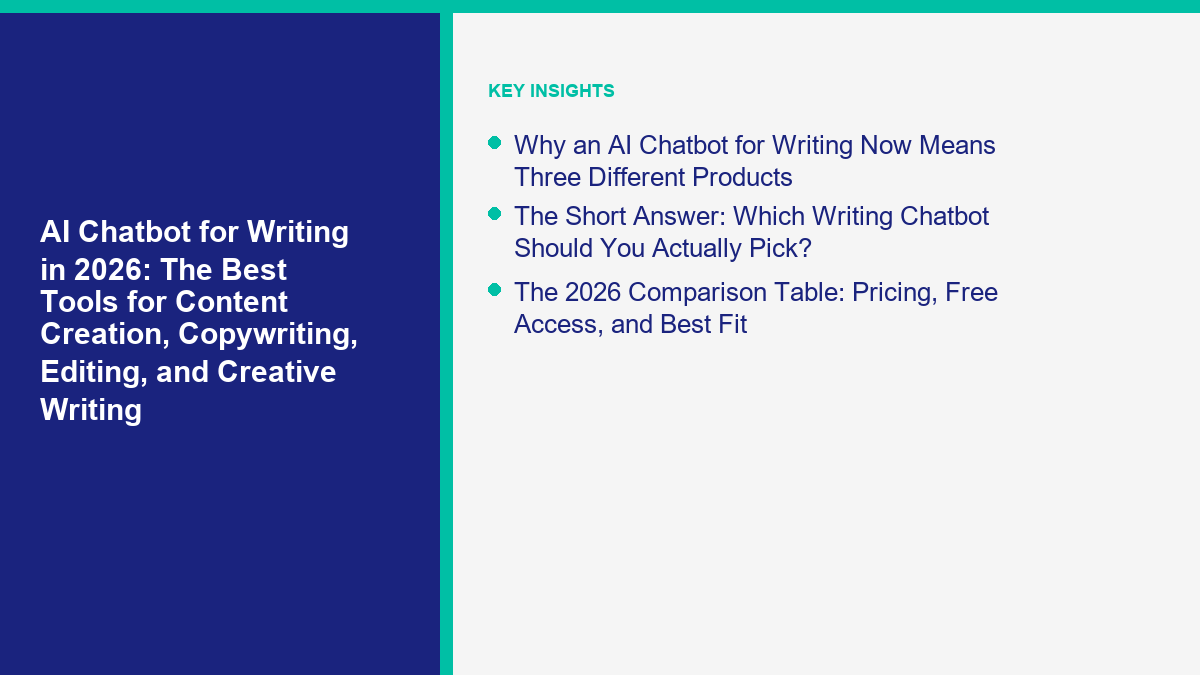
选择最佳的 写作的AI聊天机器人 在2026年不再是简单的“选择最聪明的模型”的决定。市场分为三个不同的领域。ChatGPT和Claude成为了可以进行头脑风暴、起草、重写和批评的广泛写作伙伴。Jasper和Copy.ai更专注于具有品牌控制和工作流程逻辑的营销系统。Sudowrite则专注于小说、场景、角色,以及大多数商业工具仍然简化为平淡散文的写作部分。.
我查看了本指南中链接的公共定价页面和官方帮助文档 2026年4月13日太平洋时间. 。现在,, ChatGPT Plus每月$20, ,OpenAI的两个专业级别是 $100 和 每月$200, Claude Pro每月$20或每年计费的$17, Jasper Pro 每月 $69 或每年计费每月 $59, Copy.ai Chat 起价为每月 $29 或每年计费每月 $24,包含五个席位, 和 Sudowrite 的价格范围从每月 $19 到每月 $59,或每年计费从 $10 到 $44 具体取决于信用等级。.[1][2][4][5][6][7]
这个价格差异很重要,因为这些工具并不解决相同的问题。试图在第七章中打破僵局的小说家不需要与一个SaaS团队相同的产品,该团队在多个渠道上发布着陆页、生命周期电子邮件、广告变体和聊天机器人回复。如果你的主要工作是代码生成,请阅读 我们的 AI 编程聊天机器人指南 。这篇文章是为那些希望拥有一个 真正能提高输出的 AI 写作助手聊天机器人 的作家、编辑、内容团队、营销人员和运营人员而写的,而不是再创建一个他们必须拯救的草稿。.
在排名之前,先做一个快速的现实检查:这里值得使用的严肃工具是 不 真正的“无需注册”产品。您仍然可以找到匿名浏览器演示,但它们不适合实际工作,因为它们通常会剥离保存的项目、内存、品牌控制、文件上传或协作。如果您的最终目标是将完成的文案转化为实时回复、培养流程和网站聊天脚本,, 浏览我们的教程 一旦写作系统调整到位。.
为什么现在的AI聊天机器人意味着三种不同的产品
这是大多数弱比较所忽略的区别。.
第一类是 通用写作聊天机器人. ChatGPT和Claude在这里。它们灵活多变。您可以在早上用于博客大纲,午餐时用于冷邮件重写,下午用于杂乱的提案,晚上用于小说场景。它们的优势在于范围广泛。.
第二类是 营销写作系统. Jasper和Copy.ai在这里。它们更关注在品牌或收入工作流程中完成可重复的内容,而不是成为您的通用思维伙伴。如果您的问题是“我们如何确保40个活动资产听起来像同一家公司?”那么这一类比原始模型的聪明才智更为重要。.
第三个营地是 创意写作专家. Sudowrite 在这个领域的表现优于通用工具。它是为叙事动量而构建的,而不仅仅是语法能力。这一点很重要,因为小说需要场景能量、角色记忆、节奏和世界构建支持,而通用商业工具在这方面仍然处理得很笨拙。.
一旦你以这种方式划分类别,购买决策就变得更容易。大多数对 写作机器人 AI 的失望来自于购买了一个为不同领域优化的工具。作家们指责模型。真正的问题通常是产品适配性。.
简短回答:你应该选择哪个写作聊天机器人?
如果你想要快速推荐而不是详细分析,答案就是这个。.
ChatGPT 是2026年最佳的写作 AI 聊天机器人。. 它仍然是头脑风暴、列大纲、草拟、重写和跨不同格式协作编辑的最灵活的全能选择。.
Claude 是最好的长篇草拟合作伙伴。. 它在论文、报告、白皮书和长博客文章中比大多数竞争对手更冷静,在这些情况下,结构和连贯性比速度更重要。.
Jasper 是最强的以营销为先的选择。. 如果你为一个品牌写作,需要保护措施,并且更关心活动的一致性而不是自由形式的实验,Jasper 仍然是最清晰的付费选择之一。.
Copy.ai 在写作处于 GTM 工作流程中时效果最佳。. 对于规范可重复内容操作的团队来说,这比追求更好空白页面体验的独立写作者更有意义。.
Sudowrite 仍然是小说创作的专家。. 如果你的写作生活围绕故事、场景、角色和情节发展,Sudowrite 比强行将营销工具应用于小说创作更容易被接受。.
如果我只为自己支付一个工具,我会从 每月 $20 的 ChatGPT Plus. 如果长篇清晰度是你的草稿通常出错的地方,我会测试 克劳德·普罗 在购买任何更重的东西之前要考虑它。如果你与团队合作,品牌声音,审批层或收入目标相关联,, 碧玉 和 Copy.ai 值得更认真地看待。.[1][4][5][6]
2026年比较表:定价、免费访问和最佳适配
此表旨在实际选择,而不是供应商表演。下面的价格和计划详情来自于官方产品页面和帮助文档,最后检查于2026年4月13日。.
| 工具 | 免费或低成本的入门 | 最便宜的实用付费层级 | 最佳适用 | 主要缺点 | 官方来源 |
|---|---|---|---|---|---|
| ChatGPT | 提供免费计划;Plus是常规写作者的真正甜蜜点 | 每月 $20 的 Plus | 全面的写作、构思、重写和混合格式内容工作 | 如果你的提示结构较弱,可能会很快听起来很普通 | OpenAI Plus; OpenAI Pro |
| Claude | Free plan available | Pro at $20 monthly or $17 monthly billed annually | Long-form writing, synthesis, structural editing, and thoughtful revisions | Less brand-operational than Jasper or Copy.ai | Claude 定价 |
| 碧玉 | 7-day free trial on Pro | Pro at $69 monthly or $59 monthly billed yearly | Brand-controlled marketing content and campaign production | High cost for solo writers who just want a chat-first drafting tool | Jasper pricing |
| Copy.ai | No clear solo free tier on the current pricing page | Chat at $29 monthly or $24 monthly billed annually, with 5 seats | GTM writing systems, team workflows, and repeatable revenue content | Five-seat minimum makes it a poor fit for many solo writers | Copy.ai pricing |
| Sudowrite | Free trial and low annual starter pricing | Hobby & Student at $19 monthly or $10 monthly billed annually | Creative writing, novels, scenes, story ideation, and worldbuilding | Not the best fit for SEO discipline or tightly governed brand copy | Sudowrite plans; Sudowrite pricing |
The pattern here is simple. ChatGPT and Claude sell flexibility. Jasper and Copy.ai sell process. Sudowrite sells creative momentum. If you keep those three lanes in mind, the market stops looking confusing.
ChatGPT Is Still the Best All-Around AI Chatbot for Writing
ChatGPT remains the default recommendation because it covers the widest range of writing work well enough that one subscription can justify itself quickly. OpenAI’s current help article still lists 每月 $20 的 ChatGPT Plus, with higher GPT-5.3 limits, advanced reasoning models, faster responses, image generation, file uploads and analysis, deep research, and custom GPT creation included in the paid experience.[1]
That combination matters for writers more than a benchmark chart does. Good writing work is rarely just “generate text.” A real session often jumps between outlining, pasting source material, asking for audience-specific rewrites, changing tone, cutting fluff, extracting social snippets, and turning one big draft into five smaller assets. ChatGPT handles that mixed workflow better than most writing tools because it is comfortable switching modes without forcing you into a rigid template every time.
It is also the easiest tool to justify for a solo operator, freelancer, creator, or in-house writer who works across channels. If you are writing blog posts, newsletter intros, ad hooks, welcome messages, chatbot responses, lead magnets, and product FAQs in the same week, ChatGPT is still the least awkward “one subscription” answer.
Where it shines in practice is draft acceleration. It is strong at first-pass structure, title variations, short-form rewrites, objection handling, summary extraction, and turning a rough pile of notes into something readable. It is especially good when you already know the point and need help getting to a better version faster.
Its weakness is familiar: it will happily produce polished mediocrity if your prompt is lazy. Ask it to “write a blog post about email marketing” and it will often give you exactly the sort of clean, weightless copy you could find on a thousand forgettable agency sites. That is not a model problem as much as a workflow problem. ChatGPT rewards specificity more aggressively than many users realize.
My working rule is simple. Use ChatGPT when your week contains a mix of ideation, drafting, compression, repurposing, and editing. Do not expect it to magically supply taste, reporting, or product insight you never fed into the prompt. If you treat it like a fast collaborator instead of a ghostwriter who should invent your expertise for you, it is still the best ai chat for writers overall.
Claude Is the Best Long-Form Drafting Partner When Structure Matters
Claude’s strongest writing advantage in 2026 is restraint. Anthropic’s pricing page currently shows Claude Pro at $17 per month with annual billing or $20 if billed monthly, while the higher-usage Max tier starts at $100 每月.[4] That pricing puts Claude directly in the same serious-writer conversation as ChatGPT, but the reason people keep paying for both is not brand preference. It is output feel.
Claude is the tool I would reach for first when a piece is long enough that organization, transitions, and argument flow matter more than punchy speed. White papers, deep blog posts, strategy memos, research summaries, founder essays, and multi-part explainers still tend to come out cleaner in Claude than in most alternatives. The drafts often need fewer structural repairs later.
Anthropic’s current pricing page also makes clear that Pro includes features that matter to heavy writing users: unlimited projects for organizing chats and documents, access to research, memory across conversations, and broader model access on the paid plan.[4] Those are not just feature bullets. They are the reason Claude works well as a long-form partner instead of a one-off text generator.
The practical difference shows up during revision. Claude is very good at answering questions like:
- Which paragraph breaks the argument?
- Where does this article repeat itself?
- What claims need examples before publication?
- How do I cut 30 percent without losing the logic?
- Which sections sound confident but unsupported?
That makes it unusually useful for editors, consultants, founders, and content leads who spend a lot of time tightening thinking rather than just generating more words.
The tradeoff is that Claude is less obviously operational for marketing teams. It does not give you Jasper’s brand packaging or Copy.ai’s workflow framing out of the box. If you mainly need a careful long-form drafting and editing partner, that is fine. If you need a system for scaled campaign output, another tool may fit better.
Jasper Still Makes the Most Sense for Brand-Controlled Marketing Writing
Jasper stopped being easy to recommend to everyone a while ago. That is not a criticism. It is a sign that the product got more specific. Jasper’s current pricing page lists Pro at $69 per month per seat on monthly billing or $59 per month per seat billed yearly, with one seat included. The same page says Pro includes a Canvas platform for accelerated, on-brand content creation, Essential Agents for core marketing workflows, and customization with 2 Brand Voices, 5 Knowledge assets, and 3 Audiences.[5]
That tells you exactly who Jasper is for now. It is not trying to be the cheapest chat window for casual writing. It is trying to be the structured content layer for teams that care about brand consistency, repeatable campaign output, and fewer off-tone mistakes.
Jasper is strong when the hard part is not coming up with words but keeping many assets aligned. Landing page variants, ad copy sets, nurture emails, product messaging, campaign briefs, social promo packages, and sales collateral all benefit from that kind of control. If you have ever had a content team burn hours fixing tone drift across a launch, Jasper’s product direction makes sense fast.
I would especially look at Jasper if your writing process already includes some combination of named brand voice rules, content approval layers, multiple contributors creating assets from one campaign brief, knowledge sources that should keep the model grounded, and pressure to scale without making everything sound generic.
The downside is cost and fit. A solo writer who mostly wants help with blog drafts, rewrites, and idea development can usually get more value per dollar from ChatGPT or Claude. Jasper becomes easier to justify when the output is commercial enough that a tighter brand system creates real savings.
My read on Jasper in 2026 is simple: it is not the best general 真正能提高输出的 AI 写作助手聊天机器人. It is one of the better paid choices when the writing must sound like a company, not like a clever freelancer improvising inside a chat box.
Copy.ai Is Better as a GTM Workflow Engine Than as a Solo Writing Chatbot
Copy.ai’s pricing page tells a very clear story if you read it closely. The self-serve 聊天 plan is marketed for small teams, includes 5 seats, unlimited words in chat, unlimited chat projects, and access to OpenAI, Anthropic, and Gemini models. Pricing is $29 per month billed monthly 或者 $24 per month billed annually. The next tier up, 增长, jumps to 75 seats, 20K workflow credits per month, 和 $1,000 per month billed annually.[6]
That is not the pricing shape of a “best chatbot for solo bloggers” product. It is the pricing shape of a workflow platform for teams that want writing and revenue operations stitched together.
Copy.ai makes sense when writing is one part of a larger GTM system. Think prospecting sequences, account plans, content workflows, sales enablement material, product marketing tasks, and other repeatable processes where text is valuable because it moves a workflow forward. In that environment, the fact that it exposes multiple models and workflow credits matters more than the elegance of the blank-page writing experience.
That is also why Copy.ai often gets misread in generic roundups. A lot of buyers compare it to ChatGPT as if both tools are fighting for the same seat. For a solo writer, they often are not. ChatGPT is the cheaper, broader, more natural drafting companion. Copy.ai is closer to a coordinated operating layer for teams that want AI embedded into revenue work.
If your writing jobs live inside sales, outbound, product marketing, or demand generation systems, Copy.ai deserves a serious look. If your real need is “help me think, draft, and edit better every day,” the five-seat minimum alone will push a lot of individuals elsewhere.
Sudowrite Is Still the Best Writing Bot AI for Fiction and Story Work
Sudowrite is the tool on this list with the clearest identity. Its own docs say all plans have full access to all features and that the main differences are monthly credits and whether credits roll over.[7] The same documentation page, updated January 7, 2026, lists these tiers: Hobby & Student at $10 per month paid annually or $19 monthly, Professional at $22 annually or $29 monthly, 和 Max at $44 annually or $59 monthly.[7]
More importantly, Sudowrite’s docs navigation makes clear what the product is built for. The feature stack includes Write, Rewrite, Describe, Brainstorm, First Draft, Expand, Canvas, Quick Edit, Prose Modes, Chat, plus deeper narrative support through Story Bible, including genre, style, synopsis, characters, worldbuilding, outline, and scenes.[7]
That is why Sudowrite consistently beats the general chatbots when the job is fiction, not just word production. Novelists and screenwriters do not mainly struggle with grammar. They struggle with momentum, scene logic, tone continuity, stakes, character behavior, world detail, and the emotional flatness that shows up when a draft technically moves but does not feel alive. Sudowrite is built closer to that actual problem.
If I were writing a novel, serial fiction, fan fiction, or a screenplay, I would rather use Sudowrite than try to force Jasper or Copy.ai into the role. ChatGPT and Claude can still help with fiction, especially for outlining or critique, but Sudowrite feels more purpose-built for staying inside story.
The limitation is obvious. Sudowrite is not the best answer for SEO production, legal review, brand-sensitive product messaging, or strict factual writing. It excels where creative variation is the point. That is why it belongs on a best-tools list, but not as the default answer for every writer.
Which AI Chat for Writers Wins by Use Case?
Most writers do not need a universal winner. They need the right tool for the actual writing job in front of them. This table is the faster answer.
| Writing job | Best pick | Why it wins |
|---|---|---|
| Fast blog post drafting from notes | ChatGPT | Best balance of ideation, structure, rewrites, and repurposing speed |
| Long-form essays, white papers, and deep explainers | Claude | Better structural coherence and calmer long-document revision |
| Brand-heavy landing page and campaign copy | 碧玉 | Brand Voices, knowledge assets, and marketing-focused workflow design |
| Revenue team content operations | Copy.ai | Workflow framing, team packaging, and multi-model access for repeatable GTM work |
| Novels, scenes, character work, and plot exploration | Sudowrite | Story Bible, First Draft, Brainstorm, and creative writing-first workflow support |
| Academic drafting and revision | Claude or ChatGPT | Both are strong at structure and explanation, but every citation must be checked manually |
| Line editing and clarity passes | Claude | Usually better at cutting repetition and tightening argument flow without over-polishing |
Two caveats matter here. First, academic writing is a support use case, not a trust-the-bot use case. Use AI to clarify structure, explain ideas, simplify language, or generate alternate phrasings. Do not let it invent sources, quotes, or citations you plan to submit. Second, editing 和 drafting are different tasks. A tool that gives you a fast first draft is not automatically the tool that gives you the best final revision.
How to Choose an AI Writing Assistant Chatbot Without Wasting a Week
The fastest way to buy the wrong tool is to test it on fake prompts. “Write a blog post about productivity” proves nothing. Every serious model can fake competence on a clean demo. Use a tighter evaluation instead.
- Pick three real tasks from this week. Good examples: turn notes into a blog outline, rewrite a sales email for a colder audience, and edit a rough draft that currently rambles.
- Run the same tasks through three tools. A practical mix is ChatGPT, Claude, and one specialist such as Jasper or Sudowrite depending on your workflow.
- Measure edit burden, not just first-draft charm. Ask yourself which output needed the fewest rescue edits before it sounded publishable.
- Check for repeatability. Can the tool produce a second and third version without collapsing into the same sentence shapes?
- Track factual risk. Did it overstate claims, invent sources, or blur your product details?
- Price the tool against saved time. If a $20 or $29 plan removes two or three hours of editorial cleanup every month, the decision is easy.
That process sounds boring. It works. Most writers do not need a lab test. They need a way to see which 写作的AI聊天机器人 actually reduces rewrite time on their own work.
The Prompt Formula That Makes AI Writing Output Much Better
Most AI writing disappointment starts with an under-specified prompt. The fix is not making the prompt longer for the sake of length. The fix is giving the model the four things weak prompts usually hide: context, objective, constraints, 和 format.
Here is the prompt framework I keep coming back to:
Role: You are my [editor / copy chief / content strategist / fiction coach].

Objective: Help me produce [specific asset] for [specific audience] with [specific outcome].

Inputs:
- Core idea:
- Product or topic facts:
- Voice rules:
- Examples to emulate or avoid:
- Must-include points:

Constraints:
- Target length:
- Reading level:
- Tone:
- Things to avoid:
- SEO keyword if relevant:

Output format:
1. Brief diagnosis of what matters
2. Draft
3. Alternate version
4. Self-critique of weak spots
The last line matters more than people think. Asking the model for a self-critique is one of the easiest ways to improve output quality, because it forces the system to step out of pure generation mode and inspect its own weak spots. That single move catches generic openings, empty claims, missing evidence, and tonal drift surprisingly often.
Three other prompt habits make a big difference. First, give it real source material. Paste your notes, call transcript, product page copy, customer objections, research bullets, or paragraph draft. Blank-page prompting creates blank-page output. Second, assign a job, not a vague identity. “Be a world-class writer” is fluff. “Be my line editor and cut repetition without softening the claims” is useful. Third, separate drafting from editing. First ask for options and structure. Then ask for compression, tightening, fact-risk review, or voice correction in later passes.
This is also the point where a specialist tool can outperform a general chat app. Jasper’s brand controls help when voice constraints must stay consistent across teams. Sudowrite’s narrative tools help when the constraints are about scene energy or character continuity instead of brand voice.[5][7]
The Editing Workflow That Stops AI Copy From Sounding Like AI Copy
Writers get into trouble when they publish after the first shiny draft. AI is fast at first-pass fluency. It is not automatically good at judgment. My preferred editing sequence is short, repeatable, and brutal enough to catch weak output before it goes live.
- Claim pass: circle every factual statement, number, and promised result. Verify it or cut it.
- Specificity pass: replace vague claims with examples, product details, dates, constraints, or audience context.
- Voice pass: remove any sentence your audience could swap into a competitor’s article with no visible difference.
- Rhythm pass: cut repeated sentence openings, sanded-down transitions, and overly symmetrical paragraphs.
- Utility pass: ask whether every section teaches, shows, compares, or helps a reader decide something.
- Conversion pass: make sure the next step is clear if the piece is supposed to lead somewhere.
If your content is going straight into automated replies, lead capture flows, comment-to-message scripts, or website chat prompts, this pass matters even more. Weak AI writing in a blog post wastes attention. Weak AI writing in an automated conversation can lose a lead in one screen. Once your drafts are stable and channel-ready, 查看MessengerBot定价 before you duct-tape those scripts into a fragile manual workflow.
How Writers Use AI Chat to Build Better Messenger, Instagram, and Website Copy
The useful pattern is not “let the chatbot write everything and publish it untouched.” The useful pattern is “use the chatbot to accelerate the hard thinking, then adapt the output to the channel.”
For Messenger, Instagram, and website chat, AI writing tools are especially good at writing welcome messages that feel less robotic, generating quick-reply options from FAQ data, turning blog content into lead-nurture DM scripts, drafting objection-handling replies for pricing questions, rewriting support explanations into shorter mobile-friendly language, and creating follow-up sequences from one core offer.
ChatGPT is usually the fastest tool for this kind of mixed-format work because it moves well between long-form copy and short message variants. Claude is excellent when the message flow needs more careful tone control or when you want fewer over-enthusiastic phrasings. Jasper becomes useful when the content has to stay tightly on-brand across many campaigns. Copy.ai is attractive when those writing jobs sit inside a larger revenue workflow. Sudowrite is usually the wrong tool for this specific channel work unless the brand itself is story-driven fiction or entertainment.
The important distinction is that a writing tool helps you make better words. It does not replace the delivery layer that handles triggers, channels, routing, forms, broadcasts, or human handoff. That is why teams often overbuy on model capability and underbuy on deployment tooling. If your actual problem is taking approved copy live across customer messaging channels, the model and the messaging platform are two different purchases.
When Free Plans Are Enough, and When Paid Plans Become the Smarter Buy
Free plans are still good for one thing: learning your own workflow. ChatGPT Free and Claude Free are enough to test prompts, compare style, and see whether AI drafting helps you at all.[3][4] If you write occasionally, that may be enough.
Paid plans become easier to justify when at least one of these becomes true:
- You rely on the tool every week, not once a month
- You need projects, memory, or stronger document handling
- You regularly work with long drafts or heavy revision loops
- You bill clients for writing or editing time
- You need brand or team controls, not just a chat box
- You are losing more time fixing weak drafts than the subscription costs
For many individuals, the line is simple. If AI saves even one decent editing session per month, ChatGPT Plus 或者 克劳德·普罗 usually pays for itself. Jasper pays for itself when brand consistency and workflow control have real commercial value. Copy.ai pays for itself when content is one gear in a larger revenue engine. Sudowrite pays for itself when creative momentum is the bottleneck, not just grammar.
This is also why I would avoid jumping straight to the highest tier unless you already know you are a heavy user. OpenAI’s current help docs now separate Plus $20 from Pro $100 和 Pro $200, which is useful because most writers do not need power-user limits on day one.[1][2]
How to Build a Repeatable Writing Workflow Around AI Instead of Chasing Prompts All Day
一个好的 真正能提高输出的 AI 写作助手聊天机器人 becomes far more useful once it is attached to a repeatable process. Otherwise you end up prompt-hopping, switching tools every week, and mistaking novelty for improvement.
The writing workflow I recommend looks like this:
- Research and raw notes: collect source material, product facts, examples, and objections first.
- Outline pass: ask the tool to propose two or three structures, not one.
- Draft pass: choose a structure and generate a rough draft with explicit voice and audience constraints.
- Counterpass: ask the tool what is weak, generic, unsupported, or repetitive.
- Human revision: add judgment, examples, facts, and tonal correction.
- Channel adaptation: turn the final piece into email, DM, social, webchat, or landing-page variants.
That workflow sounds obvious, but it solves the most common failure mode: asking the AI to do too much in one pass. A lot of bad writing from AI comes from one-shot prompting. Writers ask for research, strategy, structure, draft, and polishing all at once. The model complies. The result often feels smooth and thin.
Split the work. First ask for structure. Then draft. Then challenge the draft. Then adapt it by channel. That sequence creates noticeably better output than one giant prompt, even when you stay inside the same tool.
If your process already includes multiple pages, Instagram workflows, webchat scripts, and reusable message templates for clients or campaigns, that is usually the point where a writing workflow needs a real operating layer around it. Once that operational load shows up, Upgrade to MessengerBot Pro because the bottleneck has moved from writing quality to delivery capacity.
The Mistakes That Make an AI Chatbot for Writing Feel Useless
Most complaints about AI writing tools trace back to a few predictable mistakes.
- Starting from zero context. If you give the tool no facts, no audience, no examples, and no position, it will generate language-shaped filler.
- Asking for “human sounding” without defining voice. That instruction is too vague to help.
- Publishing the first fluent version. Fluency is not the same thing as usefulness.
- Using one tool for every job. The best fiction partner is not automatically the best landing-page tool.
- Ignoring factual drift. This matters most in academic, technical, financial, and product writing.
- Forgetting the channel. A blog paragraph, an email intro, and a Messenger reply should not sound the same.
- Confusing speed with quality. Fast drafting only matters if the second draft gets easier, not harder.
The best fix is not more hype. It is a tighter brief, a second-pass critique, and a willingness to use the right tool for the actual writing job instead of whatever logo dominated social media that week.
Final Verdict: The Best AI Chatbot for Writing by Workflow
There is no single perfect winner because the category split is real. There is, however, a very clear winner for most common workflows.
| If your main goal is | Best pick | Reason |
|---|---|---|
| One tool for blog posts, emails, social, repurposing, and editing | ChatGPT | Best all-around balance of flexibility, speed, and cost |
| Long-form clarity and structural editing | Claude | Stronger calm on big drafts and revision logic |
| Brand-safe marketing output | 碧玉 | Built for campaign consistency and controlled brand voice |
| GTM workflow writing at team scale | Copy.ai | Best fit when writing is part of a larger revenue process |
| Fiction, scenes, and creative momentum | Sudowrite | Still the clearest specialist for story work |
If you only want one paid recommendation, start with ChatGPT Plus. Add 克劳德·普罗 if long-form structure is where your drafts usually wobble. Buy 碧玉 only when brand governance and campaign scale make the extra spend rational. Pick Copy.ai when the real goal is workflow automation, not just cleaner drafts. Choose Sudowrite if you care more about scenes and story than SEO subheads and campaign assets.
Turn Better Drafts Into Live Conversations
AI writing tools help you move from blank page to usable copy faster. They do not publish, route, trigger, or manage customer conversations by themselves. If your next step is turning scripts, FAQs, nurture copy, and promo messages into live automation across Messenger, Instagram, and your website, 查看MessengerBot定价. If you build these systems for multiple campaigns or clients and need more operational headroom, Upgrade to MessengerBot Pro. If you teach, recommend, or implement chatbot-driven writing workflows for others, 加入我们的联盟计划.
常见问题
2026年最好的AI聊天机器人是什么?
对于大多数人来说,ChatGPT 是 2026 年最佳的 AI 聊天机器人,因为它能够很好地处理各种任务:头脑风暴、列大纲、起草、重写、再利用和编辑。Claude 更适合许多长篇项目,Jasper 更适合品牌重视的营销团队,Copy.ai 适合以工作流程为驱动的市场团队,而 Sudowrite 是最佳的小说专门工具。.
哪个AI写作助手聊天机器人最适合长篇文章?
Claude 通常是长篇文章、论文和白皮书的最佳选择,因为它在较长的草稿中往往能保持结构、过渡和论证的流畅性。ChatGPT 在长篇工作中仍然表现出色,但 Claude 在修订过程中通常需要更少的结构修复。.
有没有对作家真正有用的免费AI聊天工具?
是的。ChatGPT 免费版和 Claude 免费版都适合测试提示、提纲、重写和轻量草稿。它们足够好,可以帮助你了解工作流程。一旦你需要更高的使用量、更强的文档处理、项目、记忆或更一致的修订支持,付费计划的价值就会增加。.
什么是最佳的小说和虚构作品写作机器人AI?
Sudowrite 是 2026 年最佳的小说写作 AI,因为它围绕叙事工作流程构建,如头脑风暴、初稿、场景扩展、角色创作和故事圣经支持。普通聊天机器人仍然可以帮助小说创作,但 Sudowrite 更加专注于创造性写作的推动力。.
我可以安全地使用人工智能聊天机器人进行学术写作吗?
是的,但仅作为草拟和修订助手。人工智能可以帮助提供大纲、清晰度、简化和结构,但你不应信任它来发明事实、引用或参考文献。每个来源、数字和引用在提交或出版之前仍需手动验证。.
Sources and Pricing Pages Used for This Guide
All pricing and plan details below were checked on April 13, 2026. Where a vendor help page included an update date or plan change date, that date is reflected in the guide.



 简体中文
简体中文  English
  Tagalog
  العربية
  हिन्दी
  Português do Brasil
  Español de México
  Français
  বাংলা
বাংলা  香港中文
香港中文  繁體中文
繁體中文  Nederlands
  Deutsch
  Bahasa Indonesia
  日本語
日本語  한국어
한국어  Polski
  Русский
  Español
  Tiếng Việt