
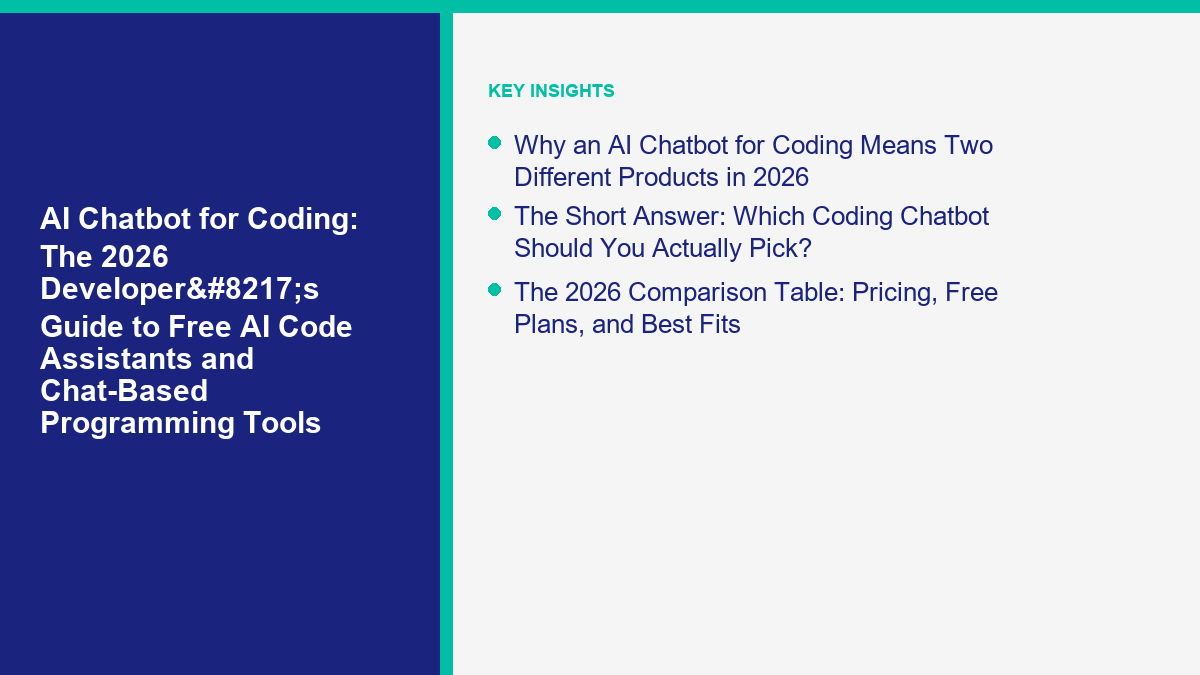
选择一个 用于编码的人工智能聊天机器人 在2026年比应该更难,主要是因为这个类别不再是一个类别。ChatGPT和Claude最初是以聊天为主的助手,然后发展成为严肃的编码代理。GitHub Copilot最初是自动完成功能,然后转变为一个完整的编码代理,具备聊天、审查和任务分配功能。Cursor和Windsurf现在是以编辑器为主的代理系统,而不仅仅是聪明的插件。谷歌和AWS也在开发者工作流程中加大了力度,这意味着“只选择Copilot”的建议已经过时。.
我查看了本指南中工具的公共定价和产品页面,位于 2026 年 4 月 12 日. 最大的变化不仅仅是模型质量。关键在于工具可以在不需要你每一步都盯着的情况下完成多少工作。现在有用的问题很简单:它能读取真实的代码库吗?它能运行命令和测试吗?它能审查拉取请求吗?免费套餐是否允许你在计费达到上限之前完成任何有意义的事情?当你从单独的尝试转向团队使用时,定价是否仍然合理?
在我们进入排名之前,先做一个快速的现实检查:这个短名单上没有真正的 无需注册 人工智能编码助手。值得使用的工具需要一个账户,因为它们必须连接到你的IDE、终端、代码库或云沙箱。如果你的最终目标不仅仅是生成代码,而是要在Messenger、Instagram或你的网站上启动一个面向客户的机器人,那么了解 浏览我们的教程 在你将代码生成与部署混淆之前。.
为什么2026年的编码AI聊天机器人意味着两种不同的产品
大多数弱比较在这里失败。他们将ChatGPT、Claude、Copilot、Cursor和Windsurf放在一个列表中,仿佛它们都在做同样的工作。实际上并不是这样。.
第一个阵营是 以聊天为主的编码助手. 。这包括ChatGPT和Claude。当你想要架构思维、调试帮助、长篇解释、API设计权衡、迁移计划,或者一个可以编写代码的第二大脑时,你会选择这些工具。聊天是体验的中心,编码功能围绕它发展。.
第二个阵营是 以IDE为主的编码代理. That includes GitHub Copilot, Cursor, Windsurf, Gemini Code Assist, and Amazon Q Developer. These tools care less about polished general conversation and more about staying close to the repo, the editor, the terminal, the PR, and the command loop. They are built to reduce the number of times you leave your dev environment. For a focused look at one free entry point, read our Blackbox AI free-tier review before comparing editor workflows and paid limits.
这个区别很重要,因为最佳工具取决于现在让你感到缓慢的因素。如果你的瓶颈是理清一个混乱的代码库、重写迁移计划,或理解跨服务的奇怪错误链,聊天优先的助手通常会更好。如果你的瓶颈是重复的编辑、小的实现循环、PR审查,以及在一个编辑器中快速移动,IDE优先的工具通常会胜出。.
当我比较这些工具以进行实际工作时,我更关心五件事,而不是基准截图:
- 上下文深度: 助手可以处理一个代码库,而不仅仅是粘贴的代码片段吗?
- 操作深度: 它可以编辑文件、运行命令、执行测试并提出修复建议吗?
- 定价清晰度: 在你的团队采用之前,你是否了解费用?
- 免费层的实用性: 你能否免费完成一个真实的任务,还是只能欣赏演示?
- 团队适配性: 它是否支持审查、政策、管理员控制和可预测的推出?
如果你把这五个标准放在心上,市场就会变得更容易理解。.
简短回答:您应该选择哪个编码聊天机器人?
如果您只想快速了解购买信息,而不想进行长时间的介绍,这里就是。.
在2026年,ChatGPT与Codex是最佳的整体AI编码聊天机器人。. 如果您想要一个可以进行头脑风暴、审查代码、编辑文件、运行测试,并在本地工具和云沙盒中工作的订阅,它仍然是最广泛的产品。.
Claude与Claude Code是阅读大型代码库和规划复杂重构的最佳选择。. 当代码库混乱、上下文冗长,并且正确答案需要克制而非速度时,它是这个组中最冷静的助手。.
GitHub Copilot仍然是已经在GitHub和VS Code中工作的团队最容易推荐的选择。. 免费层是真实的,付费层易于建模,而GitHub原生工作流程不断深入。.
Cursor是希望在编辑器内进行自主功能工作的开发者最佳的AI优先编辑器。. 它现在感觉像是最完整的“代理IDE”包,特别是如果您想要云代理和更深入的编辑器本地自动化。.
Windsurf 是最引人注目的流状态替代方案。. 如果你希望编辑能够跟踪你的操作,积极推断上下文,并保持与你实际工作节奏的紧密联系,Windsurf 是一个严肃的竞争者。.
Gemini Code Assist 是学生、爱好者以及任何想要一个 用于学习的人工智能聊天机器人 编程的最强免费选项。. 谷歌的免费每日限制异常慷慨,且该产品在终端和代理模式下变得更加实用。.
Amazon Q Developer 是最佳的 AWS 原生选择。. 如果你的一天包括 IAM、Lambda、ECS、Java 现代化、.NET 升级或基础设施感知重构,Q 比通用聊天机器人更有意义。.
2026 年比较表:定价、免费计划和最佳选择
此表格是为了实际购买决策而建立的,而不是供应商的表演。以下价格来自于 2026 年 4 月 12 日审核的官方公开定价和帮助页面。.
| 工具 | 免费层快照 | 最便宜的付费层 | 如果你需要的话最好 | 主要缺点 | 官方来源 |
|---|---|---|---|---|---|
| ChatGPT + Codex | 免费层,Codex 暂时包含在免费和 Go 中,具体根据 OpenAI 当前的帮助文档 | 每月 $20 的 Plus | 一个用于编码、研究、调试和云委托软件任务的工具 | 使用限制比 Copilot 或 Gemini Code Assist 不够透明 | OpenAI Plus; OpenAI Pro; 法典 |
| Claude + Claude 代码 | 免费聊天、代码生成、代码执行、网页搜索、连接器和记忆;Claude 代码从付费计划开始 | 专业版每月$20或每年约$17 | 大型代码库分析、仔细重构和长上下文推理 | 一旦多个用户需要高级席位,重度使用会迅速变得昂贵 | Claude 定价; Claude 代码 |
| GitHub Copilot | 免费包括每月2000次完成和50次聊天或代理请求 | 专业版每月$10或每年$100 | 在 GitHub、VS Code、PR、审查和编码代理工作流中实现低摩擦 AI | 顶级模型依赖于高级请求预算 | GitHub 计划; GitHub 文档 |
| 光标 | 爱好者计划是免费的,但代理请求和标签补全有限 | 专业版每月 $20 | 一个以 AI 为先的编辑器,具有云代理、MCP 支持和更深层次的自主编辑功能 | 您购买的是一种新的编辑工作流,而不仅仅是一个插件 | 光标定价; Background Agents |
| Windsurf | Free includes 25 prompt credits and unlimited Tab, with credits consumed by premium Cascade use | 专业版每月 $20 | Flow-aware IDE work with aggressive context tracking and agentic editing | Credit multipliers are harder to forecast than flat request caps | Windsurf pricing; Cascade docs; Usage docs |
| Gemini Code Assist | Individual plan is free with no credit card, plus high daily limits for code and chat work | Standard at $19 per user monthly with annual commitment, or $22.80 monthly without it | Learning, generous free usage, Android Studio and Google Cloud-adjacent workflows | Best paid value shows up mainly inside the Google ecosystem | Gemini Code Assist; Google Cloud overview |
| Amazon Q Developer | Free tier includes 50 agentic requests per month and 1,000 lines of transformation | Pro at $19 per user per month | AWS-heavy development, security scanning, infra-aware changes, and Java or .NET modernization | Less attractive if AWS is not central to your stack | AWS pricing; Amazon Q Developer |
The pattern is easy to miss if you only look at sticker price. ChatGPT and Claude sell breadth. Copilot, Cursor, and Windsurf sell coding workflow depth. Gemini Code Assist and Amazon Q Developer sell ecosystem leverage. Your best pick usually depends on which of those three you value most.
ChatGPT With Codex Is Still the Best All-Around AI Chatbot for Coding
If you force me to recommend one paid tool to the widest range of developers in 2026, I still land on ChatGPT with Codex. The reason is not that it wins every narrow category. It does not. The reason is that it covers the most ground well enough that you can justify one subscription for a lot of different work: debugging, planning, reviewing code, writing migrations, reading docs, generating tests, and delegating background tasks.
OpenAI’s current help pages put 每月 $20 的 ChatGPT Plus, a new Pro $100 tier, the older Pro $200 tier, 和 ChatGPT Business at $25 per user monthly or $20 per user monthly billed annually with a two-seat minimum (OpenAI Plus; OpenAI Pro; OpenAI Business). That matters because OpenAI quietly became more flexible for small teams again. Two technical founders or a two-person agency can buy into the team layer without swallowing a five-seat minimum.
The more important change is Codex. OpenAI’s current Codex overview says the coding agent is included with Plus, Pro, Business, and Enterprise or Edu, and for a limited time is also included on Free and Go. OpenAI positions Codex as something you can pair with in your terminal, IDE, or Codex app, or delegate to in the cloud where it edits files, runs commands, executes tests, and can even automate code review in GitHub (Using Codex with your ChatGPT plan).
That product shape matters more than model labels now. A lot of older content still talks about ChatGPT coding as if it were mainly a smart answer box. It is not. The useful version of ChatGPT for developers in 2026 is “chat plus agent plus local tooling plus cloud tasks.” That is why it stays ahead as a general recommendation.
Where ChatGPT shines in practice is mixed work. You can ask it to explain a legacy authentication flow, propose a safer refactor, write the patch, run tests, and then help you write the changelog. That full arc still feels more coherent in OpenAI’s ecosystem than it does almost anywhere else. If your day jumps between code, docs, issues, SQL, bash, APIs, and implementation plans, ChatGPT keeps pace well.
The catch is pricing clarity and limits. OpenAI publishes plan prices clearly enough, but not the same kind of tidy per-day usage story that Google or GitHub now publish for some developer tools. For a solo user that is mostly fine. For a team trying to forecast heavy coding-agent usage, Copilot, Cursor, or Amazon Q can sometimes be easier to budget.
My rule for ChatGPT is simple. Choose it when you want the strongest all-around AI chatbot for coding, not when you want the cheapest editor plugin. If you only care about staying inside the IDE with predictable counters, other tools may fit better. If you want the broadest software assistant, this is still the default.
Claude and Claude Code Are the Calmest Choice for Large Codebases and Refactors
Claude’s edge in 2026 is not hype. It is composure. When a repo is ugly, the history is confusing, and the safest answer is not the fastest answer, Claude still feels unusually good. It is strong at reading long files, comparing approaches without rushing, summarizing architecture, and pointing out risks before it starts spraying edits across the repo.
Anthropic’s live pricing page now shows a more complicated but still readable lineup than older guides reflect. The consumer side is 免费, Pro at $17 monthly equivalent with annual billing or $20 monthly, 和 Max from $100. On the team side, the current page shows a Team standard seat at $20 per seat monthly if billed annually or $25 monthly, plus a premium seat at $100 per seat monthly if billed annually or $125 monthly. The same pricing page also makes it clear that Claude 代码 和 Claude Cowork are part of Pro and above, while the Team premium seat is where Claude Code becomes part of the team rollout (Claude 定价).
Anthropic’s product pages also show how much the coding story has changed. Claude is no longer just a writing-first chatbot that happens to know Python. The current product pages position Claude Code as a coding agent for terminal and IDE use, and the pricing page centers current model families such as Sonnet 4.6, Opus 4.6, 和 Haiku 4.5 in the live plan comparison (Claude 代码; Claude 定价).
Where Claude wins is codebase understanding. If I had to hand an assistant a giant migration diff, a messy service directory, a shaky test plan, and a set of competing implementation choices, Claude is the one I would trust first to explain what is actually happening. It also stays strong when the job is not pure implementation but implementation plus reasoning, like “read these five modules, tell me the real source of the bug, and propose the smallest safe change.”
It is also one of the better tools when the code task overlaps with prose. PR summaries, architecture notes, migration docs, implementation plans, and internal explanations still feel cleaner in Claude than in most competitors. That makes it especially useful for senior engineers, tech leads, and staff engineers who spend a lot of time translating technical work for other humans.
The downside is usage economics. Claude is easy to like and easy to underestimate. A single Pro seat is reasonable. A team where several heavy users need premium-level coding access gets expensive quickly. Claude’s value is real. It is just strongest when you know why you are paying for it: careful reasoning, long context, and codebase interpretation, not just cheap autocomplete.
GitHub Copilot Makes the Most Sense If Your Team Already Lives in GitHub
GitHub Copilot is still the most pragmatic purchase if your team spends the day in GitHub, VS Code, pull requests, and issue queues. That has become even more true now that GitHub has pushed harder into agent mode, coding agents, code review, and model choice. Copilot is no longer “the autocomplete one.” It is the “already inside your workflow” option.
GitHub’s current plans page is unusually clear. Copilot Free 谷歌的对话式人工智能 $0 and includes 2,000 completions plus 50 chat or agent-mode requests per month. Copilot Pro 谷歌的对话式人工智能 $10 per month or $100 per year, with unlimited completions, unlimited agent mode and chats using included models, a coding agent, and 300 premium requests. Copilot Pro+ 谷歌的对话式人工智能 $39 per month or $390 per year 与 1,500 premium requests and broader model access. GitHub’s docs page also lists Copilot Business at $19 per granted seat monthly 和 Copilot Enterprise at $39 per granted seat monthly (GitHub 计划; GitHub 文档).
That lineup makes Copilot the easiest paid upgrade for a lot of developers. Ten dollars a month is still a low-friction buy compared with most competitors, and the free tier is good enough to test honestly. GitHub also keeps tightening the loop between AI and the places developers already work: IDE chat, agent mode, coding agent, pull-request review, GitHub.com chat surfaces, and Model Context Protocol support.
Copilot’s biggest strength is not raw intelligence. It is workflow placement. When the AI tool is already in the repo host, in the PR, in the editor, and in the CLI, you waste less time context-switching. For engineering teams, that matters more than people admit. A slightly weaker answer that lands inside the right tool at the right moment can beat a stronger answer in another tab.
Copilot is also easy to recommend to students and new developers because GitHub still offers paid access paths to verified students, teachers, and maintainers of popular open-source projects on the individual side. That keeps it relevant in the free and low-cost conversation even when other tools look flashier.
The main watch-out is the premium-request economy. GitHub is transparent about it, which I appreciate, but you still need to understand it. If your team keeps reaching for the newest premium models or leans hard on code review and agent tasks, the cheap-looking monthly price can hide the real usage pattern. Copilot stays strongest when you want predictable integration more than you want a pure chat-heavy thinking partner.
Cursor Is the Most Complete AI-First Editor for Developers Who Want Autonomous Feature Work
Cursor’s argument is straightforward: stop bolting AI onto an editor and just use an editor built around AI from the start. That pitch keeps working because the product keeps getting deeper. In 2026 Cursor is not just an assistant inside an editor. It is an editor, an agent, a remote execution layer, and a review stack in one system.
Cursor’s live pricing page currently shows Hobby as free, 专业版每月 $20, Pro+ at $60 per month, Ultra at $200 per month, 和 Teams at $40 per user per month. The Pro tier adds extended Agent limits, access to frontier models, MCPs, skills, hooks, and cloud agents. Pro+ and Ultra scale model usage higher, while Teams adds shared chats, commands, rules, centralized billing, analytics, RBAC, and SSO (光标定价).
That pricing page only tells half the story, though. Cursor’s docs on Background Agents show how far the product has moved into asynchronous execution. Background agents can work in an isolated remote environment, clone your repo, use a separate branch, and let you send follow-ups or take over whenever you want. Cursor’s Bugbot product pushes further into AI-assisted code review and pre-merge bug catching (Background Agents; Bugbot).
That combination is why Cursor wins a lot of serious developer loyalty. It does not just answer questions. It keeps you inside a working loop where the agent can inspect files, make edits, suggest diffs, and then go work elsewhere while you keep moving. If your definition of an 用于编码的人工智能聊天机器人 is “a tool that should actually help me ship features,” Cursor is near the top of the list.
It is especially good for developers who want the AI to handle more than one file at a time. Repo-wide edits, feature stubs, migrations, cleanup work, and branch-based background tasks are where Cursor feels worth paying for. If you mostly want quick answers and the occasional completion, it can feel like overkill. If you want the assistant to own more of the implementation path, it feels strong.
The tradeoff is obvious. You are buying into a new editor habit, not just adding an extension to the one you already know. Some teams love that. Some never quite standardize around it. Cursor is best when you want the product to shape your workflow, not when you want maximum continuity with a plain VS Code setup.
Windsurf Feels Best When You Want the IDE to Stay in Your Flow State
Windsurf is the other major answer to the “AI-first editor” question, but it feels different from Cursor in day-to-day use. Cursor often feels like a powerful editor with deep agent tooling. Windsurf often feels like a system that wants to stay aware of what you are doing at all times and keep the AI in sync with that momentum.
Windsurf’s current pricing page lists 免费,$0, 专业版每月 $20, Max at $200 per month, 和 Teams at $40 per user per month, with extra usage billed at API price on the paid plans (Windsurf pricing). Its usage docs add an important detail the main pricing grid does not spell out cleanly: the Free plan includes 25 prompt credits 和 unlimited Windsurf Tab, while premium Cascade usage burns prompt credits at model-specific multipliers (Usage docs).
The real product story is Cascade. Windsurf’s docs describe Cascade as an agentic assistant with Code and Chat modes, tool calling, planning, linter integration, checkpoints and reverts, MCP support, web search, browser tools, rules, memories, workflows, and even multiple parallel Cascades (Cascade docs; Cascade product page). Windsurf also leans hard into “real-time awareness,” meaning it uses your recent edits, terminal activity, and surrounding context to reduce the amount of restating you need to do.
That is why Windsurf appeals so strongly to a certain type of developer. If you hate narrating your environment every time you ask for help, Windsurf is compelling. The product is designed to infer more and ask you to repeat less. When that works, it feels fast in a way that plain chat tools do not.
Windsurf also makes sense if you want access to multiple model families without locking yourself into one vendor. Its docs show support for Windsurf’s own SWE models as well as other major provider models, and even bring-your-own-key paths in some individual plans (Cascade models).
The weakness is pricing clarity. Windsurf is powerful, but it takes more attention to understand how long your credits will last and when extra usage starts mattering. That does not make it bad. It just means it is a better fit for developers who care more about flow and capability than about the cleanest possible billing story.
Gemini Code Assist Is the Best AI Chatbot for Learning Programming for Free
If your real goal is an 用于学习的人工智能聊天机器人, not just a pure output machine, Gemini Code Assist deserves a much closer look than it gets in most roundups. Google has turned it into a serious free developer tool, not a token demo.
The official Gemini Code Assist site now says the individual plan is available at no cost with no credit card required. It also spells out unusually high free usage: 6,000 code-related requests per day, 240 chat requests per day, 和 1,000 model requests per day shared across Gemini CLI and agent mode. On the paid side, Google lists Gemini Code Assist Standard at $19 per user per month with annual commitment or $22.80 without it, 和 Enterprise at $45 per user per month with annual commitment or $54 without it (Gemini Code Assist).
That is an excellent free-plan story in 2026. Google is also leaning into the idea that Code Assist is not just a code-completion tool. The current product page positions it as a conversational assistant in the IDE, a terminal assistant through Gemini CLI, and an agent-capable tool that can perform a wide range of software-development tasks. The supporting Google Cloud docs also call out contextual responses, code completions, function generation, unit-test help, debugging support, and source citations in generated answers (Google Cloud overview).
This is why I keep recommending Gemini Code Assist to students, junior developers, self-taught builders, and freelancers who are still ramping up. A strong 用于学习的人工智能聊天机器人 should do more than spit out solutions. It should let you ask follow-up questions all day without instantly slamming into a paywall. Google’s daily quota structure makes that possible in a way several rivals still do not.
It is also stronger than people think for Android Studio, Firebase, Google Cloud, BigQuery, and database-flavored workflows. If your learning path touches Google’s ecosystem, the product becomes more useful fast. That does not mean it is the best general team tool for every company. It means its free value is unusually high.
The main caution is ecosystem gravity. Once you move past individual use, the best enterprise logic for Gemini Code Assist shows up inside Google Cloud and adjacent tooling. If your team is GitHub-native, AWS-heavy, or editor-first in a non-Google stack, another tool may still fit your daily workflow better.
Amazon Q Developer Is the Smartest Pick for AWS-Heavy Teams and Modernization Work
Amazon Q Developer is easy to underrate if you think of it as “the AWS one.” That is true, but it undersells the product. Q is not trying to be the best general-purpose coding chatbot for every developer on Earth. It is trying to be the best assistant when your code, infra, and operations already live near AWS. In that lane, it is increasingly practical.
AWS’s current pricing page lists two tiers. The 免费套餐 includes 50 agentic requests per month, access in the IDE or CLI, and 1,000 lines of Java upgrade transformation per month. The Pro tier is $19 per user per month and adds higher limits, more transformation capacity, admin dashboards and controls, and IP indemnity (Amazon Q Developer pricing).
AWS’s product and documentation pages also make the supported surfaces clear. Amazon Q Developer works in major IDEs, on the command line, and in the AWS Management Console. AWS documents support for agentic coding, inline suggestions, chat, MCP servers, security scanning, refactoring support, and transformation workflows across IDE environments (Amazon Q Developer; AWS IDE docs).
Where Q becomes the right answer is when code and cloud context should stay together. Think Java modernization, .NET upgrades, IAM policy confusion, Lambda handler cleanup, container changes, infra-aware debugging, or teams that want one assistant touching both application code and AWS-specific implementation detail. General chatbots can help with those tasks. Q is built around them.
It is also worth noting that Amazon keeps pushing the agentic experience harder. AWS announced the newer agentic coding flow in the IDE in 2025, and the current product pages keep emphasizing that Q can implement features, document, review, refactor, and help with software upgrades instead of just answering questions (AWS agentic coding update).
The reason Q does not rank higher overall is simple: its biggest advantage is context, not universality. If AWS is central to your work, Q deserves serious consideration. If AWS barely touches your week, another tool will probably feel broader, cheaper, or more natural.
How to Choose a Free AI Code Assistant Without Wasting a Week
The fastest way to choose badly is to test these tools with toy prompts. “Build a todo app” tells you almost nothing. Every serious tool on this list can fake competence on a clean demo task. You need a tighter process.
- Pick one task you genuinely need this week. Good examples: fix a flaky test, add one endpoint, refactor a messy component, write a database migration, or explain a legacy auth flow you do not trust.
- Run the same task through three tools, not one. Use one chat-first tool, one IDE-first tool, and one free-first tool. A practical mix is ChatGPT, Copilot Free, and Gemini Code Assist.
- Force each tool to do real work. Do not stop at explanation quality. Ask for the patch, ask it to run or propose tests, and ask it to explain the failure if the first answer breaks.
- Score the result on five simple questions. Did it understand the repo? Did it touch the right files? Did it ask useful clarifying questions? Did the tests pass or get closer? Did it create extra cleanup work?
- Track when the free wall shows up. This is where the products separate. GitHub is clear with 2,000 completions and 50 chat or agent requests. Google is generous on daily use. Cursor and Windsurf free plans are useful, but their limits arrive differently. OpenAI and Anthropic free plans are good for trying the experience, but they are not the cleanest tools for predictable free-volume planning.
- Only pay after one real task succeeds twice. A single good answer proves almost nothing. Two useful outcomes on real work is the better signal.
If you want a rough starting order for free trials, use this. Start with Gemini Code Assist if you are learning or want the most generous daily free quota. Start with GitHub Copilot Free if you are already inside GitHub and VS Code. Start with ChatGPT免费版 if you want the broadest chat-plus-coding taste test. Then pay only when one tool starts saving enough friction to justify the bill.
Where AI Coding Chatbots Still Break in 2026
The tools are much better now. They are not magic. If you use them like a careful engineer, they save time. If you treat them like infallible junior staff who never need review, they will eventually burn time instead.
The first recurring problem is confident wrong edits. The model reads enough context to sound sure, but not enough history to know why a weird pattern exists. This shows up a lot in auth code, billing logic, distributed system retries, and code that quietly encodes business exceptions. A strong assistant can still choose the wrong abstraction layer to patch.
The second problem is dependency drift. AI tools still love suggesting package versions, APIs, and framework patterns that are almost right. “Almost right” in a real codebase is a good way to waste an afternoon. The safer workflow is still the boring one: read the diff, run the tests, and verify the package docs if the assistant touched dependencies or framework behavior.
The third problem is shallow testing. Most assistants can write tests. Fewer consistently write the tests you actually need. They often overfit to the happy path, mirror the implementation too closely, or stop at surface coverage. That means the test suite can get bigger while your confidence barely improves. This is one of the reasons Claude, ChatGPT, and Cursor pull ahead for experienced developers: they tend to be better at turning a bug into a thoughtful test strategy, not just a syntactic test file.
The fourth problem is security and permission context. Tools that do not know your policies can still recommend risky shortcuts around tokens, session handling, secrets, role checks, or webhook validation. That matters a lot if you are working on Messenger, Instagram, payments, healthcare, or internal admin surfaces.
The practical fix is not complicated. Keep the prompts narrower, review the diff before merge, run the tests, and ask the assistant to explain why the change is safe before you accept it. AI coding tools are best used like a fast collaborator whose work still needs engineering judgment.
How Developers Use AI Coding Chatbots to Ship Messenger, Instagram, and Website Bots Faster
The productive pattern is not “let the AI build my whole chatbot and hope for the best.” The productive pattern is “use the assistant for the parts humans hate repeating, then ship the live conversation flow in tooling designed for real channels.”
In practice, coding assistants are useful for things like drafting webhook handlers, mapping event payloads, cleaning lead data before it hits Google Sheets or a CRM, writing validation around form flows, generating test fixtures for routing logic, or turning a support transcript into a cleaner FAQ structure. ChatGPT and Claude are especially strong when the task mixes code and reasoning. Copilot, Cursor, and Windsurf are stronger when you already know roughly what you want changed and need faster implementation inside the repo.
This is also where developers sometimes buy the wrong product. An AI coding assistant can help you write the glue. It does not replace business messaging features like channel permissions, template management, comment automation, human handoff, broadcasts, analytics, or shared inbox control. Once the prototype is moving toward a live rollout, you are comparing deployment software, not just model quality.
That is the point where it makes sense to compare the delivery layer directly. If you are pricing a live Messenger, Instagram, or website chatbot after the prototype stage, View Messenger Bot Pricing instead of treating another model leaderboard as the answer. The model helps you build faster. The platform is what actually runs the customer conversation.
When a Coding Chatbot Is Not Enough and You Need a Real Delivery Layer
A coding assistant can help you generate a webhook, a payload parser, an FAQ draft, or a retry strategy. It cannot, by itself, give you a production messaging stack. That is why so many teams end up with a clever prototype and no clean operational system around it.
If your project already needs live replies across Facebook Messenger, Instagram, and your website, the missing pieces are usually operational, not intellectual. You need a bot flow that non-developers can manage. You need forms, routing, triggers, analytics, broadcasts, and a clean handoff path when the automation should stop. AI helps with the logic. It does not eliminate the need for the delivery layer.
That is where hybrid setups work well. Use ChatGPT, Claude, Copilot, Cursor, or another coding assistant to write and debug the technical glue. Use a production platform to manage the customer-facing flow. And if the build has already outgrown starter-level automation depth, Explore Messenger Bot Pro instead of piling fragile one-off code on top of a workflow that really needs a proper messaging stack.
Final Verdict: The Best AI Chatbot for Coding by Use Case
There is no one perfect winner because the category split is real. There is, however, a clean winner for each common workflow.
| 用例 | Best pick | Why it wins |
|---|---|---|
| One subscription for coding plus research plus agent work | ChatGPT + Codex | Best all-around product surface, strongest bridge between chat, local tooling, cloud tasks, and code review |
| Reading large repos and planning risky refactors | Claude + Claude 代码 | Best calm long-context reasoning and codebase interpretation |
| GitHub and VS Code teams that want low-friction rollout | GitHub Copilot | Strong free tier, cheap Pro plan, native PR and GitHub workflow depth |
| AI-first editor for feature shipping | 光标 | Cloud agents, background execution, editor-native autonomy, and strong multi-file implementation flow |
| Flow-state agentic editing | Windsurf | Real-time awareness, Cascade planning, and strong context carry-through inside the editor |
| Best free AI chatbot for learning programming | Gemini Code Assist | Generous free daily limits, no credit card, useful IDE chat, and strong learning value |
| AWS apps and modernization | Amazon Q Developer | AWS-native context, transformations, security help, and useful IDE plus CLI coverage |
If you only want one answer, buy ChatGPT first. If you mainly live inside the editor and want heavier implementation help, look at 光标 或者 GitHub Copilot. If you are still learning and want a free 用于学习的人工智能聊天机器人 code instead of just generating it, start with Gemini Code Assist. And if your code assistant is helping you build a real customer-facing bot, remember that the agent and the live delivery layer are two different purchases.
Build Faster, Then Put the Bot Where Customers Actually Message You
AI coding assistants help you get from blank file to working logic faster. They do not replace a production messaging stack. If your next step is moving from prototype code to a live Messenger, Instagram, or website chatbot, View Messenger Bot Pricing for the delivery layer, and if you teach these builds to clients or readers, 加入我们的联盟计划 instead of keeping that expertise trapped in one-off project work.
常见问题
2026年最好的编程AI聊天机器人是什么?
对于大多数开发者来说,ChatGPT与Codex是2026年最佳的整体AI聊天机器人,因为它涵盖了最广泛的工作内容:规划、调试、代码生成、本地工具、云委托和审查。如果你的优先考虑是对代码库的理解而不是广度,Claude更强。如果你的优先考虑是编辑器本地的速度,Cursor或GitHub Copilot可能更合适。.
目前哪个 AI 代码助手的免费计划最好?
双子座代码助手对许多开发者来说拥有最强大的免费计划故事,因为谷歌以免费、无需信用卡的方式提供,并且每日请求限制异常高。如果你在 GitHub 和 VS Code 中工作,GitHub Copilot Free 也很不错。ChatGPT Free 和 Claude Free 对于尝试基于聊天的编码帮助很有用,但在可预测的免费使用量方面不够干净。.
ChatGPT在编码方面比GitHub Copilot更好吗?
如果您希望有一个助手来处理广泛的软件工作,包括编码、研究、调试、写作和后台代理任务,那么 ChatGPT 更好。如果您的工作流程已经在 GitHub、拉取请求和编辑器中,并且您希望在该环境中拥有最少摩擦的 AI 层,那么 GitHub Copilot 更好。更好的工具取决于您想要广度还是工作流程的嵌入。.
学习编程的最佳 AI 聊天机器人是什么?
Gemini Code Assist is the best AI chatbot for learning programming for many people because its free plan is generous enough to support repeated follow-up questions, experiments, and daily practice. ChatGPT Free is still good for concept explanation, and Claude is strong for understanding code and design tradeoffs, but Google’s current free quota makes it especially practical for learners.
在使用人工智能构建代码后,我还需要一个真正的聊天机器人平台吗?
是的,如果项目旨在处理实时客户对话。AI 编码助手可以帮助您编写 webhook 逻辑、常见问题解答和路由代码,但它不能替代业务消息功能,例如频道权限、表单、广播、评论自动化、分析和人工交接。对于 Messenger、Instagram 和网站部署,您仍然需要在代码周围构建一个生产交付层。.
Sources and Pricing Pages Used for This Guide
- OpenAI: What is ChatGPT Plus?
- OpenAI: About ChatGPT Pro plans
- OpenAI: Using Codex with your ChatGPT plan
- Anthropic: Claude pricing
- Anthropic: Claude Code
- GitHub: Copilot plans and pricing
- GitHub Docs: Copilot subscription plans
- Cursor: pricing
- Cursor Docs: Background Agents
- Windsurf: pricing
- Windsurf Docs: Cascade overview
- Google: Gemini Code Assist
- Google Cloud: Gemini Code Assist overview
- AWS: Amazon Q Developer pricing
- AWS: Amazon Q Developer



 简体中文
简体中文  English
  Tagalog
  العربية
  हिन्दी
  Português do Brasil
  Español de México
  Français
  বাংলা
বাংলা  香港中文
香港中文  繁體中文
繁體中文  Nederlands
  Deutsch
  Bahasa Indonesia
  日本語
日本語  한국어
한국어  Polski
  Русский
  Español
  Tiếng Việt