Grok AI 不再僅僅是 X(前身為 Twitter)內部的奇怪 AI 標籤。至 2026年4月13日, Grok 涵蓋 grok.com, X、iPhone、Android 以及 xAI 的開發者平台,這意味著許多舊的 “Grok vs GPT-4” 文章已經過時。目前的公共消費者產品故事分為兩個層面:您在 Grok.com 或 X 內使用的消費者助手,以及在 xAI 的 API 文檔中更快更新的開發者模型系列。xAI 的公共消費者更新表示 Grok 4.1 已於 Grok.com、X 和移動應用上推出於 2025 年 11 月 17 日, 而 xAI 當前的 API 文檔列出 Grok 4.20 Beta 作為最新的旗艦 API 模型,具有一個 2,000,000-token 上下文窗口.[3][2]
這個區分很重要,因為人們使用 grok 聊天機器人 來同時表示三種不同的意思:X 內的免費或付費助手、完整的 Grok.com 網頁應用,以及 xAI 的 API 模型。如果你只比較標語,Grok 聽起來像是一個單一產品。如果你比較實際能做的事情,它更像是一個擁有不同訪問路徑、速率限制、計費擁有者和隱私規則的生態系統。這就是為什麼「Grok 值得嗎?」這個問題需要比大多數綜合文章提供的更精確的答案。.
我查看了本指南中鏈接的官方公共頁面 2026年4月13日. 簡短版本很簡單。. 當你關心實時信息、X 原生上下文和更符合互聯網形狀的助手時,Grok 是最強的。. 當你需要最精緻的生產力生態系統、最乾淨的商業控制或最好的編碼工作流程時,它就比較弱。如果你的實際最終目標不是個人 AI 標籤,而是在 Facebook Messenger、Instagram 或你的網站上的面向客戶的機器人,那麼不要僅僅停留在消費者 AI 訂閱上。. 瀏覽我們的教程 首先,因為個人 AI 助手和可部署的聊天機器人平台解決的是非常不同的工作。.
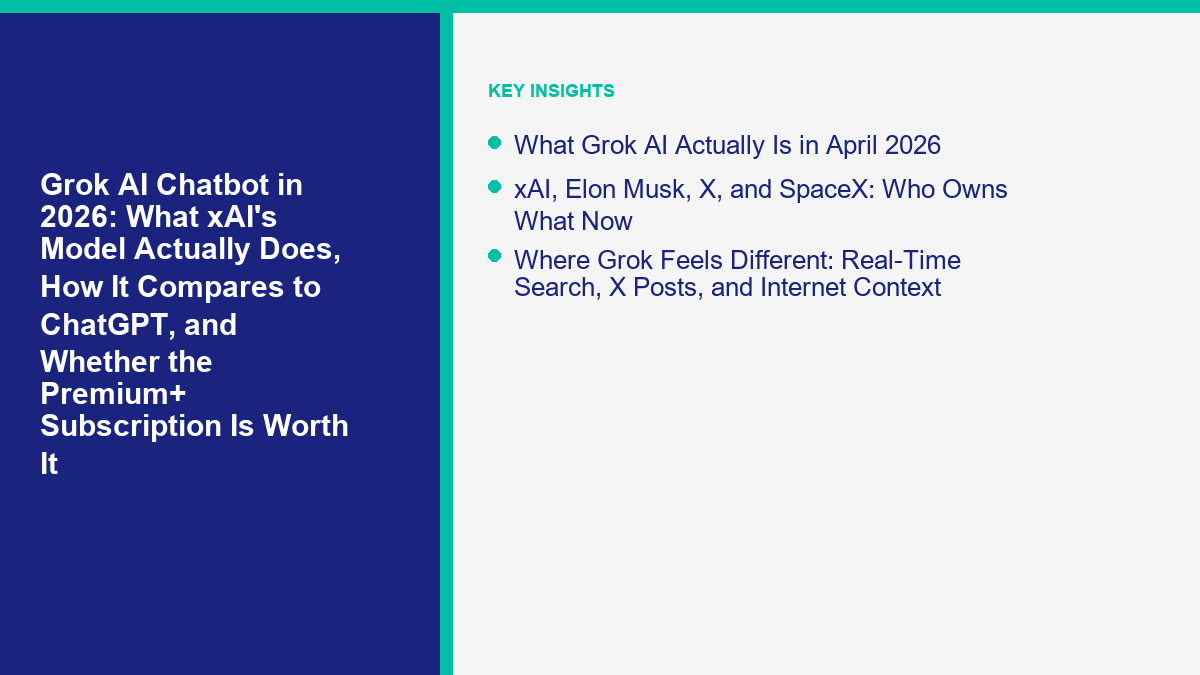
Grok AI 在 2026 年 4 月實際上是什麼
誤解的最快方式 xAI Grok 是將其視為一個固定的單一模型。事實並非如此。Grok 是一系列模型加上一個消費者體驗層。xAI 的文檔將 Grok 描述為一系列大型語言模型,這些模型驅動 Grok.com, iOS 和 Android 應用程序,以及 Grok in X 體驗。相同的文檔還做出了一個重要的產品區分:Grok.com 是更完整的網絡 AI 助手,而 Grok in X 的功能較少 並且與平台體驗的關聯更緊密。.[8]
在消費者方面,xAI 最新的公開產品公告表示 Grok 4.1 可供所有 Grok.com、X、iOS 和 Android 用戶使用,並且可以在模型選擇器中明確選擇。在開發者方面,xAI 當前的模型文檔表示 Grok 4.20 Beta 是最新的旗艦 API 模型,具有代理工具調用、推理、結構化輸出和 2M 令牌的上下文窗口。.[3][2]
所以當有人問是否 grok ai 在 2026 年是否好用,誠實的回答是: 你在使用哪個 Grok? 如果你只是在線上聊天,你正在購買一個社交平台的 AI 助手,能更好地訪問當前的對話流。如果你使用的是 Grok.com,你會得到一個更完整的助手,能處理文本、語音、文件、代碼指導,以及圖像或視頻生成。如果你使用的是 API,你則完全處於不同的類別,具有工具使用、代碼執行、文件檢索和模型級定價。.[1][14]
這種差異也是為什麼通用的 “Grok vs ChatGPT” 評估未能切中要點。一個評估 $40 X Premium+ 訂閱的用戶,並不是在做同樣的決定,作為一個開發者在定價 API 調用或一個團隊在考慮企業工作空間。.
xAI、Elon Musk、X 和 SpaceX:現在誰擁有什麼
這個 elon musk ai 的角度引起了注意,因為它是 Grok 吸引力的一部分,也是混淆的一部分。Grok 是由 xAI, 不是由 X 本身,而是因為消費者體驗的很大一部分存在於 X 內部。xAI 的公開隱私政策表示 xAI 是一間與 X Corp. 分開的公司。. 並且還明確說明了一個關鍵的隱私細節:如果你通過 X 使用 Grok,你的使用將受 X 隱私政策和 X 條款的約束, 而不是 xAI 的 Grok.com 和 Grok 應用程式的消費者隱私政策。.[7]
這裡還有另一個 2026 年的變數。xAI 的新聞頁面表示在 2026 年 2 月 2 日, SpaceX 收購了 xAI.[15] 這並不意味著你日常的 Grok 工作流程突然變得像 SpaceX 的軟體。這對於人們如何看待公司結構、品牌方向以及圍繞馬斯克控制的產品的長期整合策略是重要的。.
實際上,思考這個堆疊的最簡單方法是:
- xAI 建立模型並運行 Grok.com、應用程式和 API。.
- X 在社交平台內分發 Grok 體驗並對 X Premium 等級收費。.
- SpaceX 根據 xAI 於 2026 年 2 月的通知,現在在企業層面擁有 xAI。.
這就是為什麼計費和隱私會感覺混亂。xAI 的 Grok 常見問題解答說,如果您訂閱了 SuperGrok, ,您可以通過 Grok.com > 設定 > 計費. 來管理它。如果您訂閱了 X Premium, X handles the subscription and refund path.[9] Same assistant family, different operational owner depending on where you buy in.
Where Grok Feels Different: Real-Time Search, X Posts, and Internet Context
This is still Grok’s most distinctive advantage. xAI markets Grok as having the strongest real-time search story in the category, and the official product page says Grok has “the most real-time search capabilities of any AI model.” xAI’s general FAQ backs up the mechanism behind that claim more clearly: live data comes through 網頁搜索 並 X Search 工具。[1][13]
That last detail matters because it explains what Grok’s “real-time” edge actually is. xAI’s model docs say Grok has no access to real-time events without search tools enabled, and that the knowledge cutoff for Grok 3 and Grok 4 is November 2024.[2] In plain English, Grok is not magical. Its freshness comes from integrated retrieval, not from a permanently live underlying model memory.
In practice, that still makes Grok more useful than most rivals for a specific class of tasks:
- breaking news summaries where the reaction on X matters as much as the article itself
- product-launch sentiment checks and competitor-watch prompts
- sports, politics, crypto, or creator-economy questions where people care about the current discourse
- quick verification of what is trending, which links are circulating, and how users are framing a topic
If you ask Grok something like “what is everyone saying about OpenAI’s latest model change?” or “what is the reaction to a new Tesla announcement?”, Grok’s X-native retrieval gives it a very different texture from ChatGPT, Claude, or Gemini. It often feels less like a polished assistant and more like an assistant that has one monitor open to the live internet.
The tradeoff is obvious too. Current discourse is not the same thing as truth. X can surface speed, tone, memes, and raw sentiment faster than most platforms, but it can also amplify noise, outrage, speculation, and coordinated nonsense faster than most platforms. Grok’s strength is not that it eliminates that mess. Its strength is that it lets you inspect that mess faster because search is built directly into the workflow.[13]
What the Grok Chatbot Can Do on Grok.com, Mobile, and Inside X
The official Grok product page is more useful than a lot of third-party reviews because it shows the capability stack plainly. Grok can chat by text or voice, create rich documents, understand documents, write code, and generate images and video.[1] That means the current product is not just “an X chatbot.” It is trying to behave like a general assistant.
Here is the practical breakdown by surface:
Grok.com
This is the fullest consumer version. It is where Grok behaves most like a modern AI assistant instead of a social add-on. The web experience is where xAI pushes document work, richer chats, image and video generation, and the cleaner separation from the X feed itself.[8]
iPhone and Android
The apps matter if voice and camera-style usage are important to you. xAI’s Grok page explicitly positions mobile Grok as a voice-capable assistant, and the 4.1 rollout note says the current generation is available across the apps too.[1][3]
Grok in X
This is the fastest way to use Grok in a live social context, and it is still the best reason to care about Grok if you already live on X. It is also the least complete version. xAI’s own docs say Grok in X 的功能較少 than Grok.com or the mobile apps.[8]
xAI API
This is not what most people mean when they say grok ai chatbot, but it matters because it shows where xAI is strongest technically. The API now supports tool calling, web search, X search, code execution, collections search, and MCP tools. That is great for developers. It is not the same thing as buying X Premium+ for personal use.[14]
If your goal is simply “I want an AI assistant that feels alive and current,” Grok.com plus X is a compelling package. If your goal is “I want the cleanest all-purpose workspace,” Grok still feels less mature than the best parts of ChatGPT, Claude, or Google’s broader Gemini ecosystem.
Premium, Premium+, SuperGrok, and SuperGrok Heavy: The Pricing Map You Actually Need
This is where most Grok reviews get fuzzy. There is not one upgrade path. There are two main consumer purchase paths and one of them branches again.
| 訪問路徑 | Who bills you | Current public entry price | What you actually gain | 主要警告 |
|---|---|---|---|---|
| X Premium | X | $8/month or $84/year on web in the United States | Blue check, reduced ads, creator monetization eligibility, and increased Grok usage limits on X | Still an X subscription first, not a pure AI product |
| X Premium+ | X | $40/month or $395/year on web in the United States | Higher Grok limits, no ads across most of X, Radar Search, Articles, and all Premium features | Expensive if you mainly want AI and do not care about the rest of X |
| SuperGrok | xAI | Public xAI docs confirm the plan exists, but the docs pages reviewed did not publish a fixed public price table | Direct Grok.com subscription path with xAI-managed billing | Harder to compare cleanly from public docs alone |
| SuperGrok Heavy | xAI | Public xAI docs confirm the tier exists, but no fixed public price table was surfaced in the docs pages reviewed | Access to Grok Heavy or Grok 4 Heavy plus much higher rate limits | This is aimed at heavier users, not casual buyers |
The price point most U.S. readers should anchor on is X Premium+ at $40/month on web. X’s official Premium page lists the current U.S. web pricing at $3/month for Basic, $8/month for Premium, 和 $40/month for Premium+, with annual options at $32, $84, and $395 respectively.[4] The same page also shows why people mention a wider Premium+ range online: regional pricing varies a lot. X’s current official table shows £31/month in the UK, €38/month in several euro-zone countries, 56 CAD/month in Canada, and even higher equivalents in Australia and New Zealand.[4]
That means the “Premium+ costs around $22 to $50” shorthand you still see in older posts is not precise enough anymore. For a U.S. buyer on web, the current public answer is $40/month. For buyers in other regions, the bill can land materially higher or lower, and in-app pricing can differ again.
If you are weighing this against an actual chatbot platform budget, this is the point where categories matter. Grok is a consumer assistant subscription. If you need a cross-channel bot for Messenger, Instagram, or a site widget, you are solving a different problem entirely, and the right benchmark is product deployment cost, not personal AI-seat cost. That is where it makes more sense to 查看 MessengerBot 價格 than to keep comparing Grok against personal chat apps.
Is X Premium+ Worth It for Grok Alone
Usually, no. For most people, X Premium+ is only worth the money if you value both the Grok upgrade 並 the X-side benefits. At $40/month in the U.S. on web, Premium+ is not competing with free AI tabs. It is competing with ChatGPT Plus at $20/month, Claude Pro at $20/month, 和 Google AI Pro at $19.99/month in the U.S.[10][11][12]
That is a hard comparison for Grok if all you want is a general-purpose AI assistant. ChatGPT, Claude, and Gemini all give you broader productivity value per dollar. Grok becomes easier to justify when the X layer is part of the value calculation, especially if you care about ad removal, priority product access, and X-native monitoring.
Here is the practical checklist I would use before paying for Premium+:
- You already spend real time on X every day. If you barely open the platform, Premium+ is a bad AI buy.
- Your questions are time-sensitive. Grok is much more impressive on fast-moving topics than on evergreen work.
- You want current discourse, not just polished answers. If you care about live reaction, Grok makes more sense.
- You value no-ads, Radar Search, and X features anyway. If those are worthless to you, half the Premium+ case disappears.
- You do not need the best coding or business workflow. Grok is competent here, but that is not its cleanest win.
If you answer yes to four or five of those, Premium+ is defensible. If you answer yes to only one or two, you are probably paying extra for an ecosystem you do not really use.
My own buying rule is blunt: pay for Premium+ when you want a better X experience that includes stronger Grok access. Do not pay for Premium+ if your goal is merely “the best AI subscription for work.” That job belongs to other products more often than not.
Aurora, Grok Imagine, and Whether the Image Tools Are Actually Good
Grok’s image story is more serious than a lot of people realize. xAI announced Aurora 在 December 9, 2024 as a new autoregressive image generation model available on X, saying it was strong at photorealistic rendering, real-world entities, text, logos, and image editing from user-provided images.[5] Since then, xAI has widened the product story. The current Grok product page says the assistant can create images and video, and xAI’s January 2026 release notes say video generation and a revamped image generation system are available on the API too.[1][6]
What this means in practice is that Grok image generation is no longer a novelty feature bolted onto a chat app. It is one of the reasons people stay in the ecosystem, especially for:
- meme-ready visuals that feel native to internet culture
- quick concept images tied to current topics or public figures
- prompt-driven experiments where you want looser guardrails than some rivals allow
- iterative social content workflows inside the same platform where the content may be posted
The official Aurora launch post also shows xAI leaning into something a lot of mainstream image tools still struggle with: rendering recognizable entities, text, logos, and realistic portraits.[5] That internet-native flexibility is one reason Grok feels different from more tightly constrained consumer image tools.
The weakness is control. If you need brand-safe campaign assets, consistent product mockups, layered design approval, or the strongest enterprise media workflow, Grok image generation still feels more like a fast creative engine than a structured design system. It is fun, capable, and increasingly good. It is not my first pick for high-governance visual production.
For most regular users, the right summary is this: Grok is much better at image generation than people who only know the old X chatbot version assume. If you already like the rest of the ecosystem, Aurora and the newer Grok Imagine stack are real reasons to stay.
How Good Grok Is for Coding and Research Work in 2026
Grok can write code. That part is real. The official Grok page literally includes a “Supercharge your code” section and positions Grok as a tool that can give you code guidance, solutions, and best practices.[1] But there is an important nuance in xAI’s own wording there: the consumer product example emphasizes code help without executing or debugging. That is not the same thing as a mature coding agent workflow.
For lightweight coding tasks, Grok is useful. It is good at:
- explaining snippets and error messages
- generating small functions, shell commands, and regexes
- summarizing docs or forum chatter around a fast-moving package change
- combining internet search with code guidance when library behavior has changed recently
Where Grok gets more interesting is on the developer side. xAI’s November 19, 2025 API announcement for Grok 4.1 Fast and Agent Tools API shows a much stronger technical stack: web search, X search, remote code execution, file retrieval, and MCP tools. The same post positions the model as strong at real-world agentic tasks and includes benchmark claims against GPT-5, Claude Sonnet 4.5, and Gemini 3 Pro on search-heavy workflows.[14]
That is great news for developers building with xAI. It does 表示收件人已打開消息線程。Messenger 不會 automatically make consumer Grok the best coding subscription. ChatGPT Plus is tied to a more mature general work stack and OpenAI’s current public product pages still emphasize projects, tasks, advanced voice, deep research, and access to reasoning models at $20/月.[16] Claude Pro includes Claude Code 在 $20/月 billed monthly or $17 equivalent with annual billing.[11] Google’s AI Pro plan now bundles higher limits in Gemini CLI 並 Gemini Code Assist IDE extensions alongside the broader Gemini suite.[12]
So the practical answer is this: Grok is a solid coding assistant, but not the cleanest coding subscription. Its biggest coding edge is that it can mix current web context and X context into the answer stream. Its biggest weakness is that the consumer experience is still less purpose-built for serious repo work than the strongest OpenAI, Anthropic, or Google developer paths.
Grok vs ChatGPT: The Comparison That Actually Matters in 2026
A lot of search traffic still says grok vs gpt-4, but you should be careful with that framing. OpenAI’s current help documentation says that GPT-4o and GPT-4.1 were retired from ChatGPT on February 13, 2026, with the remaining GPT-4o access in certain Business, Enterprise, and Edu custom GPT scenarios ending by 2026 年 4 月 3 日.[10] So if you are making a live buying decision in April 2026, you are not really choosing between “Grok and GPT-4” in the old 2024 sense. You are choosing between Grok and the current ChatGPT product stack.
| Question | Grok | ChatGPT |
|---|---|---|
| Cheaper paid entry point | X Premium starts at $8, but the real Grok-heavy plan is Premium+ at $40 on web in the U.S. | Plus is $20/month |
| Best current-events feel | Usually better, especially if X discussion matters | Strong web search, but less X-native |
| Best productivity workspace | Good, but less mature as an all-day work hub | Usually better for general work, projects, tasks, and broader feature depth |
| Best coding subscription for most people | Useful, especially with live search context, but not the cleanest default | Usually better, especially if you want the broader OpenAI ecosystem and coding-adjacent features |
| Most internet-native personality | 是的 | More polished and mainstream |
Choose Grok over ChatGPT if you spend real time on X, care about live reaction and current discourse, and want an assistant that feels closer to the moving internet than to a structured productivity suite.
Choose ChatGPT over Grok if you want the cleaner default assistant for writing, coding, file work, deep research, and general productivity at a lower subscription price. If you want the wider market view after this section, the better companion piece is our 更深入的 ChatGPT 替代品比較.
The simplest buying summary is this: Grok beats ChatGPT on immediacy and X-native context. ChatGPT beats Grok on breadth-per-dollar.
Grok vs Claude and Gemini: Where xAI Wins and Where It Clearly Does Not
The broader market picture gets even clearer once you stop treating “AI assistant” as one job.
Grok vs Claude
Anthropic’s pricing page puts Claude Pro at $20/month or the equivalent of $17/month billed annually, and the plan includes Claude Code 並 Claude Cowork.[11] Claude is usually the calmer, more deliberate tool for writing, long-context interpretation, and cautious reasoning. If your work involves dense documents, architecture thinking, careful drafts, or codebase reading, Claude still has the more mature “serious work” feel.
Grok beats Claude when the question depends on current web chatter, X-native sentiment, or a more live and playful interaction style. Claude beats Grok when you need discipline, tone control, and fewer “too online” habits in the answer voice.
Grok vs Gemini
Google’s current public plan pages put Google AI Pro at $19.99/month in the U.S., with higher access to Gemini models, Deep Research, Gemini in Gmail, Docs, and Sheets, NotebookLM benefits, and higher limits in Gemini CLI and Gemini Code Assist.[12] Gemini’s advantage is ecosystem leverage. If your work already lives in Google Search, Gmail, Docs, Drive, Chrome, Android, or Google Cloud, Gemini compounds its value faster than Grok does.
Grok’s edge over Gemini is that it feels more plugged into the live public internet, especially the X layer, and often less sanitized in tone. Gemini’s edge is that it is woven into a much larger productivity environment and is easier to justify as a work subscription if you already use Google’s stack heavily.
So if you want the shortest honest summary of the market:
- Pick Grok for real-time internet context and X-heavy workflows.
- Pick ChatGPT for the strongest all-around general assistant value.
- Pick Claude for careful reasoning, writing, and codebase interpretation.
- Pick Gemini for Google ecosystem leverage and solid everyday productivity.
Privacy, Safety, and Bias Concerns Most Grok Reviews Gloss Over
Grok’s public brand is part of the product. xAI originally leaned into the idea of a more “truth-seeking” and less over-sanitized assistant, and that style still shapes how people talk about it. The problem is that a strong persona can make users over-trust the model in exactly the moments where they should slow down.
xAI’s current privacy policy, effective April 4, 2026, says users should not include personal information in prompts. It also says that if you log into xAI’s services with X, xAI may receive information such as your X public profile, username, numeric X ID, date of birth, whether you subscribe to X Premium, and your Grok on X conversation history.[7] That is a real reminder that the convenience of cross-platform sign-in comes with a data-sharing consequence.
There is also the policy split I mentioned earlier. If you use Grok on Grok.com or the Grok apps, xAI’s privacy policy applies. If you use Grok on X, X’s privacy policy and terms govern that use instead.[7] For privacy-conscious users, that alone is worth understanding before you start treating Grok as your default notebook for sensitive questions.
On the reliability side, xAI’s own docs tell you the important limitation in plain language: Grok does 表示收件人已打開消息線程。Messenger 不會 know current events unless search tools are in play, and its knowledge cutoff for the underlying Grok 3 and 4 model families is November 2024.[2] So the right mental model is not “Grok knows what is happening now.” The right mental model is “Grok can look up what is happening now.”
Bias is the harder part to score because it depends on task type. Grok often feels more willing than rivals to follow politically charged or culturally sharp prompts, which some people read as honesty and others read as volatility. I would not use that as a pure selling point. For anything that touches compliance, policy, medical decisions, law, or reputation-sensitive research, you still want citations, source checking, and a second system in the loop.
The safe rule is simple: use Grok for speed, context, and synthesis; not for blind trust.
The Best Real-World Use Cases for Grok AI Right Now
Grok is easiest to recommend when the work is close to the moving edge of the internet. These are the use cases where it consistently makes more sense than a slower, tidier, more office-shaped assistant.
Breaking-news briefings
If you want a quick read on what happened, what sources are being passed around, and how people on X are reacting, Grok is unusually well positioned. It feels close to a live analyst feed.
Social listening and trend monitoring
For creators, founders, crypto traders, journalists, marketers, and PR teams, Grok is good at the “what are people saying right now?” layer. That does not replace proper analytics. It does speed up the first pass dramatically.
Current-topic explainers
Grok works well when the question is a mix of fact pattern and online reaction. Product launches, controversies, live events, election cycles, and platform changes all fit this pattern.
Internet-native creative work
If you want meme concepts, social-post variants, edgy image prompts, and commentary that sounds less corporate, Grok is a good fit.
Quick document and file interpretation
Grok’s document and rich-document features make it better than the old “X assistant” label suggests, especially if the document analysis needs to connect to current events or current discussion.
These are all legitimate reasons to choose Grok. They just are not the same as “best AI for everything.”
When Grok Is the Wrong Tool
There are also very clear situations where I would not choose Grok first.
- Customer support operations: Grok is not a help desk, not a CRM-backed bot builder, and not a consent-aware automation platform.
- Long-horizon team productivity: ChatGPT, Claude, and Google’s stack are easier to justify for broad office use.
- Serious software delivery: Grok is helpful for coding, but the cleanest repo-centric workflows still live elsewhere.
- Sensitive internal data work: The privacy split across X and xAI should make cautious teams think twice.
- Businesses that need a deployable audience-facing bot: a consumer AI assistant is the wrong product category.
That last point matters more than people think. A lot of companies waste weeks trying to stretch a personal assistant into a business chatbot. If your actual requirement is lead capture, website chat, Messenger automation, or Instagram replies, you do not need a personal AI subscription first. You need a bot builder and workflow layer. That is where Upgrade to MessengerBot Pro makes more sense than paying for another personal AI tab and hoping it somehow becomes a customer service system.
How to Test Grok Before You Pay for Premium+
You can get a much better read on Grok in one hour than in ten hours of reading hot takes. Use the free experience first, then compare outputs side by side.
- Run one time-sensitive prompt. Ask about a breaking story, a product launch, or a fast-moving public topic. Judge source quality, not just answer confidence.
- Run one evergreen prompt. Use a concept explanation or technical topic that does not need live data. This shows whether Grok is still strong once the real-time edge disappears.
- Run one document task. Upload a file or paste a long block of text and see how well Grok extracts the signal.
- Run one coding task. Use a practical problem, not a benchmark flex. Ask for a script, bug explanation, or library comparison.
- Run the same four prompts in ChatGPT, Claude, or Gemini. The difference becomes obvious very quickly.
If Grok clearly wins on the tasks you do most often, the subscription case becomes easier. If it only wins on one novelty prompt about current chatter, that is usually not enough to justify Premium+ by itself.
One more practical check: pay attention to rate-limit anxiety. xAI’s public material is clear that paid tiers bring higher usage limits, but it is not as transparent as some rivals about the exact workflow ceiling most consumer users will hit.[4] If you are a heavy user, test whether the service feels generous enough before you lock into the more expensive tier.
If You Need a Real Chatbot Instead of a Personal AI Assistant
This is where the category line needs to be redrawn. Grok is a personal AI assistant. It can help you think, summarize, search, generate, and code. It is not the thing you deploy when you need a customer-facing system on Facebook Messenger, Instagram, or a website.
If you need a real business chatbot, your buying questions change completely:
- Can it connect to Messenger, Instagram, and website chat in one place?
- Can it route leads and support requests without manual babysitting?
- Can it trigger forms, flows, automations, and follow-ups?
- Can your team manage it without treating a consumer AI tab like backend infrastructure?
That is the gap MessengerBot is built for. If you want the broader market frame first, open our 完整的聊天機器人比較. If you already know you need Meta-channel automation or website chat, the next steps are simpler: 查看 MessengerBot 價格 to see the current plans, then 瀏覽我們的教程 if you want the setup path before you buy.
What I Would Do Instead of Overbuying Premium+
If your main use case is personal AI plus current-event analysis, Grok is worth testing and sometimes worth paying for. If your main use case is customer messaging, do not force a consumer assistant into a business role. Start with 查看 MessengerBot 價格, move to Upgrade to MessengerBot Pro when you need deeper channel coverage and automation, and 加入我們的聯盟計畫 if your plan is to recommend the platform as part of an agency or creator workflow.
常見問題
在2026年,Grok AI 是免費的嗎?
Grok has a free access path, but the meaningful paid tiers sit behind X Premium, X Premium+, and xAI’s separate SuperGrok subscriptions. The current official X pricing page lists Premium at $8 per month and Premium+ at $40 per month on web in the United States, with higher Grok limits on the upper tiers.
Grok 現在比 ChatGPT 更好嗎?
當你關心當前的網絡環境、原生情感以及更符合互聯網形狀的助手時,Grok 更好。對於大多數人來說,ChatGPT 仍然是更強大的全方位選擇,因為它在 Plus 層級的價格更低,並提供更廣泛的生產力和編碼生態系統。.
Grok 在 2026 年使用什麼模型?
On the consumer side, xAI’s latest public announcement says Grok 4.1 rolled out to Grok.com, X, and the mobile apps on November 17, 2025. On the API side, xAI’s current model docs list Grok 4.20 Beta as the newest flagship model.
僅僅為了 Grok,X Premium+ 值得嗎?
通常不會。當您已經重視 X 本身時,Premium+ 才最具意義,特別是無廣告體驗、雷達搜尋和更高的 Grok 限制。如果您只想要一個通用的 AI 助手,ChatGPT、Claude 或 Gemini 通常提供更好的性價比。.
Grok 可以取代 Messenger 或 Instagram 的商業聊天機器人嗎?
不,Grok 是一個個人 AI 助手,而不是 Messenger、Instagram 或網站聊天機器人平台。它可以幫助您撰寫和研究,但它不是用於客戶對話、自動化流程或潛在客戶路由的部署層。這項工作屬於像 MessengerBot 這樣的機器人平台。.
Sources and References
- xAI: Grok product page
- xAI Docs: Models and Pricing
- xAI: Grok 4.1 announcement
- xAI: Grok Image Generation Release (Aurora)
- xAI Docs: Release Notes
- xAI: Privacy Policy
- xAI Docs: What is Grok?
- xAI Docs: FAQ for Grok Website and Apps
- OpenAI Help Center: What is ChatGPT Plus?
- Anthropic: Claude pricing
- Google One: Plans and pricing
- xAI Docs: General FAQ on live data
- xAI: Grok 4.1 Fast and Agent Tools API
- xAI: xAI joins SpaceX
- OpenAI: ChatGPT pricing
 香港中文
香港中文  English
  Tagalog
  简体中文
简体中文  العربية
  हिन्दी
  Português do Brasil
  Español de México
  Français
  বাংলা
বাংলা  繁體中文
繁體中文  Nederlands
  Deutsch
  Bahasa Indonesia
  日本語
日本語  한국어
한국어  Polski
  Русский
  Español
  Tiếng Việt