
大多數 ChatGPT 替代品在各方面都無法超越 ChatGPT。它們在某一項工作上勝過它。.
那項工作可能是長篇寫作、帶有引用的網絡研究、編輯器內的代碼補全、更便宜的 API 訪問或自我託管。如果你把每個 AI 助手都當作同一產品,只是標誌不同,那麼排名就沒有意義了。Claude 並不是想以 Perplexity 的方式獲勝。Grok 並不是為 Pi 的同一受眾而建。Llama 更像是一個生態系統,而不僅僅是一個單一的精緻應用程序。這就是為什麼在 2026 年比較 ChatGPT 替代品的唯一有用方式是按任務進行比較。.
我查看了 2026 年 4 月 10 日的公共定價頁面、幫助文檔和計劃詳情。這很重要,因為免費限制、模型訪問和訂閱包裝現在不斷變化。如果你想要更大的平台視圖,還包括商業聊天機器人軟件,請閱讀 我們的完整聊天機器人比較 這篇文章。這篇文章專注於人們在嘗試替代 ChatGPT 本身時實際測試的工具。.
為什麼人們在 2026 年尋找 ChatGPT 替代品
人們在 2026 年離開 ChatGPT 的原因有五個,只有一個是「質量」。“
第一個原因是使用摩擦。. 許多人喜歡 ChatGPT,直到他們在實際工作中遇到限制。免費用戶會遇到上限。付費用戶在開始上傳檔案、使用高級推理、生成大量圖像或每天依賴代理風格工具時,仍然會注意到邊界。這並不意味著 ChatGPT 弱。這只是意味著最便宜的通用選擇並不總是最適合特定工作負載的工具。.
第二個原因是回答風格。. Claude 在長篇寫作和編輯工作中仍然感覺更謹慎。當你需要在螢幕上顯示引用時,Perplexity 仍然感覺更好。Grok 更快且更隨意。Pi 感覺更人性化。這些差異在你使用這些工具一週後比排行榜截圖更重要。.
第三個原因是生態系統鎖定。. 如果你整天都在 Gmail、Docs、Drive 和 Android 中工作,Gemini 明顯佔優勢。如果你生活在 Windows、Edge 和 Microsoft 365 中,Copilot 就成為最少阻力的選擇。如果你的編程生活發生在 VS Code、JetBrains 或 Cursor 中,純聊天應用程序很快就會感覺次要。.
第四個原因是價格。. DeepSeek, Qwen, Mistral, and open-weight Llama deployments changed the conversation here. The question is no longer “Which AI is smart?” It is “Which AI is smart enough for this exact task at a cost I can justify?” That is why some teams keep ChatGPT for managers and writers, then use cheaper or self-hosted models for internal tooling and support workflows.
第五個原因是控制。. 如果你想要一個精緻的主流助手,ChatGPT 是一個很好的產品。如果你需要完全自我託管、自訂推理路由、隔離部署,或是可以調整到自己堆疊的開放權重模型,那就不適合使用 ChatGPT。這就是 Llama、Mistral、Qwen 和 DeepSeek 繼續贏得關注的地方。.
實際的要點很簡單:大多數人不需要「更好的 ChatGPT」。他們需要更適合他們主要任務的工具。.
12 款最佳 ChatGPT 替代品排名,適用於實際使用
這個排名最重視三個方面:工具在第一天的實用性、限制變得煩人所需的時間,以及產品在特定工作中的明確優勢。我不會給每個平台在理論能力上相等的評價。一個需要自我託管的模型家族不如一個精緻的消費者應用方便。沒有明顯優勢的精緻消費者應用不如一個能為你節省實際時間的專業工具有用。.
在表格之前有一點需要注意:消費者 AI 的上下文窗口是混亂的。一些供應商會發布確切的限制。一些則根據計劃發布不同的限制。有些只在 API 端公開乾淨的數字,而不是在聊天應用中。當供應商發布明確的數字時,我會使用它。當他們不這樣做時,我會將該字段標記為模型依賴或未披露,而不是假裝數字已經確定。.
| 排名 | 工具 | 定價 | 上下文窗口 | 專業領域 | 免費層級 |
|---|---|---|---|---|---|
| 1 | Claude | 免費;專業版 $20/月 或 $17/月 年繳 | 200K 標準;通過 API 在 Sonnet 4 上的 1M 測試版 | 長篇寫作、謹慎推理、代碼幫助、文檔 | 是的 |
| 2 | Gemini | 免費;Google AI Pro $19.99/月 | 32K 免費應用程式,Google AI Pro 上有 1M | Google 工作區整合、檔案分析、多模態工作 | 是的 |
| 3 | Perplexity | 免費;Pro 約 $20/月;最高 $200/月 | 消費者應用程式依模型而定 | 研究、引用、當前網頁答案、報告生成 | 是的 |
| 4 | 微軟 Copilot | 免費;Copilot Pro $20/月 | 未公開披露 | Windows、Edge、Microsoft 365、語音、日常生產力 | 是的 |
| 5 | Grok | 免費;使用 X Premium 或 Premium+ 可提高限制;基於 API 使用 | 目前 xAI API 模型可達 200 萬 | 快速的網頁和 X-grounded 回答,直白的語氣,實時趨勢 | 是的,有限 |
| 6 | Mistral Le Chat | 免費;專業版 $14.99/月 | 目前旗艦模型可達 128K | 快速聊天,多語言工作,注重隱私的團隊,連接器 | 是的 |
| 7 | DeepSeek | 免費網頁/應用程式;API 每 1M 代幣約 $0.28 進和 $0.42 出 | 目前 API 模型可達 128K | 便宜的推理、編碼,對 API 使用者來說價值強大 | 是的 |
| 8 | You.com | Free; Pro $20/mo or $15/mo billed annually; Max $200/mo | Up to 16K free, 64K Pro, 200K Max | Agent-style workflows, research, multi-model access | 是的 |
| 9 | Qwen | Free in Qwen Chat; API pay-as-you-go | Up to 256K on current flagship chat models | Multimodal tasks, coding, deep research, open releases | 是的 |
| 10 | Llama | Free in Meta AI; self-host and inference costs vary | Model-dependent; long-context variants available | Open-weight ecosystem, self-hosting, customization | 是的 |
| 11 | Pi | Free; no public paid consumer plan | 未公開披露 | Supportive conversation, voice, decision support | 是的 |
| 12 | HuggingChat | Free; Hugging Face Pro $9/mo improves credits and usage elsewhere | Model-dependent | Open-source model playground, experimentation, tool testing | 是的 |
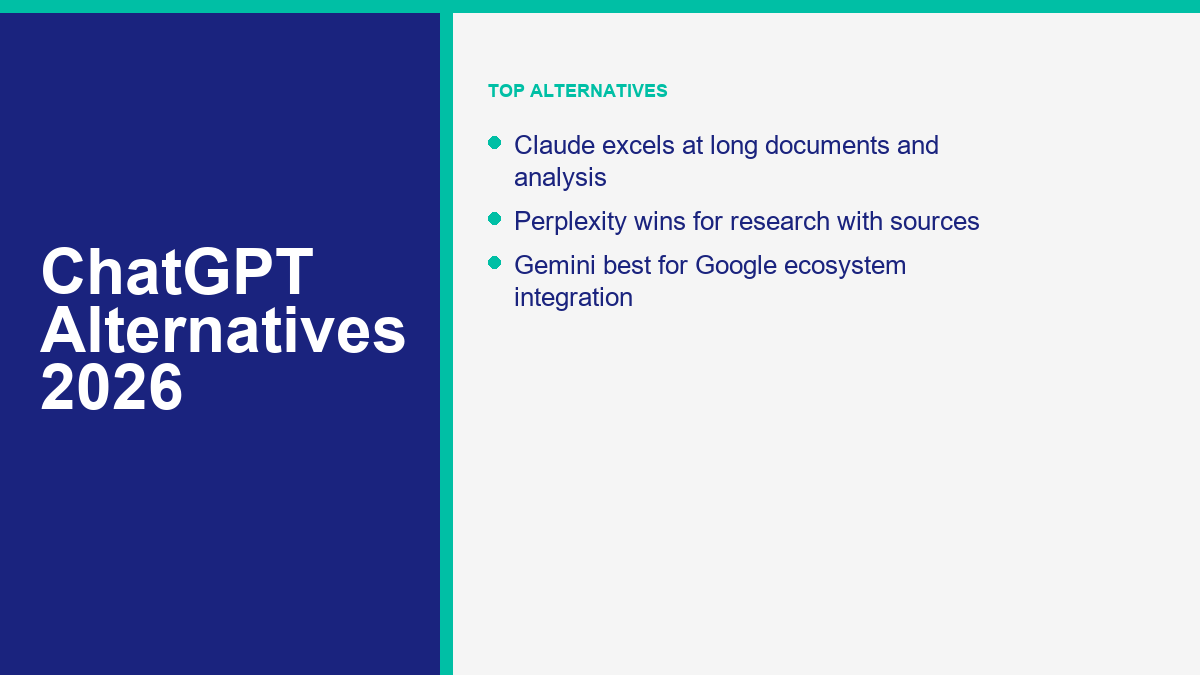
Claude Is the Closest Thing to a Straight ChatGPT Replacement
If you want one sentence, here it is: Claude is the best ChatGPT alternative for people who mostly write, read, code, and think in long documents. It still gives the cleanest long-form prose of the mainstream assistants, and it is unusually good at staying coherent when the conversation gets dense. ChatGPT still has the broader consumer tool stack, but Claude feels calmer and more deliberate. For many users, that matters more than headline features.
Gemini Is the Best Alternative if Google Already Owns Your Workflow
Gemini becomes much better the second you stop judging it as a standalone chatbot and start judging it as a Google layer. If your work lives in Gmail, Docs, Drive, Chrome, and Search, Gemini does not have to beat ChatGPT at everything to be the smarter choice. It just has to reduce friction. Right now it does that well, especially for document-heavy users who want a large published context window and a predictable paid plan.
Perplexity Still Wins the Research Battle Because It Shows Its Work
Perplexity is not the most poetic writer on this list. It is one of the most useful. If your job is comparing products, checking claims, scanning sources, or building quick research briefs, the product still saves more time than most competitors because citations are part of the interface, not an afterthought. ChatGPT is better at all-purpose conversation. Perplexity is better at turning the open web into something you can verify quickly.
Microsoft Copilot Is the Safest Pick for Windows and Microsoft 365 Users
Copilot is the definition of low-friction AI. It is not the flashiest assistant, and Microsoft still does a poor job of making the branding feel simple, but the product earns its place because it is everywhere Microsoft users already work. If you are already in Edge, Windows, Outlook, Word, and Excel, Copilot often feels less like a separate tool and more like a built-in feature you should already be using.
Grok Is Better Than ChatGPT at Fast, Current, Opinionated Answers
Grok is not the best mainstream assistant for careful writing. It is one of the best for current, web-connected, less sanitized answers. That is why some users love it and some immediately bounce. It feels closer to a live internet-native assistant than a polished office assistant. If you care about trending news, X-native context, and a less filtered style, Grok has a real edge. If you care about polish and stability, Claude or ChatGPT will feel safer.
Mistral Le Chat Is the Best Underappreciated General Alternative
Mistral is easy to underrate because it gets less mainstream coverage than ChatGPT, Claude, or Gemini. That is a mistake. Le Chat is fast, the paid tier is fairly priced, and the product keeps getting stronger for multilingual work, connectors, project-based organization, and lighter business use. I would not call it the best overall replacement for ChatGPT, but I would absolutely call it one of the best value alternatives if you want something capable without paying flagship-brand premiums.
DeepSeek Is the Value Monster
DeepSeek belongs high on this list because cost still matters. The web app is free, the API is dramatically cheaper than most top-tier rivals, and the model family remains strong for code and reasoning relative to price. The tradeoff is polish. DeepSeek still feels rougher than ChatGPT, Claude, or Gemini in consumer experience. If you judge it as a cheap workhorse, it looks excellent. If you judge it as a premium mainstream assistant, it looks less convincing.
You.com Makes Sense for People Who Want Research Plus Agents in One Place
You.com has spent years sitting just outside the mainstream conversation, but the current product is more serious than many people realize. Its free tier is limited but real, the paid plans are clearly segmented, and the platform does a respectable job combining live web answers, custom agents, file support, and multi-model access. It still lacks the cultural pull of ChatGPT or Claude, but for users who want an agent-style workspace without jumping straight to enterprise tooling, it is worth testing.
Qwen Is the Dark Horse for Power Users
Qwen is the tool I see more technical users taking seriously every quarter. The consumer chat experience is free, the model family is broad, the latest releases keep getting better at coding and multimodal work, and the open-model story is strong. The reason it ranks below the top tier for a US and UK audience is simple: distribution and polish still lag behind ChatGPT, Claude, Gemini, and Copilot. The capability gap is smaller than the awareness gap.
Llama Is an Ecosystem, Not a Simple App Choice
Llama is hard to rank because most people say “Llama” when they really mean one of three things: Meta AI in consumer apps, an open-weight model they want to run locally, or a model family they access through a third-party provider. That ambiguity is exactly why it ranks tenth instead of higher. Llama is hugely important and still one of the best self-host foundations. It is just not the cleanest one-click ChatGPT replacement for normal users.
Pi Is Better Than ChatGPT if You Want Conversation, Not Workflow
Pi still feels more emotionally intelligent than most competitors. That is its lane. If you want a reflective, voice-friendly, low-pressure assistant to talk through choices, routines, stress, or ideas, Pi is excellent. If you want file-heavy work, deep research, coding, or agentic productivity, it is the wrong tool. Pi is not trying to replace ChatGPT for everything, and judging it that way misses the point of why people still use it.
HuggingChat Is the Best Free Open-Model Sandbox, Not the Best Polished Assistant
HuggingChat remains useful because it lets you try open models quickly without building your own stack first. That makes it great for experimentation, comparison, and curiosity. It also makes it inconsistent. The model quality changes with routing, availability, and whatever open models are strongest at the moment. If you want stable daily output, you will probably outgrow it. If you want a low-cost way to test the open-model world, it is still one of the easiest places to start.
Best Free ChatGPT Alternatives That Are Still Worth Using
Free is where people get misled most often. A lot of “free” AI tools are really feature demos with tiny limits or a useful core experience wrapped in premium upsells. If you only care about zero cost, start with our free AI chatbot comparison after this article. For the tools in this list, these are the free tiers I would actually recommend by use case.
- Best free overall replacement: Claude. It feels the closest to a serious everyday assistant without paying on day one.
- Best free for Google users: Gemini. The free plan is more useful than many people expect, especially for documents and general productivity.
- Best free for research: Perplexity. Limited, yes, but still the fastest route to sourced answers.
- Best free for Windows users: Microsoft Copilot. It is the easiest no-drama option if your workflow is already Microsoft-heavy.
- Best free for cheaper technical work: DeepSeek. Great value if you can tolerate a less polished consumer experience.
- Best free for open models: HuggingChat if you want a hosted playground, Qwen or Llama if you are willing to go deeper.
The tool I would not recommend choosing on free-tier hype alone is Grok. The free version can be useful, but the product makes more sense once you are already using X heavily or you want xAI’s paid ecosystem. The same goes for You.com: promising free tier, real limits, better fit once you understand the agent angle.
The Best ChatGPT Alternative for Coding Depends on Where You Actually Code
For coding, people often compare the wrong products. A browser chatbot and an AI-first IDE are not interchangeable. If your coding workflow mostly happens in a chat tab, Claude is the best alternative to ChatGPT. If your workflow lives inside the editor all day, GitHub Copilot or Cursor will usually matter more than switching consumer chatbots.
| 工具 | 價格 | 最佳用途 | Where it falls short |
|---|---|---|---|
| Claude | Free; Pro $20/mo | Architecture thinking, debugging explanations, long code reviews, refactor planning | Not as tight as an IDE-native coding workflow |
| GitHub Copilot | Free with limits; Pro $10/mo | Inline completions, repo-aware chat, low-friction coding assistance in mainstream IDEs | Less strong than Claude for long reasoning and editorial explanation |
| Cursor | Hobby free; Pro $20/mo | Agentic edits, codebase-wide changes, all-day AI IDE workflow | Overkill if you only ask occasional coding questions |
My rule is straightforward. Use Claude when you want a model to explain, review, or reason through code with you. Use GitHub Copilot when your top priority is staying inside VS Code, JetBrains, Xcode, or GitHub and moving faster line by line. Use Cursor when you want AI to act more like a coding teammate than autocomplete.
If you already like ChatGPT for coding, the case for switching is still specific. Claude often writes cleaner explanations and handles giant pasted context better. Copilot often wins on flow. Cursor wins on editor-native agent behavior. ChatGPT still wins if you want a broad toolset around coding, not just coding itself.
Perplexity and You.com Are the Strongest ChatGPT Alternatives for Research
Research is where “better than ChatGPT” becomes a real claim, not marketing noise. ChatGPT can research, especially with search enabled, but it still does not feel as research-native as Perplexity.
Perplexity is the better pure research assistant because the product is built around citations, follow-up discovery, and fast scanning. It is the tool I would hand to someone doing product comparisons, competitor checks, travel planning, market scans, or quick fact validation. It is less elegant than Claude, but much better at showing where the answer came from.
You.com is the more agent-style pick. It is better if your idea of research is not just “answer this question” but “help me combine search, files, custom agents, and model choice in one workspace.” The free tier is much narrower than the paid product, but the Pro plan makes more sense once you want repeated research workflows rather than one-off searches.
If your research depends on the open web, choose Perplexity first. If it depends on building repeatable agent workflows around that research, test You.com next. If it depends on reasoning over long internal documents more than live search, Claude or Gemini may still be better.
Claude and Mistral Are Better Picks for Creative Writing Than Most Alternatives
Creative writing is not just about generating text. It is about control over voice, pacing, tone, and revision quality. That is why Claude still leads this category for many writers. It tends to overdo the polish less than some rivals, and it handles revision instructions unusually well. If you want a draft rewritten in a calmer, sharper, less generic voice, Claude is still the easiest recommendation.
Mistral earns second place here because it writes faster and cleaner than many people expect, especially when the task is concise marketing copy, multilingual content, short-form ideation, and style variation. It is not as consistently strong as Claude for long, nuanced editorial work, but it is better than its market visibility suggests.
ChatGPT is still strong for brainstorming volume. It is often excellent at generating angles, outlines, hooks, and variant ideas quickly. Where alternatives beat it is in the feel of the prose. Claude is still the model I trust most when the sentence-level voice matters. Mistral is the one I would test if I wanted a lower-cost creative second opinion instead of another ChatGPT subscription.
Open Source ChatGPT Alternatives You Can Actually Self-Host
If self-hosting is the reason you are searching for a ChatGPT alternative, the conversation changes immediately. You are no longer choosing the most polished consumer app. You are choosing the best open or open-weight model family for your hardware, latency tolerance, privacy needs, and deployment skill level.
Llama is still the default ecosystem answer. It is widely supported, easy to find through local runners and cloud providers, and it has the healthiest third-party tooling footprint. If you want broad compatibility, Llama remains the safe starting point.
Qwen is one of the most interesting self-host choices right now because the model family has become strong across coding, multimodal tasks, and agent-style workflows. For technical users, Qwen is no longer a niche backup plan. It is a serious first-choice candidate.
Mistral stays attractive for teams that want European vendor alignment, faster inference on smaller setups, and a cleaner privacy-and-control story than most consumer chat products. DeepSeek is the value pick if you want strong reasoning and coding capability without paying frontier-model prices. The catch is the same as always: running open models well is easier than it used to be, but it is still not as effortless as opening ChatGPT in a tab.
If you do not want to self-host but also do not want to create accounts everywhere, this is a different problem. In that case, start with free AI chat with no sign-up instead of forcing a self-hosting workflow onto a problem that really just needs quick access.
When ChatGPT Is Still Better and When the Alternatives Win
ChatGPT is still the best all-around consumer AI product for most people. That remains true in 2026. It has the cleanest mainstream ecosystem, strong multimodal features, broad familiarity, and the least confusing path from casual use to power use. If you do a little writing, a little research, a little coding, and a little brainstorming, ChatGPT is still the easiest default answer.
Alternatives win when your main task stops being “a little bit of everything.”
- Claude wins when you care most about writing quality, thoughtful long-form reasoning, and code explanation.
- Gemini wins when your life is already built around Google apps and long document context matters.
- Perplexity wins when citations and current web research matter more than prose polish.
- Copilot wins when you want AI embedded into Microsoft and Windows instead of living in another tab.
- Grok wins when speed, current awareness, and a less filtered style matter more than polish.
- Cursor and GitHub Copilot win when coding happens inside the IDE, not in browser chat.
- Llama, Qwen, Mistral, and DeepSeek win when privacy, self-hosting, customization, or cost control matter most.
Before you pay for any of them, run this five-minute shortlist:
- Pick one main task. Writing, research, coding, business automation, or self-hosting. Do not choose based on vibes.
- Decide whether web citations matter. If yes, Perplexity jumps up your list immediately.
- Decide whether your real workflow lives in an ecosystem. Google users should test Gemini. Microsoft users should test Copilot. Developers should test Copilot or Cursor.
- Check whether privacy or local control is the actual requirement. If yes, skip the consumer beauty contest and start with Llama, Qwen, Mistral, or DeepSeek.
- Test one repeated real task on the free plan. The fastest way to pick the right tool is to run the same prompt, file, or workflow through three assistants and keep the one that saves the most time.
If Your Real Goal Is Automation, Not Just AI Chat
A lot of businesses searching for a ChatGPT alternative are not really looking for another all-purpose assistant. They are looking for a way to answer customer questions, route leads, and automate conversations on Facebook Messenger without adding more manual work. That is a different category. If that sounds closer to your actual use case, 查看 MessengerBot 價格 and compare it against what you are currently trying to force a consumer AI assistant to do.
常見問題
2026年最好的ChatGPT免費替代品是什麼?
For most people, Claude is the best free alternative to ChatGPT in 2026 because it gives you a serious writing and reasoning assistant without immediately feeling like a demo. Gemini is the strongest free pick if you live in Google’s ecosystem, and Perplexity is the best free option for source-backed research.
Claude 比 ChatGPT 更好嗎?
Claude is better than ChatGPT for some jobs, especially long-form writing, editing, and careful reasoning over dense material. ChatGPT is still better as an all-purpose consumer product with a broader tool stack and a more mature mainstream ecosystem. The honest answer is that Claude is better for depth and tone, while ChatGPT is better for overall breadth.
Which AI is better for coding — ChatGPT or Claude?
Claude is often better for code explanation, architecture thinking, and long debugging sessions. ChatGPT is still strong if you want a broader mix of coding help plus general-purpose tools. If your coding happens mainly inside an editor, GitHub Copilot or Cursor will usually improve your workflow more than switching between ChatGPT and Claude alone.
我可以在沒有帳戶的情況下使用 ChatGPT 替代品嗎?
Sometimes, but not reliably across the strongest mainstream options. The best no-account experiences change often and usually come with lighter limits, fewer saved features, or weaker models. If account-free access is your main priority, look for tools specifically built around that experience instead of assuming every major chatbot supports it well.
開源的 ChatGPT 替代品好嗎?
Yes, especially if you care about self-hosting, privacy, customization, or API cost. Llama, Qwen, Mistral, and DeepSeek all have real strengths. The tradeoff is convenience. Open and open-weight alternatives are getting better fast, but the smoothest consumer experience still usually comes from polished hosted products like ChatGPT, Claude, or Gemini.



 香港中文
香港中文  English
  Tagalog
  简体中文
简体中文  العربية
  हिन्दी
  Português do Brasil
  Español de México
  Français
  বাংলা
বাংলা  繁體中文
繁體中文  Nederlands
  Deutsch
  Bahasa Indonesia
  日本語
日本語  한국어
한국어  Polski
  Русский
  Español
  Tiếng Việt