
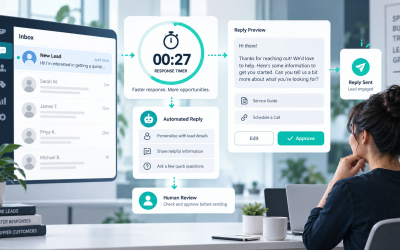
Instagram 曾經是一個以評論為主的渠道,私訊則是附帶的。在 2026 年,收件箱才是真正的購買意圖所在。人們在私訊中詢問鏈接,對故事做出反應,在自己的故事中提到你的品牌,詢問運送問題,要求預約,並在你的團隊睡覺時嘗試購買。一旦這個量開始上升,手動回覆就不再是「客戶服務任務」,而是變成了一個速度問題。.
這裡是大多數指南跳過的部分:Instagram 聊天機器人不僅僅是自動回覆器。它是一個意圖的路由層。它捕捉簡單的問題,開始正確的銷售路徑,將奇怪的問題交給人類處理,並保持你的回應時間不會在短片、贈品或廣告起飛的瞬間崩潰。.
我在 2026 年 4 月 9 日檢查了與公共產品頁面相比的定價和計劃細節,因為這個類別不斷變化。免費層級會受到限制,AI 附加功能會重新包裝,而上個季度看起來便宜的工具,一旦聯絡人或對話數量增加,可能會迅速變得昂貴。如果你仍在 Instagram 工具和更廣泛的商業聊天平台之間做決定,請閱讀 我們的完整聊天機器人比較 這篇文章。這份指南專注於一個任務:將 Instagram 私訊轉變為可重複的潛在客戶和銷售系統。.
為什麼 Instagram 聊天機器人對於 2026 年的商業比以往任何時候都重要
Instagram messaging volume is not growing because brands suddenly got better at community management. It is growing because customers now expect the fastest path to be private. They do not want to hunt through a bio link, then a menu, then a contact page, then wait for an email reply tomorrow morning. They want to tap a Story, type one line, and get what they need.
That is a problem if your team is still handling Instagram like a handcrafted concierge channel. One person can keep up with 20 or 30 straightforward DMs a day. Past that point, the cracks show fast. Links get sent late. Repeat questions pile up. Prospects who were ready to buy cool off. You start answering high-intent messages with the same tired copy-and-paste replies, which is exactly the kind of work automation should remove.
Manual DM Handling Breaks the Moment a Campaign Actually Works
A lot of brands say they want “more engagement,” but they are not operationally ready for what that means. If a Story poll, a Reel CTA, a giveaway, or a click-to-DM ad lands well, the inbox fills with the same three patterns:
- Product intent: “How much is it?” “Can you send the link?” “Do you ship to the UK?”
- Qualification intent: “Do you work with salons?” “Can I book for Friday?” “Is this for beginners?”
- Support intent: “Where is my order?” “Do you have sizes left?” “Can I change my booking?”
這些對話並不困難。它們是重複的對話。而重複的對話正是聊天機器人發揮作用的地方。機器人不需要聰明。它需要立即回覆,提出下一個有用的問題,並收集足夠的上下文,以便人類在必要時介入。.
對於一個小帳戶來說,計算一下時間。如果你每個月處理400條來自Instagram的消息,每條消息平均需要3分鐘來閱讀、回答、搜尋正確的鏈接和標記潛在客戶,那就是1,200分鐘的工作。在任何人進行真正的跟進、內容創建或客戶成功之前,你已經花了20小時。這就是為什麼當私信成為真正的收入渠道時,Instagram自動化從「有點好」變成「顯而易見」。.
故事提及自動化是你可以使用的最高意圖觸發器之一
當有人在他們的故事中提及你的帳戶時,他們已經舉起了手。他們不是從無處而來的冷門潛在客戶。他們正在積極談論你的產品、服務、活動、創作者品牌或你的優惠。這就是為什麼故事提及自動化在實際活動中經常超越一般的「私信我們」提示。對話是從自願的注意開始,而不是冷淡的請求。.
Meta 自家的 Instagram 訊息文件使這個觸發器特別有用且特別具時效性。故事提及是短暫的,內容在 24 小時後消失,而私密帳號的提及只有在對方關注你時才會流通。這意味著快速的自動確認很重要。如果你等到下一個工作日,勢頭就已經消失了。.
在實際操作中,故事提及回覆之所以有效,是因為它感覺很自然。“謝謝你標記我們,想要產品連結嗎?” 與品牌隨便發送的促銷 DM 是截然不同的體驗。一種感覺像是後續行動,另一種則像是垃圾郵件。.
在購買之前值得比較的 6 個 Instagram 聊天機器人平台
目前沒有真正的「無需註冊」的 Instagram 聊天機器人可供商業使用。如果某個工具聲稱可以,則它只是在向你展示演示,而不是生產設置。真正的 Instagram 自動化需要一個 Instagram 專業帳號、Meta 權限、在許多設置中連結的 Facebook 頁面,以及能夠管理觸發器、交接和報告的平台。.
在審查當前市場後的簡短版本是:如果 Instagram 是你的漏斗中心,ManyChat 仍然是市場領導者;如果 Instagram 與 Facebook Messenger 和網站聊天並行,MessengerBot.app 是最具價值的選擇;而當你有更狹窄的運營模式,例如網站支持、全渠道銷售操作或服務預訂自動化時,其他平台則有其意義。.
| 平台 | 公開起始價格 | 最佳 Instagram 功能 | 自動化深度 | 免費層級 | 最佳契合 |
|---|---|---|---|---|---|
| ManyChat | Free plan; Pro from $15/mo | Instagram DMs, comment replies, Story Reply trigger, Story Mention Reply trigger, AI steps, live chat | Deep | 是的 | Creators, coaches, ecommerce brands, and social-first teams |
| MessengerBot.app | Free trial; Premium $19.99 per 30 days | Instagram chatbot, auto comment reply, reply enhancers, visual flow builder, website chat, Messenger-first automation | Deep for Meta channels | Trial | SMBs that want Instagram plus Facebook Messenger in one system |
| Chatfuel | 7-day free trial; $69/mo | Instagram auto-replies to messages and mentions, Story replies, booking flows, AI assistant, CRM | Medium to deep | Trial | Service businesses that want simple setup and AI-led replies |
| MobileMonkey / Customers.ai InstaChamp | Free gift tier; Platinum promo from $9.95/mo | DM autoresponders, Story mention replies, Story reactions, keyword replies, audience-growth automation | Medium | Limited free access | Promo-driven creators and brands that are comfortable with the Customers.ai transition |
| Respond.io | 7-day free trial; Starter $79/mo | Instagram inbox, workflows, broadcasts, AI agents, ads capture, team routing | Very deep | Trial | Sales and support teams running multiple channels from one inbox |
| Tidio | Free plan; Starter $24.17/mo | Instagram integration, shared inbox, Flows, Lyro AI agent, website and email support | Medium | 是的 | Website-first businesses that also need Instagram covered |
ManyChat Is Still the Safest First Recommendation for Instagram-First Brands
ManyChat stays on top because it understands how Instagram growth actually happens. You need comment-to-DM, story reply triggers, story mention automations, keyword triggers, lead capture, and a builder that non-technical marketers can ship quickly. The free plan is real, not fake, and the Pro tier starts low enough for creators and smaller businesses to test without a giant commitment. If Instagram is the primary sales surface, ManyChat is still the benchmark.
MessengerBot.app Is the Best Value If Instagram Is Part of a Bigger Meta Funnel
MessengerBot.app makes more sense than ManyChat when your funnel does not stop at Instagram. If you also care about Facebook Messenger, website chat, visual flows, form capture, sequences, Google Sheets, and SMB-friendly pricing, the platform becomes very attractive. Its public pricing is straightforward, the Instagram features are already listed on the pricing page, and the builder is easier to justify for businesses that want one operating layer across Meta channels instead of one tool for Instagram and another for everything else.
Chatfuel Feels Simpler Than It Used To, Which Is Mostly a Good Thing
Chatfuel has tightened its offer into a more direct AI assistant product. The current public plan is a single $69 per month package with a 7-day trial, and the product pitch is clear: automate replies across WhatsApp, Instagram, TikTok, and website chat with booking and CRM built in. That makes it cleaner than older Chatfuel pricing models, but it is no longer the cheap starter it once looked like.
MobileMonkey Still Exists in Practice, but the Brand Story Is Messy
This is where buyers get confused. The old MobileMonkey infrastructure and login path still show up inside Customers.ai, and the Instagram automation offer now lives under InstaChamp. If you are comparing tools in 2026, that means two things. First, the underlying social DM automation is still there. Second, the company has clearly pivoted harder toward ecommerce identity resolution. That does not make InstaChamp unusable. It just makes it a less clean buy than it used to be if you want a straightforward, long-term Instagram chatbot platform.
Respond.io Is Strong, but It Is Not Really a Creator Tool
Respond.io is excellent when you need an actual sales-and-support operation across Instagram, WhatsApp, email, and other channels. Workflows, AI agents, routing, inboxes, and broadcasts are all there. The tradeoff is obvious in the price. A $79 starting tier is reasonable for a real team, but it is overkill if all you want is a comment-triggered DM funnel for a small brand.
Tidio Works Best When Your Website Still Does Most of the Selling
Tidio is an inbox and support platform first, not an Instagram growth engine first. That matters. If your website, help desk, and AI support layer are central, Tidio is a strong option. If your main question is “How do I turn Instagram comments and story mentions into sales conversations?” it is usable, but it is not the sharpest specialist in the group.
How to Set Up an Instagram Chatbot Without Making the First Flow a Mess
The fastest way to waste a chatbot subscription is to build the automation before you define the path. A good first Instagram bot is narrow. It handles one sales path, one support path, and one human handoff path. That is enough to go live and start learning.
- Switch to a professional account and connect the right assets. Meta requires an Instagram professional account for messaging automation. In many setups you also need the account connected to a Facebook Page. If the account connection is broken, the rest of the setup does not matter.
- Pick one primary business goal. Do not start with ten automations. Choose one outcome such as sending product links, booking consultations, collecting leads, or answering pre-sale questions.
- Map the triggers before you write messages. Decide whether the conversation starts from a Story mention, Story reply, comment keyword, DM keyword, ad click, or private reply from a post comment.
- Design the opening flow in plain language. The first message should acknowledge intent, not dump a menu. For example: “Happy to help. Are you looking for pricing, the product link, or a quick question answered?”
- Add a human escape hatch immediately. Every serious bot needs a clean way to hand off. “Reply HUMAN” or “Talk to our team” is enough for version one.
- Test on your phone before going live. Desktop previews lie. Instagram automation has to feel good inside the actual app, with the actual message spacing, quick replies, and link behavior.
Connect Your Instagram Business Account the Right Way First
If your Instagram account is still personal, change that first. Meta’s help documentation is clear that professional Instagram accounts can be connected to a Facebook Page, and that connection unlocks cross-app tools, message management, and third-party app integrations. In plain English, your chatbot platform needs that plumbing to work.
At a minimum, confirm these five items before you touch the builder:
- Your Instagram account is set to Business or Creator, not Personal.
- The correct Facebook Page is connected to that Instagram account.
- You have admin or equivalent task access to the connected assets.
- Connected tools are enabled inside Instagram and Meta settings.
- The platform can see the account and pass the test connection.
If your business is also running Facebook Messenger automation, use the same planning pass to align both channels. That keeps your routing, tags, and human handoff logic consistent. For the Messenger side of that setup, read our Messenger automation guide once your Instagram flow is live.
Start With Three Triggers, Not Fifteen
Most first builds should start with just three triggers:
- Story mention reply: best for warm user-generated content and customer love.
- DM keyword trigger: best for promos, giveaways, lead magnets, and “send me the link” campaigns.
- Comment or private reply trigger: best for turning public interest into a private conversation.
That mix covers most real business cases without turning your automation map into spaghetti. Once those work, then add booking logic, product browsing, follow-up sequences, or multilingual branching.
Build the First Message Like a Concierge, Not a Sales Brochure
The first message is where weak flows give themselves away. If the bot opens with six buttons, a paragraph of brand voice, three emojis, and a sales pitch, users leave. If it opens with a tight acknowledgment and one useful next question, users continue.
Use this structure:
- Acknowledge the trigger: “Thanks for the mention” or “Got your message.”
- Offer one clear next step: “Want the link, pricing, or help choosing?”
- Reduce typing whenever possible: quick replies beat open text for common paths.
- Reserve open text for qualification: name, budget, date, location, or product question.
- Hand off when confidence drops: if the user asks something unexpected, route them.
That is also where many teams overestimate AI. AI can improve classification and answer quality, but the highest-converting Instagram flows are still usually built around strong trigger design, good copy, fast links, and clean escalation. You do not need a philosophical bot. You need a fast one.
Test the Full Loop Before You Publish the Trigger
Run your own dry tests from a second account and check all of this on mobile:
- Does the trigger fire every time it should?
- Does the first reply arrive fast enough to feel instant?
- Do links open correctly on iPhone and Android?
- Do quick replies still make sense after the user chooses one?
- Does the human handoff notify the team somewhere useful?
- Do tags, contact fields, or CRM updates actually save?
Most Instagram automation failures are boring failures. The wrong page is linked. The trigger only fires on public mentions. The keyword is too narrow. The handoff exists but nobody is notified. Fixing those details does more for revenue than adding more bot complexity.
Instagram Chatbot Use Cases That Consistently Drive Revenue
Not every chatbot use case deserves equal effort. The ones below show up again and again because they sit close to purchase intent, save real time, or both.
Story Mention Auto-Replies Turn User-Generated Content Into Warm Leads
This is one of the best low-friction plays in Instagram automation. A customer tags your brand in a Story, the bot replies with thanks, offers the product link, asks whether they want a discount code, or invites them into an affiliate or referral path. It feels timely because it is triggered by something the user already did.
This works especially well for beauty, fashion, food, travel, coaches, and local brands where customer Stories are normal. It also gives small teams a way to acknowledge every mention without someone manually checking the inbox all day.
DM Keyword Triggers Are Still the Cleanest Way to Capture Intent
If your content asks people to DM “PRICE,” “BOOK,” “CATALOG,” “GUIDE,” or “DEMO,” the bot should take over from there. The right automation sends the promised asset, asks one qualifying question, and records the result. That turns a fluffy engagement tactic into a measurable lead source.
Keyword flows are also the easiest place to A/B test. One version can offer a direct link first. Another can ask the qualifying question first. One can give the discount immediately. Another can trade the code for an email address. Instagram marketers love to talk about reach, but the real gains usually come from cleaning up this exact handoff.
Catalog Browsing Works When the Choice Set Is Small and Structured
Instagram DMs are great for lightweight commerce, not for dumping a giant store on someone. The winning pattern is a tight catalog path with category buttons, a short description, a hero image if the tool supports it well, and a clear route to checkout or human help. If you sell ten variants of the same product family, a bot can handle that well. If you sell 1,500 SKUs and expect the DM flow to replace search, it will feel clumsy.
The practical use case is not “browse everything.” It is “help me choose from a short shortlist.” That can still drive serious revenue when the product is visual and the buyer just needs a nudge.
Follower Growth Gets Easier When the Reward Lives Inside DM
Instagram bots do not magically create followers, but they do make follower growth campaigns easier to convert. A Reel can ask viewers to follow and DM a keyword for the checklist. A Story can invite people to mention your brand for the private link. A giveaway can use a comment trigger to move people from passive engagement into a real DM thread. The bot handles the delivery instantly, which is what keeps that spike in attention from turning into a pile of unread messages.
The important part is the exchange. Do not ask people to follow just because you want a vanity metric. Give them a reason to enter the DM: a guide, product list, sample menu, discount, booking link, early-access drop, or referral reward. That is how follower growth ties back to revenue instead of becoming empty reach.
Appointment Booking Is One of the Highest-ROI Instagram Automations
Service businesses get some of the cleanest wins from Instagram bots because the action is obvious. The customer wants availability, a price range, a service menu, or a consultation link. A bot can ask for the service type, preferred date, location, and contact details in under a minute, then hand the lead to a scheduler or a human.
Salons, clinics, trainers, agencies, home services, photographers, med spas, and consultants all fit this pattern. If your team is still manually answering “Do you have availability this week?” inside Instagram, you are spending human time on a machine-friendly task.
Meta’s Instagram Messaging Rules You Need to Respect Before You Scale
This is the section businesses ignore until a campaign stops delivering or an account gets restricted. Meta does allow meaningful Instagram automation, but it does not allow you to treat DMs like a free-for-all outbound spam channel.
You Are Usually Responding to User Intent, Not Starting Cold Conversations
The cleanest mental model is this: Instagram chatbot automation works best when the user started the interaction. They sent a DM, replied to a Story, mentioned you in a Story, commented on a post, reacted to an ad, or tapped into a thread. Meta’s messaging APIs and platform docs are built around that behavior. If your strategy depends on blasting cold promotional DMs to strangers, you are already on the wrong side of the product design.
That is why the best campaigns always begin with an explicit CTA such as:
- “DM us BOOK for today’s availability”
- “Mention us in your Story for the private link”
- “Comment GUIDE and we’ll send it”
- “Reply to this Story for the color chart”
The user initiates, the bot follows through. That is the safe and sustainable pattern.
The 24-Hour Window Still Shapes What You Can Do Next
Meta’s current Instagram Messaging docs still make the timing rules clear in the places that matter most. For private replies, you can send one message to a user who commented on a post, ad, reel, or live story, but only after the user replies can you continue inside the 24-hour messaging window. ManyChat’s current Instagram help docs reflect the same operational rule on story-based triggers: send within the allowed 24-hour period.
The practical takeaway is simple. Do not rely on slow follow-up. If someone triggers a Story mention flow, a Story reply, or a comment-to-DM entry point, your system should respond right away. Delay kills conversion and increases the chance you fall outside the safest messaging window.
Story Mentions Come With Special Privacy Rules
Meta’s Story Mention documentation includes a rule a lot of teams miss: you must not store or cache the story media on your own server. The content is ephemeral, the CDN URL can stop rendering once the Story expires or is deleted, and private-account mentions only flow through under specific visibility conditions.
If your team is building a custom inbox or using a platform with advanced rendering, treat Stories as temporary context, not permanent media assets. A good tool will reflect that reality and show a placeholder once the story is no longer available.
Comment-to-DM Is Powerful, but It Is Not Unlimited
Private Replies are one of the best bridges from public engagement to private conversation, but Meta does not give you unlimited follow-up freedom. The current docs say you can send only one private reply to the user who commented, and it has to be sent within 7 days for posts, ads posts, and reels. Instagram Live is stricter; the private reply has to happen while the live broadcast is still running.
That means comment automation works best as a hand-raiser, not as an excuse to stuff people into a long promotional sequence they never asked for. Use the first message to help, offer the asset, and invite the next step. If they respond, now you have a real conversation.
Legal Does Not Stop at Meta Policy
Platform rules are not the whole compliance picture. If you operate in the US or the UK, you still need to think about data collection, privacy notices, consent language, retention, and opt-out handling. If the bot collects names, emails, phone numbers, or purchase intent, your privacy policy should reflect that. If the bot delivers promotional offers, make the commercial nature clear. If someone wants out, give them a clean way out.
This is not legal advice, but it is practical advice: if your automation would feel sneaky, misleading, or overly aggressive to a reasonable customer, it is probably bad business even before a lawyer looks at it.
If Instagram is only one part of your Meta stack, keep the rules, tags, and handoff paths aligned with our Messenger automation guide so your team is not operating two different logic systems for customers who move between Instagram and Messenger.
How to Measure Instagram Chatbot ROI Without Lying to Yourself
A lot of businesses claim chatbot success because the bot sent a lot of messages. That is not ROI. Volume is only useful if it either saves labor, increases conversions, or both.
| Metric | What to measure | 為什麼這很重要 |
|---|---|---|
| First response time | Seconds from trigger to first useful reply | Instagram buyers are impatient; speed is often the win |
| Qualified conversion rate | Percentage of bot conversations that reach booking, checkout, lead capture, or handoff | This shows whether the flow is producing business outcomes, not just clicks |
| DM volume handled | Total inbound conversations resolved or partially handled by the bot | Good for capacity planning and staffing math |
| Human takeover rate | Percentage of conversations escalated to a person | Too high means the bot is weak; too low can mean the bot is trapping people |
| Cost saved | Hours removed from manual DM handling multiplied by your actual labor cost | This is where automation usually justifies itself first |
Use a Simple Monthly ROI Formula First
You do not need a finance team to evaluate the first month. Start with this:
ROI estimate = (hours saved x hourly labor cost) + revenue influenced – platform cost
範例:
- 350 Instagram conversations handled or pre-qualified by the bot
- 2.5 minutes of manual work saved per conversation
- 14.6 hours saved in the month
- $25 per hour blended labor cost
- $365 labor value saved
- $600 in attributable bookings or sales from DM flows
- $19.99 to $49.99 platform cost on a small-business tier
That is why the economics often become obvious quickly. Even a modest Instagram chatbot can pay for itself if it catches after-hours leads and removes repetitive admin.
Do Not Ignore Assisted Revenue
Some of your best Instagram chatbot conversations will not close inside Instagram. The bot qualifies the lead, sends the catalog, collects the phone number, books the call, or routes someone to the site. If you only count in-thread purchases, you will undercount the tool’s value badly. Track assisted outcomes wherever possible.
The Mistakes That Make Instagram Chatbots Feel Annoying or Pointless
Instagram bots do not fail because customers hate automation. They fail because the setup is lazy.
- Starting with a giant menu: the more choices you show first, the lower the completion rate tends to be.
- Ignoring trigger context: a Story mention deserves a different first message than a booking keyword.
- No human handoff: if customers cannot reach a person when needed, the bot feels like a barrier.
- Using one flow for support and sales: those jobs need different logic and different tone.
- Sending the link too late: high-intent users should not be interrogated before they get the asset they asked for.
- Not testing private-account edge cases: not every mention or reply behaves the same way.
- Forgetting the 24-hour timing pressure: Instagram automation rewards fast follow-up, not lazy batching.
- Leaving the bot unchanged for months: your offers, FAQs, and objections change, so the flow has to change too.
The strongest habit is a monthly review. Pull the top entry points, top drop-off messages, top unresolved questions, and top human takeovers. Then tighten the opening copy, fix the broken branches, and remove anything that slows the buyer down.
Where MessengerBot.app Fits If You Want Instagram and Messenger Working Together
If your business lives inside Meta’s ecosystem, the smartest move is often not buying the most famous Instagram specialist. It is buying the tool that lets Instagram, Facebook Messenger, website chat, forms, sequences, and team handoff work as one system. That is where MessengerBot.app makes the most sense. You get Instagram automation features, Messenger-first depth, and pricing that stays approachable for small businesses. If that sounds closer to your operating model than a creator-only stack, 查看 MessengerBot 價格.
常見問題
我可以在 Instagram 上為我的業務使用聊天機器人嗎?
是的。您需要一個 Instagram 專業帳戶和一個支持 Instagram 訊息自動化的工具。最佳設置可以處理用戶發起的私訊、故事回覆、故事提及、評論觸發的私人回覆,以及在不讓體驗感覺機械化的情況下進行人工交接。.
2026年最佳的Instagram聊天機器人平台是什麼?
對於大多數以 Instagram 為主的品牌來說,ManyChat 仍然是市場領導者,因為它的故事、自動回覆、私訊和潛在客戶捕捉自動化功能成熟且易於啟動。如果您想要在一個平台上整合 Instagram 和 Facebook Messenger、網站聊天以及更廣泛的 Meta 通道自動化,MessengerBot.app 是最具性價比的選擇之一。.
自動化 Instagram 私訊是否合法?
是的,當您使用經批准的工具並遵循平台和隱私規則時。安全的模式是用戶主動發送消息、清晰的披露、尊重的後續跟進、乾淨的選擇退出處理,以及對機器人收集的任何個人數據的適當處理。冷消息行為和誤導性促銷是企業陷入麻煩的地方。.
Instagram 聊天機器人的費用是多少?
小型企業的定價通常從免費到每月約 $25 的入門級別開始,然後根據聯絡人、對話、席位或自動化深度而上升。ManyChat 免費開始,Pro 版每月 $15 開始。MessengerBot.app 提供免費試用,Premium 版每 30 天 $19.99。高端團隊和全通道工具的費用可達每月 $79 及以上。.
Instagram 聊天機器人能幫我獲得更多追隨者嗎?
是的,間接地,有時也直接地。機器人在將故事提及、評論提示、贈品和私訊關鍵字轉化為更快的互動時最有幫助。這樣可以保持對話的進行,提高回應率,並使得獎勵人們以鏈接、優惠、提醒或鼓勵關注和分享的內容升級變得更容易。.


 香港中文
香港中文  English
  Tagalog
  简体中文
简体中文  العربية
  हिन्दी
  Português do Brasil
  Español de México
  Français
  বাংলা
বাংলা  繁體中文
繁體中文  Nederlands
  Deutsch
  Bahasa Indonesia
  日本語
日本語  한국어
한국어  Polski
  Русский
  Español
  Tiếng Việt