Which AI Chatbot Is the Most Intelligent in 2026?
If you want a direct answer, ChatGPT remains the most intelligent AI chat bot for overall daily use in 2026. While it does not claim a clean sweep on every single technical benchmark and is certainly not the cheapest option, OpenAI’s flagship model offers the most consistent balance of advanced reasoning, coding execution, document analysis, memory recall, and everyday reliability. However, the gap between the top models has closed significantly, and the smartest choice depends on the specific work you need to perform.
The days of claiming that a single model is universally superior are gone. The AI market has shifted to specialized capabilities. Claude feels smarter for long-document analysis and style-sensitive editing. Gemini is superior for multimodal tasks and deep Google Workspace integration. Grok is a strong contender for real-time web search and fast-moving discussions. Perplexity acts as a highly efficient research tool, and DeepSeek offers competitive reasoning benchmarks at aggressive API pricing. All model details, pricing structures, and specifications listed below were checked against official vendor pages and public leaderboards as of June 2026.
Before exploring the rankings, it is helpful to distinguish between personal AI assistants and business chatbot platforms. Personal assistants like ChatGPT or Claude help you write, code, research, and think. Business chatbot platforms automate customer support, lead routing, and follow-up flows. If you are shopping for customer-facing systems, we recommend you review our top AI chatbot examples before buying the wrong type of software.
Quick Recommendations: Smartest Chatbots by Use Case
- Best Overall Daily Assistant: ChatGPT (powered by GPT-5.5) for broad flexibility and tool use.
- Best for Long-Form Reasoning & Coding: Claude (powered by Claude Opus 4.8) for deep analysis and style-sensitive writing.
- Best for Google-Native Workflows: Gemini (powered by Gemini 3.5) for multimodal tasks and Workspace integration.
- Best for Sourced Research: Perplexity (powered by Sonar Reasoning Pro and Deep Research) for cited research.
- Best Low-Cost API & Value: DeepSeek (powered by DeepSeek V4) for developers and budget-sensitive technical tasks.
For individuals with a $20 monthly budget, the decision comes down to ChatGPT Plus, Claude Pro, or Google AI Pro. Free users can access capable tiers across all six platforms, but power users who push these models with long sessions, code interpreters, and extensive file uploads will find that ChatGPT and Claude still lead the industry in deep reasoning.
How I Ranked AI Intelligence Instead of Trusting Hype
Finding the most intelligent AI chat bot requires looking past marketing hype. Model developers often highlight specific math or coding benchmarks where their model wins, but a lab benchmark does not always translate to a great daily user experience. A model that ranks highly on a multiple-choice math test might still struggle to follow complex, multi-step instructions during a long work session.
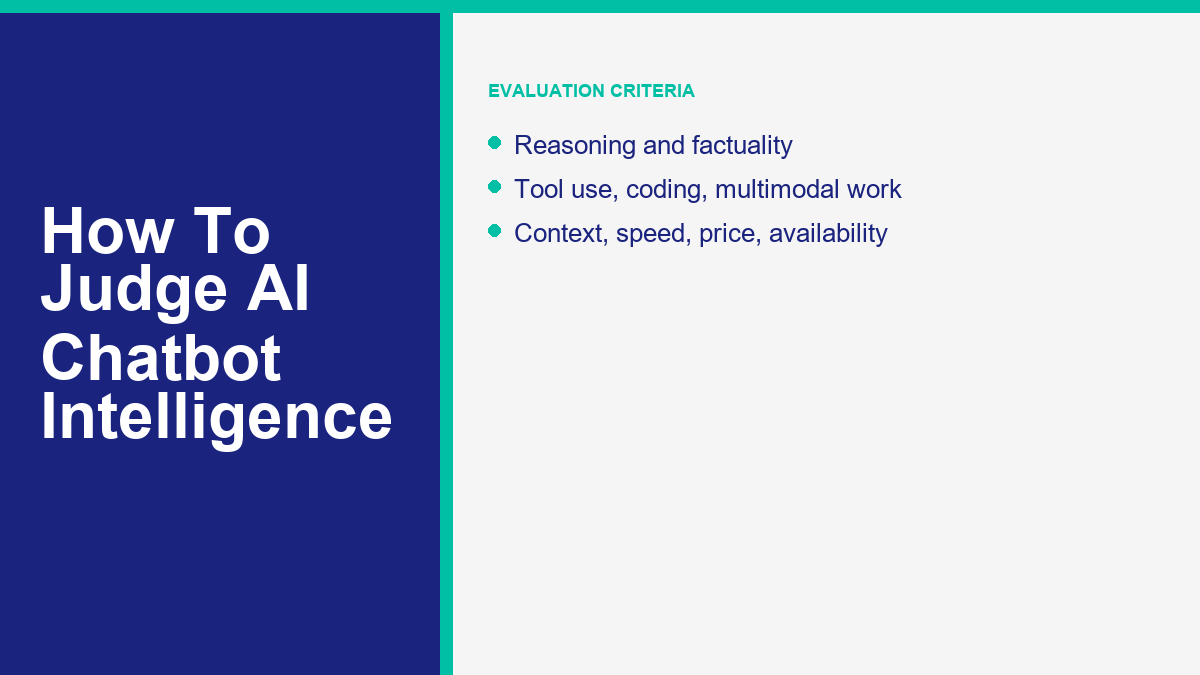
To rank these tools fairly, I evaluated them across ten distinct intelligence and usability criteria:
- Reasoning Quality: The ability to plan, execute multi-step logic, and stay on track without losing context.
- Factuality and Retrieval: Minimizing hallucinations and retrieving accurate facts when grounded with external documents or web search.
- Tool Use and Execution: Writing and executing code, browsing the web, and integrating with external APIs.
- Coding Competency: Generating correct code, debugging existing files, and refactoring large structures.
- Multimodal Ability: Understanding images, diagrams, audio, and video inputs natively.
- Search Grounding: Incorporating real-time web search to answer questions about current events.
- Context Window: The volume of text a model can hold in its active memory during a single conversation.
- Speed: How quickly the model generates replies under heavy loads.
- Price: The cost-to-performance ratio for both consumers and API developers.
- Availability: Platform accessibility across web browsers, mobile apps, and developer portals.
Evaluating these factors reveals that the smartest model on paper is not always the best chatbot to work with. Arena-style leaderboards provide useful data on human preference, but they struggle to capture how a model handles large file uploads, file editing, or complex formatting rules over several hours of collaboration.
The Leaderboard Paradox: Why Benchmarks Don’t Tell the Whole Story
Public benchmarks like LMArena (formerly Chatbot Arena) serve as a useful secondary source for tracking human preference, but they are not the sole measure of overall intelligence. LMArena relies on blind A/B testing where users vote on which model gave a better response to a single prompt. While this captures general conversational style, it fails to measure how a model performs on deep, multi-step agentic workflows.
Independent analysis platforms like Artificial Analysis show that model rankings shift rapidly. Their Intelligence Index tracking reveals that Claude Opus 4.8 (max) and GPT-5.5 (xhigh) trade the top spot depending on the day and the specific evaluation criteria. Because these leaderboards update constantly, selecting a tool based entirely on a benchmark screenshot is counterproductive. Instead, practical utility and ecosystem compatibility should drive your decision.
ChatGPT and GPT-5.5: The Smartest All-Around Assistant
ChatGPT retains its position as the top recommendation because OpenAI combines high-end model intelligence with a highly practical user interface. The primary driver of this intelligence is the GPT-5.5 model family. On the Artificial Analysis Intelligence Index, GPT-5.5 (xhigh) ranks as one of the highest-performing models available, matching or exceeding competitors in general reasoning and tool use.
OpenAI’s GPT-5.5 documentation highlights its key developer and enterprise features. The API model supports a 1 million token context window, allowing users to process massive datasets, entire codebases, or hundreds of pages of documentation in a single query. The consumer app leverages this capability through advanced data analysis tools, allowing ChatGPT to write and execute Python code in a secure sandbox to clean spreadsheets, build charts, and verify its own calculations.
ChatGPT Plus is priced at $20 per month. This plan provides access to the GPT-5.5 model family, advanced voice features, custom GPT creation, and DALL-E image generation. For developers and enterprises, OpenAI lists standard API pricing for both GPT-5.5 and GPT-5.5 Pro, offering a scalable path for building custom software integrations. ChatGPT wins on utility because it handles context switching better than its rivals, remaining helpful whether you are writing marketing copy, debugging Python, or organizing a project plan.
The main downsides of ChatGPT are OpenAI’s complex naming conventions and the fact that its best data analysis tools require a paid subscription. However, for users who want a single, versatile tool that handles the widest variety of tasks, ChatGPT remains the clear default choice.
Claude Opus 4.8: The Sharpest Long-Context Thinker
Anthropic’s Claude is the best option when your work demands meticulous reading, precise writing, and deep logical analysis. Anthropic’s Claude Opus 4.8 release notes show that it beat prior Opus models and GPT-5.5 on a named Super-Agent benchmark at cost parity. This benchmark measures a model’s ability to plan, select tools, and execute multi-step tasks across complex, long-running agentic workflows.
Opus 4.8 is particularly effective at tool use and long-session work. It features a 1 million token context window in beta, allowing it to process massive sets of source materials without losing track of instructions. Anthropic has also introduced Claude Code, a developer tool designed to run directly in the terminal to inspect codebases, execute commands, and run tests. On the Artificial Analysis Intelligence Index, Claude Opus 4.8 (max) sits at the top of the chart alongside GPT-5.5, validating its position as an industry leader in raw reasoning power.
Claude Pro costs $20 per month, with an annual billing option that lowers the effective price to about $17 per month. Anthropic also offers team plans for organizations. Claude is the ideal choice for editing drafts, reviewing legal contracts, analyzing transcript folders, and reviewing complex code. It avoids the typical “robotic” tone of many AI models, generating natural, style-sensitive text that requires less manual rewriting.
The primary drawback of Claude is its strict usage limits. Anthropic enforces caps during periods of high demand, which can interrupt your workflow if you are processing large files. If you need a tool for high-volume, rapid-fire tasks, ChatGPT or Gemini may offer a smoother experience.
Gemini 3.5: The Best Multimodal Intelligence in Google’s Ecosystem
Google’s Gemini 3.5 model family has changed the landscape for users who want their AI deeply integrated with their existing workspace. The Gemini API model page currently lists and labels Gemini 3.5 as the current standard, highlighting Google’s commitment to this architecture. Unlike competitors who added multimodal features as post-processing layers, Gemini was built from the ground up to process text, code, images, audio, and video natively.
According to Google’s Gemini 3.5 announcement, the model is optimized for complex agentic workflows. Gemini 3.5 Flash is generally available through Google Antigravity, the Gemini API in AI Studio, Android Studio, the Gemini Enterprise Agent Platform, and Gemini Enterprise. This broad availability allows developers to deploy high-speed, cost-effective multimodal agents across mobile and cloud platforms.
Google AI Pro costs $19.99 per month, giving users access to Gemini 3.5 Pro with its 1 million token context window, deep integrations with Gmail, Google Docs, Google Drive, and enhanced features in NotebookLM. Gemini is highly effective for visual reasoning tasks, such as explaining complex diagrams, extracting data from scanned layouts, and summarizing video presentations. If your business operates primarily on Google Workspace, Gemini provides a native experience that other assistants cannot match.
The main limitation of Gemini is Google’s frequent rebranding of features and plans, which can make it difficult to track which models are active in specific tools. However, for visual processing and ecosystem integration, Gemini is a top-tier choice.
Grok 4.20, Perplexity, and DeepSeek: Three Smart Options With Different Tradeoffs
Grok, Perplexity, and DeepSeek are often grouped together as alternative AI options, but they serve three entirely different purposes. Understanding their specific strengths prevents you from choosing the wrong tool for your daily work.
Grok 4.20 Is the Sharpest Real-Time Conversationalist
xAI’s Grok has evolved from a social media experiment into a highly competitive assistant. The xAI developer release notes show that Grok 4.20 and Grok 4.20 Multi-agent are live, offering native tool use, image generation, and real-time web search. This follows a development history where Grok 4.1 Fast was released to the Enterprise API in November 2025, and Grok 4 arrived in July 2025.
Grok is highly effective at tracking current events. Because it has direct access to real-time data from X (formerly Twitter) and the live web, it can summarize breaking news, explain viral trends, and synthesize market reports faster than models that rely on static training data or slower web crawlers. X Premium subscriptions start at $8 per month, while Premium+ costs $40 per month, making Grok a cost-effective choice if you already use X.
The trade-off is conversational consistency. Grok’s output can be highly opinionated, and it is more prone to stylistic variance than ChatGPT or Claude. It is a valuable second opinion for real-time tracking, but it is less suited for formal document editing or deep codebase refactoring.
Perplexity Is the Smartest Research Product
Perplexity Pro does not rely solely on a single proprietary model. Instead, it acts as a smart research routing interface, allowing users to run queries using GPT-5.5, Claude Sonnet, Gemini 3.5, and Perplexity’s own models. The value lies in the product design: Perplexity is built to search the web, extract facts, compile structured reports, and provide clickable citations for every claim.
The Perplexity Sonar Pro documentation describes it as an advanced search model with enhanced results, a 200K context window, complex Q&A capability, and 2x more search results than standard Sonar. For multi-step reasoning tasks, Perplexity Sonar Reasoning Pro provides a 128K context window. For exhaustive investigations, Perplexity Sonar Deep Research crawls hundreds of sources to build detailed, multi-page PDFs. Perplexity Pro is priced at $20 per month (or $200 per year), with a high-volume Max tier at $200 per month.
While Perplexity is the best tool for gathering and verifying facts, it is not designed for creative writing, code generation, or complex file editing. It is a research engine, not an all-purpose creation suite.
DeepSeek Is the Value Leader
DeepSeek has challenged the pricing structure of the entire AI industry by offering high-end reasoning at extremely low prices. The DeepSeek API documentation lists DeepSeek-V4-Flash and DeepSeek-V4-Pro, highlighting a 1 million token context window, large maximum output limits, native tool calls, and low listed API prices. The web and mobile interfaces are free, making it one of the strongest free or low-cost options for budget-sensitive users.
DeepSeek V4 performs exceptionally well on math, coding, and logical reasoning benchmarks. However, it lacks the polished user experience and broad app integrations of ChatGPT or Gemini. Many businesses also maintain strict compliance policies regarding data hosting, making DeepSeek a less common choice for sensitive enterprise workflows. For developers, hobbyists, or budget-conscious users, DeepSeek provides exceptional reasoning power per dollar.
AI Chatbot Comparison Table: Pricing, Context, and Standout Strengths
The comparison table below outlines the starting plans, memory limits, and target use cases for each major chatbot as of June 2026. Use this data to match your workflow to the right platform.
| Chatbot Platform | Best Active App Model | Starting Price | Context Window Limit | Primary Strength | Key Limitation |
|---|---|---|---|---|---|
| ChatGPT | GPT-5.5 / GPT-5.5 Pro | $20/month (Plus) | 1 Million Tokens (API) | Coding execution, spreadsheet work, and overall versatility | Complex naming conventions and paid data features |
| Claude | Claude Opus 4.8 | $20/month ($17 if billed annually) | 1 Million Tokens (Beta) | Meticulous writing, deep document analysis, and code review | Strict usage limits during peak traffic hours |
| Gemini | Gemini 3.5 Pro / Flash | $19.99/month (AI Pro) | 1 Million Tokens | Multimodal reasoning and Google Workspace integration | Frequent changes to product branding and packaging |
| Grok | Grok 4.20 / Multi-agent | $8/month (X Premium) | 256K Tokens (Grok 4 API) | Real-time web search and current events tracking | Higher stylistic variance and opinionated outputs |
| Perplexity | Sonar Reasoning Pro / Deep Research | $20/month (Pro) | 200K Tokens (Sonar Pro) | Source-grounded research, multi-step queries, and citations | Not designed for creative writing or code generation |
| DeepSeek | DeepSeek-V4-Pro / Flash | Free (Web/App) | 1 Million Tokens (API) | Low-cost API pricing and strong mathematical reasoning | Minimal app integrations and compliance concerns |
If you need to make a quick decision, use these three simple defaults: buy ChatGPT if you want the best all-around workhorse; buy Claude if you work primarily with long documents and editing; and buy Gemini if your workflow runs entirely through Google Workspace.
Which AI Feels Smartest for Coding, Writing, Research, and Daily Chat
To choose the right AI assistant, focus on the specific tasks that occupy most of your workweek. No single chatbot holds a monopoly on intelligence across all categories.
| Use Case Category | Recommended Winner | Runner-Up Option | Key Differentiation |
|---|---|---|---|
| Coding & Software Development | ChatGPT | Claude | ChatGPT provides the most reliable execution sandbox, while Claude excels at repo architecture. |
| Creative Writing & Copy Editing | Claude | ChatGPT | Claude generates natural, style-sensitive text and maintains editorial tone. |
| Sourced Research & Fact Gathering | Perplexity | Grok | Perplexity compiles structured reports with clear citations, while Grok tracks real-time trends. |
| Multimodal Tasks & Visuals | Gemini | ChatGPT | Gemini handles scanned layouts, diagrams, and video files with native accuracy. |
| Daily All-Purpose Tasks | ChatGPT | Gemini | ChatGPT remains the most versatile driver for daily tasks and tool execution. |
| Best Value per Dollar | DeepSeek | Claude | DeepSeek V4 API pricing is exceptionally low, while Claude Pro annual billing saves costs. |
For coding tasks, ChatGPT’s ability to run code internally is highly valuable. If your assistant writes a script that errors, it can run the script, read the error output, and correct itself before showing you the code. Claude is a strong alternative for architecture, helping you plan migrations or refactor large files using Claude Code in your terminal.
For writing, Claude is the clear leader. It avoids standard AI-generated clichés and verbose phrasing that plague many other writers. It reads long style guides and applies them accurately to your drafts, saving you significant editing time.
For research, Perplexity is the most efficient choice because it is built to organize findings. It groups search results into logical subtopics and provides immediate citation links. If you need to monitor live web and social trends, Grok’s real-time connection to X is highly effective.
For multimodal tasks, Gemini’s ability to parse long videos or complex diagrams makes it highly capable. It can watch a 30-minute recorded webinar and extract the key takeaways with timestamps, or read a hand-drawn architecture mockup and generate a clean SVG file.
How to Choose the Most Intelligent AI Chat Bot Without Overpaying
Evaluating these platforms should be a practical business decision rather than a theoretical exercise. Follow this structured process to choose the best tool for your workflow:
- Identify your primary bottleneck: If you spend most of your time writing code, start with ChatGPT. If you spend your time editing text, start with Claude. If you write research reports, start with Perplexity. If your budget is zero, test DeepSeek.
- Test with real work: Avoid testing models with generic riddle prompts. Instead, paste a real bug from your terminal, upload a real contract, or ask it to write a real client email based on your notes.
- Start with one subscription: You do not need to pay for multiple $20/month services. Choose the one that matches your primary task, use it for a month, and only switch if you hit a clear limitation.
- Use account-based interfaces for complex work: Avoid “no sign up required” portals if you need high-end intelligence. The smartest models require an account to support project memory, large file uploads, and custom system instructions. If you specifically need a convenience-first option, you can Browse Our Tutorials for a list of simple tools.
- Keep assistant use separate from automation pipelines: An assistant that is excellent at answering questions on your phone is not the same as a delivery layer for customer messaging. If you need to build advanced customer automation flows for Facebook, you can Upgrade to MessengerBot Pro to manage lead routing, auto-replies, and customer handoffs.
Most professional plans are priced close to $20 per month. The exception is DeepSeek, which remains free for consumer use, and Grok, which is included with X Premium plans. Focus on which interface fits your daily habits, as saving time is more valuable than saving a few dollars on a monthly subscription.
Need a smart assistant plus a real customer-facing bot? Choosing the most intelligent AI chat bot is only the first step if you want to automate customer service, handle lead routing, or build interactive messaging campaigns. When you are ready to deploy AI directly to your customers, View MessengerBot Pricing to evaluate our automation platform separately from the personal assistants you use for your own research.
Most Intelligent AI Chat Bot FAQ for 2026 Buyers
What is the most intelligent AI chatbot in 2026?
For most users, the most intelligent AI chatbot in 2026 is ChatGPT because it offers the most versatile combination of reasoning, tool use, coding, and spreadsheet execution. Claude is a strong alternative for long-document analysis, and Gemini leads in multimodal, Google-connected workflows.
Is ChatGPT still the smartest AI?
Yes, ChatGPT (powered by GPT-5.5) remains the top overall assistant. However, it is no longer the clear leader in every category. Claude Opus 4.8 performs better on long-form writing and complex code review, while Gemini 3.5 leads in native video and image processing.
Which AI chatbot is best for business?
The best AI chatbot for business depends on the role. For individual employee productivity, ChatGPT and Claude are the best options. For customer-facing support and marketing automation, specialized platforms like MessengerBot are required to manage lead routing, user data, and human agent handoff.
Which AI chatbot is best for research?
Perplexity is the best chatbot for research because it is designed to search the web, compile findings, and provide clickable citations. If you need to monitor breaking news and social trends, Grok’s real-time web connection is the strongest alternative.
What is the difference between the smartest AI and the best chatbot for Messenger automation?
A smart AI assistant helps you think, write, and process data. A Messenger automation chatbot is a system that routes messages, handles customer support, and connects to a CRM. You can use models like GPT-5.5 or Claude through APIs in your automation, but you still need a platform like MessengerBot to manage compliance, human handoffs, and messaging rules.
 English
  Tagalog
  简体中文
简体中文  العربية
  हिन्दी
  Português do Brasil
  Español de México
  Français
  বাংলা
বাংলা  香港中文
香港中文  繁體中文
繁體中文  Nederlands
  Deutsch
  Bahasa Indonesia
  日本語
日本語  한국어
한국어  Polski
  Русский
  Español
  Tiếng Việt