

Key Takeaways
- Integrate chatbot with Facebook Messenger by creating a Page, registering a Meta App, adding the Messenger product, and deploying a verified HTTPS webhook—this checklist makes facebook messenger integration predictable and secure.
- For rapid deployment use no-code builders like ManyChat; for full control build a custom webhook to integrate chatgpt with messenger or other AI services.
- Combine deterministic NLU (Dialogflow/Amazon Lex) and generative models—integrate amazon lex chatbot with facebook messenger for slot‑filled tasks and fallback to ChatGPT for open queries to balance cost and quality.
- Design intent‑first workflows: map high‑value intents, tune NLP confidence thresholds, summarize history before calls to integrate chatgpt with facebook messenger, and implement graduated fallbacks to human agents.
- Respect Meta rules: follow the 24‑hour messaging window, use approved messaging tags or one‑time notifications for outbound messages, and log consent for GDPR/CCPA compliance.
- Automate meaningful flows—welcome messages, appointment reminders, cart recovery—and measure KPIs (messages per session, conversion rate, cost per conversation) to iterate toward Messenger bot earn money outcomes.
- Scale reliably by decoupling webhooks from processing (queues, worker pools), persisting session state (Redis/DB), and implementing token rotation, rate‑limit handling, and monitoring for production resilience.
- Prototype fast, then migrate: validate acquisition and monetization experiments with no‑code tools, then migrate critical flows to hybrid stacks that connect chatbot to Facebook Messenger and external systems securely.
If you want to integrate chatbot with Facebook Messenger without getting lost in technical debt, this article will be the practical map: we’ll show how to add a ChatBot to Facebook Messenger, how to connect ChatGPT to Facebook Messenger, and when to choose a no-code builder versus a custom integration. You’ll learn how to use AI with Facebook Messenger in real workflows—intent design, fallback strategies, and simple monitoring—plus a step‑by‑step look at facebook messenger integration for ManyChat and alternatives. For developers we’ll cover how to integrate chatgpt with messenger and the particulars of integrating an Amazon Lex-based solution: integrate amazon lex chatbot with facebook messenger, handle webhooks, and preserve conversation state. For marketers and product owners we’ll explain how to create an automated message on Facebook Messenger, how to connect chatbot to facebook messenger using plugins or APIs, and the practical tactics to monetize a Messenger channel—Messenger bot earn money approaches that scale without annoying users. Along the way we’ll define what is a Messenger chat bot in plain terms, compare facebook chat bot free options with paid platforms, and offer checklists for deployment, privacy, and ongoing optimization so your integration chat facebook effort delivers measurable value.
Can you add a ChatBot to Facebook Messenger?
How To Create a Facebook Messenger Chatbot
Yes — you can add a chatbot to Facebook Messenger. I build Messenger bots that scale, and the process breaks down into clear, repeatable steps so you can reliably integrate chatbot with Facebook Messenger without guessing. Below is a practical, step‑by‑step process (plus common no-code alternatives, testing, permissions, and compliance notes) so you can integrate a working bot reliably.
- Create prerequisites
- Create a Facebook Page to host the bot (every Messenger bot is tied to a Page).
- Create a Meta App in Meta for Developers to receive Page tokens and webhook events (see Facebook Messenger Platform docs).
- Obtain credentials and set up Messenger product
- In your Meta App, add the Messenger product and generate a Page Access Token for the target Page.
- Save your App ID and App Secret for generating long‑lived tokens and for server authentication.
- Build and host your bot backend
- Implement a webhook endpoint on a public HTTPS server to receive Messenger events (messages, postbacks, opt‑ins) and verify it with your verify token.
- Use the Send API to reply to users and the Graph API to manage subscriptions and messaging features.
- Configure webhook subscriptions and permissions
- Subscribe your App to the Page for the relevant webhook events (messages, messaging_postbacks, message_deliveries).
- Request necessary permissions (pages_messaging, pages_manage_metadata, pages_read_engagement). Submit for App Review if you need to message users beyond Page roles.
- Test the bot safely
- Add test accounts as Page roles or App Testers to interact with the bot without App Review.
- Validate message flows, quick replies, attachments, and persistent menu behavior through the Page inbox and Graph API.
- No‑code and managed builder options
- Use no-code platforms like ManyChat or Chatfuel to quickly connect and deploy—these streamline the steps to connect chatbot to Facebook Messenger and manage webhook/token configuration for you.
- For advanced NLP, connect Dialogflow, Amazon Lex, or OpenAI/ChatGPT to your webhook. You can integrate amazon lex chatbot with facebook messenger or integrate chatgpt with messenger using the OpenAI API.
- Messaging rules, templates and compliance
- Follow Meta’s messaging policies: promotional messages outside the standard messaging window require approved tags or template messages.
- Implement fallback, opt‑out instructions, and data handling practices to comply with privacy laws such as GDPR and CCPA.
- Going live and scaling
- Submit for App Review if you need to message users who aren’t Page admins or testers.
- Monitor rate limits, set up logging and analytics, and design for scale (queueing, horizontal workers).
Quick checklist: Facebook Page created; Meta App with Messenger product; Page Access Token and App credentials; public HTTPS webhook with verification; subscribed Page events and required permissions; tested with Page roles/App Testers; App Review submitted if needed; compliance with Messenger Platform policies. For a step‑by‑step development walkthrough, see my guide to connect chatbot to Facebook Messenger.
Step-by-step checklist to integrate chatbot with facebook messenger: permissions, app setup, and webhook configuration
Integrating a bot requires attention to permissions, app setup, and a secure webhook. I recommend the following compact checklist to make facebook messenger integration predictable and audit‑ready:
- Page & App setup — Create or confirm your Facebook Page. Register a Meta App and add the Messenger product. Link the Page to the App and generate a Page Access Token.
- Permissions matrix — Determine what your bot needs: pages_messaging to send/receive messages, pages_manage_metadata for subscription, pages_read_engagement for insights. Plan App Review if you’ll serve general users.
- Webhook & hosting — Deploy a public HTTPS endpoint. Verify the webhook with your verify token and subscribe to required events (messages, messaging_postbacks, message_reads).
- Authentication lifecycle — Exchange short‑lived tokens for long‑lived Page tokens, secure App Secret, and rotate credentials periodically.
- Testing plan — Use Page roles and App Testers, test edge cases (attachments, multi‑turn flows), and validate persistent menu and templates.
- Compliance & messaging rules — Map flows to Meta’s messaging windows and use appropriate messaging tags or one‑time notifications where needed. Log consents and opt‑outs.
- Monitoring & scale — Add rate‑limit handling, message queues, retry logic, and analytics to measure conversations, conversions, and the path to Messenger bot earn money outcomes if monetization is a goal.
If you prefer a no‑code start, try the Facebook chatbot builder guide for creating a free Messenger bot and then migrate to a custom webhook as your needs grow: Facebook chatbot builder. For developers ready to code, my Python and GitHub walkthrough for Messenger bots outlines deployment patterns and repo examples: Messenger bot with Python.

How to connect ChatGPT to Facebook Messenger?
How to connect ChatGPT to Facebook Messenger?
Overview: You can connect ChatGPT (OpenAI) to Facebook Messenger either via a no‑code/integration platform (ManyChat, Zapier/Make) or a custom webhook that forwards Messenger events to the OpenAI API and returns replies via the Send API. I recommend choosing the approach that matches your scale and control needs—ManyChat for rapid prototyping, a custom webhook for full control and scalability. Below is a clear step‑by‑step process for both approaches so you can integrate chatgpt with messenger effectively.
No‑code / integration platform (fastest)
- Choose a platform — Pick ManyChat, Zapier, or Make (Integromat) which support Facebook Messenger triggers and HTTP/API actions. ManyChat is a common choice for fast facebook messenger integration.
- Authenticate Messenger — Connect your Facebook Page in the platform and grant pages_messaging and required scopes so the platform can send/receive messages.
- Configure ChatGPT action — Use the platform’s HTTP request or custom code block to call OpenAI’s Chat Completions or Responses API. Store your OpenAI key in the platform’s secrets area to protect credentials.
- Map events and test — Map incoming message text to the API prompt, return ChatGPT responses into the Messenger flow, add typing indicators, and test with Page roles or App Testers.
- Production checklist — Ensure Meta messaging rules are followed, implement opt‑in flows where needed, and monitor rate limits and costs.
Custom webhook (full control, scalable)
- Decide architecture — Host a secure HTTPS service (serverless or container) to receive Messenger webhook events, call OpenAI, and push replies via the Send API.
- Create prerequisites — Create a Facebook Page and register a Meta App. Add the Messenger product and generate a Page Access Token as part of your facebook messenger integration.
- Register webhook & permissions — Implement webhook verification, subscribe to message events, and request pages_messaging, pages_manage_metadata and pages_read_engagement; plan for App Review if messaging non‑admins.
- Obtain OpenAI credentials — Secure an API key from OpenAI and choose an appropriate model for responses; design prompts and system instructions for multi‑turn context.
- Implement message flow — On incoming message: validate sender, normalize text, optionally run intent classification, send prompt + recent history to OpenAI, then format the response for Messenger (text, quick replies, templates).
- Use Send API correctly — Reply with the Graph Send API using your Page Access Token and adhere to the 24‑hour messaging window and template/tag rules.
For a developer walkthrough on connecting a bot to Messenger and covering webhook configuration in depth, see my guide to connect chatbot to Facebook Messenger and the broader integration guide for integrating ChatGPT with Facebook Messenger: chatbot integration with Facebook.
Integrate chatgpt with facebook messenger: security, rate limits, and maintaining conversation state
Security and privacy are non‑negotiable when you integrate chatgpt with facebook messenger. I secure tokens in environment secrets, rotate keys regularly, and minimize logged PII. Use HTTPS/TLS for all endpoints and store OpenAI and Page tokens in a vault or encrypted config. Follow GDPR/CCPA practices—document consent, provide clear opt‑outs, and redact sensitive fields before storing any conversation data.
Rate limits and cost control matter for a reliable facebook messenger integration. Implement request queuing, exponential backoff, and local caching to avoid hitting OpenAI or Messenger rate limits. Summarize or truncate conversation history to reduce tokens and cost: keep a rolling window of recent turns or generate condensed summaries before sending context to ChatGPT. For enterprise scale, use message queues (SQS, RabbitMQ) and worker pools to smooth bursts and ensure consistent throughput.
Maintaining conversation state: store short‑term context in a fast cache (Redis) and persist session metadata in a database for longer retention. Use session IDs tied to user IDs and track last interaction timestamps to expire stale sessions. Design prompts that include only the necessary context—user role, recent turns, and explicit instructions—so ChatGPT produces coherent multi‑turn replies while controlling token usage.
Finally, build robust error handling and fallbacks: detect API failures, return friendly fallback messages, and route complex queries to human agents when needed. Measure latency, conversation completion rates, and conversion paths—especially if you plan to monetize via Messenger bot earn money strategies—to keep costs predictable and UX strong. For advanced intent routing, consider combining ChatGPT with a lightweight NLU or Amazon Lex to handle deterministic tasks and hand off to generative responses when appropriate (see Amazon Lex for NLU options).
How to use AI with Facebook Messenger?
Practical workflows for how to use chatbots on facebook messenger: intent design, NLP tuning, and fallback strategies
I design workflows that make facebook messenger integration predictable and useful. Start by mapping high‑value intents (support, product info, pricing, cart recovery) and create a prioritized intent list. For each intent define sample utterances, required slots, success criteria, and required UX elements (quick replies, buttons, or templates). Use a lightweight NLU or intent classifier to route messages first—this keeps deterministic flows fast and reduces token usage when you integrate chatgpt with messenger or combine with a tool like Amazon Lex.
For NLP tuning, collect real conversations, label intents, and retrain periodically. Implement confidence thresholds: when the intent classifier confidence is high, run the deterministic handler; when low, route to generative AI (integrate chatgpt with facebook messenger) with a short context window. Summarize previous turns before sending to ChatGPT to control cost and preserve coherence. Add fallback strategies: a graduated fallback where the bot retries with clarification, then offers canned options, then hands off to a human agent. Always surface opt‑out and human handoff paths to remain compliant with Meta policies and to preserve user trust.
Operationally, I keep conversation state in a fast cache (Redis) and persist session metadata to track timeouts and user journeys. Implement message batching, typing indicators, and quick replies to make interactions feel responsive while minimizing back‑and‑forth prompts. These practices ensure how to use chatbots on facebook messenger effectively for both simple automations and advanced generative flows.
Use cases: customer support, lead generation, and Messenger bot earn money tactics for monetization
I deploy Messenger bots across several monetizable use cases that directly link to ROI. For customer support, automate tier‑1 triage: intent detection → knowledge base response → escalate to agent. This reduces response time and agent load. For lead generation, use interactive qualification flows (quick replies, forms) and push validated leads into your CRM; these flows are prime candidates when you connect chatbot to facebook messenger and integrate chatbot with facebook messenger on your site for seamless capture.
To monetize, consider subscription content, paid support tiers, cart recovery with incentivized coupons, and conversational commerce using structured message templates. Track conversion events and A/B test messaging and CTAs to optimize performance. If you want to explore quick monetization experiments, I recommend prototyping with ManyChat for rapid facebook messenger integration then migrating to a custom webhook as volumes grow (see ManyChat for prototyping). For enterprise or advanced NLU, you can integrate amazon lex chatbot with facebook messenger for slot‑filled tasks and fallback to ChatGPT for open questions—this hybrid approach balances cost and quality.
Finally, measure KPIs tied to monetization: messages per session, conversion rate, cost per acquisition, and LTV uplift from Messenger traffic. If you’re aiming to Messenger bot earn money, instrument funnels end‑to‑end and iterate on prompts, flows, and incentives until you reach sustainable unit economics.
Does Manychat work with Messenger?
Does ManyChat work with Messenger?
Yes — ManyChat fully supports Facebook Messenger and is one of the most widely used platforms for building, automating, and monetizing Messenger bots. I use ManyChat frequently for rapid prototyping and growth experiments because it removes much of the friction in facebook messenger integration.
How to connect Facebook Messenger to ManyChat (step‑by‑step)
- Create prerequisites — Ensure you have a Facebook Page (a Messenger bot must be tied to a Page) and a ManyChat account.
- Connect your Page — In ManyChat, go to Settings > Channels > Facebook Messenger (or My Profile > Manage accounts > + Add new account) and follow the OAuth flow to authorize ManyChat to manage your Page. ManyChat requests pages_messaging scopes to send/receive messages.
- Grant permissions and verify — Accept the permissions dialog in Facebook; confirm the Page is linked and the Page Access Token is provisioned by ManyChat.
- Configure bot settings — Set default reply, welcome message, persistent menu, keywords, and growth tools inside ManyChat. Map user fields and CRM integrations as needed.
- Test with Page roles — Use Page admins/testers to validate flows before going live. ManyChat includes a preview/test mode and logs for debugging.
- Go live and monitor — After testing, publish automations. Monitor message delivery, subscriber counts, and analytics in ManyChat’s dashboard.
Core ManyChat capabilities I rely on: a visual flow builder, growth tools for subscriber capture, broadcasts and sequences (respecting Facebook messaging windows), native integrations and webhooks to integrate chatgpt with messenger, and commerce features for conversational sales. ManyChat handles a lot of the heavy lifting for Facebook Messenger bot setup, but I still layer custom webhooks when I need advanced NLU or proprietary integrations.
Alternatives and comparison: integrate amazon lex chatbot with facebook messenger, ManyChat, and other bot builders
When deciding between ManyChat and alternatives, I evaluate three dimensions: speed to launch, control (customization & data residency), and cost at scale. ManyChat is best for fast facebook messenger integration, marketing automations, and Messenger bot earn money experiments. For deterministic, slot‑filled flows (bookings, transactions) I often integrate Amazon Lex or Dialogflow and use a hybrid architecture: Lex for intent routing and ManyChat (or a custom webhook) for messaging delivery.
- ManyChat — Rapid prototyping, visual flows, built‑in growth tools, and easy ways to connect external APIs (useful to integrate chatgpt with messenger). Ideal for marketers and SMBs who want facebook messenger integration without deep engineering.
- Amazon Lex — Strong for structured dialog, slot filling, and enterprise NLU. You can integrate amazon lex chatbot with facebook messenger via a custom webhook to combine reliable intent handling with generative fallbacks.
- Custom webhook + OpenAI — Full control: I use this when I need to integrate chatgpt with facebook messenger directly, preserve data residency, or implement complex orchestration across systems.
- Other builders (Chatfuel, MobileMonkey) — Comparable to ManyChat for core features; choose based on pricing, specific integrations, or preferred UI.
If you want step‑by‑step guidance for a full developer route, my connector guide explains how to connect chatbot to Facebook Messenger. For a no‑code start, the Facebook chatbot builder walkthrough shows how to build a free Messenger bot and then move to advanced integrations as you scale.
Practical recommendation: use ManyChat to validate messaging, acquisition, and basic monetization funnels (Messenger bot earn money tests). When deterministic accuracy, regulatory controls, or scale costs become constraints, migrate critical flows to a hybrid stack that can integrate amazon lex chatbot with facebook messenger or a custom ChatGPT webhook for flexible natural language responses.
What is a Messenger chat bot?
Definition and anatomy of a Messenger chat bot: messages, persistent menu, and integration chat facebook essentials
A Messenger chat bot is an automated software agent that communicates with users inside Facebook Messenger (and often Instagram or embedded web widgets) to answer questions, guide workflows, collect data, and complete tasks—without requiring a human agent for every interaction. I use Messenger Bot to automate replies, moderate comments, and run workflows across channels; at scale this is how I integrate chatbot with facebook messenger to deliver consistent, measurable results.
The anatomy of a Messenger chat bot includes:
- Messaging channel — delivery via the Facebook Messenger Platform (Send API, webhooks, Page tokens) for core messaging and events (Messenger Platform docs).
- Intent/NLU layer — a classifier or NLU (Dialogflow, Amazon Lex, or generative models) that decides what the user wants; this is where you choose whether to integrate amazon lex chatbot with facebook messenger or integrate chatgpt with messenger for generative replies.
- Orchestration/backend — business logic, user session state, CRM and ecommerce connectors, and persistence (DB/cache) that implement the conversation flow and enable facebook messenger integration with your stack.
- UI elements — persistent menu, quick replies, buttons, templates and carousels that guide users and reduce ambiguity in conversation.
- Analytics & moderation — logging, KPI tracking, content filters and compliance controls to enforce privacy and messaging rules while optimizing for conversions or Messenger bot earn money goals.
Whether you want a simple facebook chat bot free setup or a complex hybrid that integrates ChatGPT, the core pieces remain the same: channel, NLU, orchestration, UI elements, and monitoring. For a developer path I link messaging flows to verified webhooks and the Send API; for non‑developers I validate flows with no‑code builders before migrating to a custom stack.
Types of bots: rule-based, AI-powered (ChatGPT/Amazon Lex), and free builders—how to make a Messenger bot for free
Bots fall into three practical categories depending on complexity, cost, and control.
- Rule‑based bots — scripted trees and keyword triggers. Low technical overhead and predictable outcomes; ideal for FAQs, simple automations, and initial facebook messenger integration experiments. You can often get started with a Facebook chat bot free builder to validate value quickly.
- Hybrid bots — deterministic handlers for transactional tasks (booking, payments, slot filling) combined with generative fallbacks (ChatGPT) for open questions. This approach balances reliability and natural language capability: use Amazon Lex for intent routing and fallback to ChatGPT when needed, or integrate chatgpt with facebook messenger for richer responses while preserving control over critical tasks.
- Fully generative bots — models like ChatGPT power most of the conversation. These provide the most natural interactions but require prompt engineering, filtering, session summarization to control token costs, and robust moderation to avoid unsafe outputs.
How to make a Messenger bot for free: prototype with a no‑code Facebook chatbot builder to create a free Messenger bot, validate flows and acquisition mechanics, and then migrate to a custom webhook or hybrid NLU as you scale. If you prefer a step‑by‑step developer route to build and monetize your bot, see the comprehensive guide to build a chatbot for Facebook Messenger and the no‑code builder walkthrough for faster starts: Facebook chatbot builder.
Choose the bot type that matches your objectives—speed, control, or conversational quality—and design the integration chat facebook roadmap accordingly so you can connect chatbot to facebook messenger while managing cost, compliance, and user experience.

How to create an automated message on Facebook Messenger?
Creating automated flows: autoresponders, appointment reminders, and automated message best practices for facebook messenger integration
I design automated flows to be predictable, respectful of Meta rules, and focused on outcomes—whether that’s faster support, appointment confirmations, or conversion funnels that help Messenger bot earn money. Start by mapping the user journey: trigger → intent → response → next step. Typical triggers are: first message (Get Started), keyword, comment-to-message, or external webhook events (orders, bookings).
Core autoresponder patterns I implement:
- Instant Reply / Welcome — concise greeting that sets expectations and includes a clear CTA (menu, quick replies). This is the first line of facebook messenger integration and reduces bounce rates.
- Appointment reminder — scheduled sequences (48h, 24h, 1h) with confirmation buttons and reschedule paths; include one‑time notification tokens if sending outside the 24‑hour window.
- Drip / nurture sequences — timed messages that educate, upsell, or onboard; segment users by behavior to improve conversion and retention.
- Error & fallback handling — clarification prompts, suggested quick replies, and a human handoff when confidence is low.
Best practices for automated messages and integration chat facebook:
- Respect the 24‑hour messaging window and use approved messaging tags or one‑time notifications for outbound messages outside it.
- Keep messages short, actionable, and mobile‑first—use quick replies and buttons to minimize typing and reduce friction.
- Preserve privacy: collect minimal PII, store consent records, and follow GDPR/CCPA rules.
- Summarize session context before calling generative models when you integrate chatgpt with facebook messenger to control token costs and keep responses coherent.
- Instrument KPIs (response time, completion rate, conversions) to iterate—this is critical if you plan to monetize via Messenger bot earn money strategies.
Automation tools and examples: connect chatbot to facebook messenger with ManyChat, custom code, or WordPress plugins
I pick the tool by tradeoff: ManyChat for speed, custom webhooks for control, and WordPress plugins for site‑embedded flows. All three let you connect chatbot to Facebook Messenger; the choice depends on scale, compliance, and how deeply you need to integrate with backend systems.
- ManyChat (no‑code) — fastest path to build autoresponders, broadcasts, and sequences. Use ManyChat for rapid facebook messenger integration and early monetization tests (comment‑to‑message, growth tools). ManyChat also supports HTTP/webhook blocks if you later need to call external APIs or integrate ChatGPT.
- Custom webhook (developer) — deploy a secure HTTPS endpoint, verify the webhook with Meta, and implement message handling that calls OpenAI or Amazon Lex when needed. This is how I integrate chatgpt with messenger or integrate amazon lex chatbot with facebook messenger for hybrid NLU + generative flows. Use Redis for session state and a queue (SQS/RabbitMQ) for scale.
- WordPress plugins — embed Messenger widgets and connect chatbot to facebook messenger from your site without heavy dev work. Start with a plugin to capture leads and trigger Messenger flows, then migrate critical flows to a webhook as traffic and complexity grow. For site integration guidance see the walkthrough on integrating a Facebook chatbot into WordPress.
Example automation recipes I use:
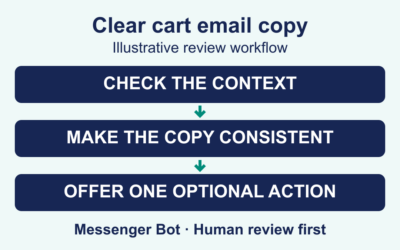
- Cart recovery — detect abandoned checkout, send a two‑step reminder (cart summary + discount CTA), and route to human sales if the user asks specific questions. This flow often produces the highest short‑term ROI for Messenger bot earn money experiments.
- Appointment flow — confirm slot, send reminders, allow reschedule via quick replies, and send post‑visit surveys to capture NPS and feedback.
- Lead qualification — ask three qualification questions with quick replies, score responses, then push qualified leads to CRM via webhook for sales follow‑up.
If you want a step‑by‑step starting guide, my tutorial on how to set up your first AI chat bot in less than 10 minutes shows a practical ManyChat → Messenger workflow, and the developer path for deeper facebook messenger integration is available in the connector guide to connect chatbot to Facebook Messenger.
Advanced deployment, monetization and maintenance
Scaling and deploying: integrating a facebook messenger chatbot into websites, WordPress, and enterprise stacks; monitoring and KPIs
I deploy production Messenger bots with a focus on predictable facebook messenger integration, observability, and horizontal scale. Start by decoupling ingestion (webhooks) from processing: receive Messenger events, enqueue them (SQS/RabbitMQ), and process with stateless workers that call your NLU or generative layer. Persist session metadata in Redis and user records in a durable DB to maintain multi‑turn context when you integrate chatgpt with messenger.
For website and WordPress embedding I add a lightweight widget that offloads conversational logic to the bot backend; this is the pattern I use when I integrate a Facebook Messenger chatbot into your website or when I integrate a Facebook chatbot into WordPress. For developer teams, I maintain a GitOps workflow and CI/CD that runs unit tests for webhook handlers and integration tests against a staging Meta App to verify pages_messaging flows before promoting to production.
Key operational controls:
- Autoscale workers and use message queues to smooth spikes; implement exponential backoff and circuit breakers when calling external APIs (OpenAI, AWS Lex).
- Monitor latency, delivery failures, and rate‑limit rejections. Track KPIs such as messages per session, completion rate, conversion rate, and cost per conversation—metrics essential if you plan to Messenger bot earn money.
- Audit logs and retention policies: redact PII for GDPR/CCPA compliance and keep consent records for messaging opt‑ins and one‑time notifications.
For teams that need a full build guide, I reference the end‑to‑end developer walkthrough to build a Messenger bot in Python and the comprehensive guide to connect chatbot to Facebook Messenger for webhook setup, token rotation, and App Review planning.
Monetization and growth: Messenger bot earn money free registration approaches, subscription models, affiliate funnels, and ongoing optimization
I treat monetization as a product problem: measure revenue per conversation and iterate. Common, compliant monetization strategies I use when I integrate chatbot with facebook messenger include:
- Lead monetization — qualify leads in‑chat, push to CRM, and tie conversions to LTV. Use in‑conversation micro‑commitments (email, phone) to increase downstream conversion rates.
- Conversational commerce — present catalog carousels, recover carts, and accept payments where supported by platform policies. These flows benefit from structured messages to reduce friction and increase AOV.
- Subscriptions & gated content — offer premium content via subscription messages or paid access links; ensure compliance with Meta messaging rules and retain transparent billing terms.
- Affiliate funnels — embed tracked affiliate links in recommended resources and measure click → conversion attribution to keep ROI positive.
- Sponsored interactions — limited, clearly disclosed sponsored messages or partner promotions that respect the 24‑hour messaging window and consent requirements.
To scale revenue while managing costs (token usage, hosting), I blend deterministic handlers with generative fallbacks: route transactional intents to AWS Lex or a rule engine, and only call OpenAI/ChatGPT for open, high‑value queries—this hybrid approach lets you integrate amazon lex chatbot with facebook messenger and integrate chatgpt with messenger where it adds the most value.
Growth mechanics and experimentation:
- A/B test CTAs, quick reply labels, and incentive levels to optimize conversion rates.
- Use retention cohorts to measure repeat engagement and the effect of messaging sequences on LTV.
- Instrument funnels end‑to‑end and attribute revenue back to acquisition channels; if you need step‑by‑step monetization playbooks, the guide to build and monetize a Messenger bot is a practical resource.
Finally, keep the engine healthy: automate key maintenance (token rotation, certificate renewal), schedule periodic privacy audits, and maintain a continuous optimization loop on prompts and NLU models to keep your facebook messenger integration efficient, compliant, and profitable.
 English
  Tagalog
  简体中文
简体中文  العربية
  हिन्दी
  Português do Brasil
  Español de México
  Français
  বাংলা
বাংলা  香港中文
香港中文  繁體中文
繁體中文  Nederlands
  Deutsch
  Bahasa Indonesia
  日本語
日本語  한국어
한국어  Polski
  Русский
  Español
  Tiếng Việt