

Choose an AI chatbot app by the customer task it can demonstrably help with, not the longest feature list. For a small business, a useful app gives customers a clear next step and lets your team correct answers or take over. Start with one recurring question, a staff owner and a budget you can check. Keep prices, account changes and other commitments under human control until their exact workflow has been tested and authorized.
The comparison below helps US small-business owners separate four approaches, run the same sample conversations for each candidate and estimate costs in USD. The test cases and prices are illustrations, not results from tested vendors. No tool earns a recommendation here from a claim that it can do everything. Ask for evidence of the particular channel, source material and handoff your business needs, then record what works and what still needs a person.
Define the Customer Job Before Comparing Software Features
Before browsing software directories or scheduling demonstrations, define the specific operational task the application must complete. Business owners often begin by asking what features a tool offers rather than identifying the exact customer problem to solve. A successful evaluation starts by documenting three non-negotiable boundaries: the precise question the tool must answer, the exact next step it triggers, and the specific actions it is forbidden to attempt.
In customer communications, response drafting differs fundamentally from response delivery. Response drafting occurs when an assistant suggests language to an operator or retrieves documentation from an internal repository. Response delivery occurs when software sends the reply into a customer channel; delivery may still require prior review or other controls. Unsupervised response delivery requires stricter operational controls, bounded scopes, and predefined fallback pathways.
Your operational definition must also assign an internal staff owner. Every automated channel requires an employee responsible for reviewing conversation logs, handling escalations, and updating reference records. Aligning your automation scope with a deliberate conversation campaign strategy ensures that automated interactions support broader business goals instead of operating in an unmonitored silo.
Compare Four Distinct Chatbot Operating Approaches
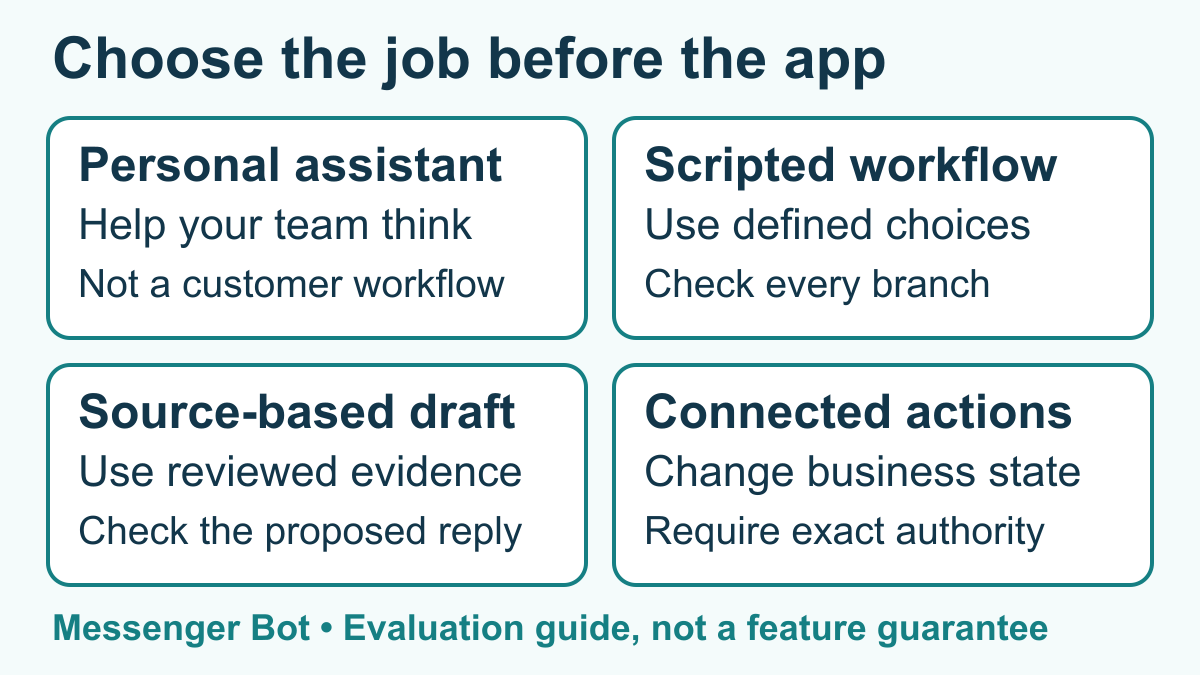
Not all conversational applications share the same underlying architecture. Conflating different tool categories leads to mismatched expectations and operational bottlenecks. Business buyers should categorize candidate software into four primary operational approaches, evaluating each against specific risk boundaries.
Personal AI assistants function as productivity aids for individual operators, helping draft memos or summarize notes. A personal assistant should not be assumed to include shared customer inboxes, permission controls or handoff records; verify those functions separately before using it in a business channel. Scripted business workflow software relies on deterministic decision trees, structured option buttons, and keyword triggers. A strictly scripted response does not generate new wording, but wrong branches, stale copy and connection failures can still produce incorrect answers. Check the configured rules and test paths rather than treating any approach as error-free.
Source-grounded reply assistants retrieve information from curated business documentation—such as published help centers, service catalogs, or policy manuals—to draft responses. Check source quality, retrieval, answer selection and refusal behavior together; a prompt alone cannot establish that an answer is supported. Finally, action-connected service agents connect directly to backend databases, scheduling engines, or customer relationship management systems to execute state changes. Action-connected agents introduce higher operational risk and demand rigorous transaction safeguards, access scoping, and error-handling routines.
| Approach | Fit and checks before use |
|---|---|
| Personal AI Assistant | Fit: Individual employee drafting and internal administrative tasks. Check: Verify prompt privacy controls and export capabilities. Boundary: Forbidden from direct, unmonitored customer communication channels. |
| Scripted Business Workflow | Fit: Deterministic routing, business hour notices, and structured menus. Check: Confirm button logic trees, keyword triggers, and fallbacks. Boundary: Staff takes over when customer requests deviate from options. |
| Source-Grounded Reply Assistant | Fit: Answering recurring customer inquiries from approved reference documents. Check: Test retrieval accuracy across conflicting or absent documentation. Boundary: Staff verifies any answer addressing pricing or commitments. |
| Action-Connected Service Agent | Fit: Looking up customer records or recording preliminary service intake. Check: Audit read-only restrictions, authentication tokens, and rollback. Boundary: Staff must authorize financial transactions and database updates. |
Understanding these distinctions prevents teams from deploying a scripted menu where customers demand nuanced policy clarification, or expecting a source-grounded assistant to execute database modifications without safeguards.
Run Identical Conversation Tests Across Every Candidate App
Never evaluate software based on pre-recorded vendor demonstrations or sanitized screenshots. To determine whether an application suits your business, subject every candidate tool to an identical, standardized conversation test battery using realistic, hypothetical customer inquiries. Avoid using real customer personally identifiable information during testing; instead, design representative mock inquiries that mirror daily operations.
Your test battery must evaluate five specific operational conditions:
- Routine verified inquiries: Submit straightforward questions with documented answers, such as your standard business hours or parking directions. Verify that the software delivers concise, accurate answers without unnecessary elaboration.
- Ambiguous customer requests: Present incomplete prompts, such as a customer stating, “My unit stopped working.” Observe whether the tool asks targeted clarifying questions or makes unwarranted assumptions about the equipment.
- Missing knowledge scenarios: Ask questions about services your business does not offer. The software must clearly state that it does not possess the requested information rather than fabricating plausible but inaccurate explanations.
- Conflicting information tests: Provide two contradictory source documents—such as a legacy summer pricing sheet and a current rate card. Verify whether the application flags the discrepancy or quotes the outdated rate.
- Sensitive transaction requests: Attempt an account cancellation or billing dispute. The application must immediately recognize the sensitive inquiry and route the conversation to staff without attempting an unauthorized resolution.
Document the exact responses from each candidate application. If a tool fails to admit missing knowledge or attempts to negotiate a disputed fee, eliminate it from consideration regardless of marketing claims.
Verify Human Handoff Protocols and Fallback Routing
The true test of customer communication software is not how smoothly it handles predictable dialogues, but how gracefully it fails when encountering edge cases. Automated systems inevitably encounter questions outside their training boundaries, frustrated customers demanding immediate human intervention, or technical connectivity timeouts. Without resilient human handoff protocols, minor conversational errors quickly escalate into severe customer service failures.
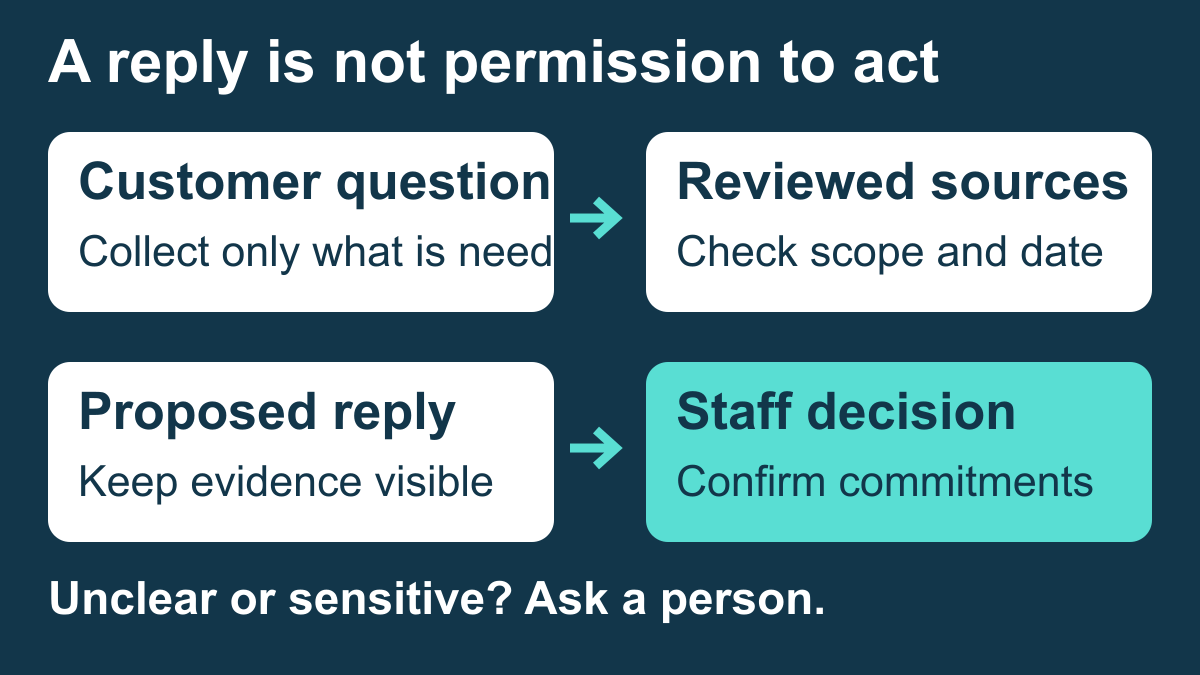
A proposed handoff plan needs clear triggers. Test whether requests such as “speak to an agent,” “billing error,” or “cancel my contract” pause automated replies and reach the assigned staff member. Do not assume an app detects frustration correctly. Repeat an unresolved question and check whether it offers a person instead of another unhelpful answer. Decide an appropriate limit with the staff owner; three repetitions is a test scenario, not a universal rule or verified feature.
Staff handoff should transfer the relevant question, attempted answer and reason for escalation. Give the assigned staff member only the conversation details needed to help the customer, with access controls for private information. Forcing a customer to repeat their problem to a live representative creates friction and undermines confidence in your business. When planning your customer support workflow, review structured customer-service chatbot evaluation methods to establish clear operational boundaries for both automated channels and live agents.
Test Real Integration Safeguards Before Checking Feature Lists
A recognizable connection logo does not prove that an app supports the customer task you need. Ask whether the connection only sends an alert, reads selected information or can change records. Then check the exact account, permissions and failure behavior with fictional records before allowing it to affect customer information.
Before authorizing any integration, audit the access permissions required by the application. Enforce the principle of least privilege: communication software should only possess read access to customer information necessary for answering inquiries, such as recent order delivery statuses or appointment dates. Never grant broad write access that allows an unmonitored tool to overwrite customer records, modify pricing tiers, or issue credits without supervisory sign-off.
Test the connection with fictional records in an isolated test account before giving it access to customer records. Test what happens when an integrated third-party service experiences downtime or returns an API error. If an appointment scheduling tool is temporarily offline, does the chatbot inform the customer and offer a callback, or does it silently crash?
In high-touch industries where initial inquiries involve significant transactions, handoff protocols and integration boundaries are essential. For example, reviewing real-world workflows in real estate social media marketing illustrates how lead qualification requires strict separation between initial automated inquiry intake and downstream agent follow-up. Ensuring that integration failures trigger immediate staff alerts prevents missed business opportunities.
Model Realistic Monthly Operating Costs in USD
Pricing structures for conversational software often combine base platform subscriptions with variable usage charges, user seat fees, and labor overhead. Calculating only the advertised base fee produces unrealistic budget expectations. To determine true total cost of ownership, small businesses must model direct software expenses alongside ongoing human supervision time.
Ask each vendor what it bills: individual messages, sessions, contacts, staff seats or another unit. A session has no universal duration, so record the definition, reset date, included allowance and any overage rate. If Bring Your Own Key (BYOK) is an option, check whether separate model charges apply. Do not assume another app uses the same billing unit or includes the same connections.
Consider a practical, hypothetical cost model for a growing US small business managing 2,000 monthly customer sessions:
- Base software platform subscription: $60 per month
- Session usage charges (2,000 sessions at an illustrative $0.04 per session): $80 per month
- Subtotal direct software cost: $140 per month
- Internal staff monitoring and quality assurance (5 hours per month at an estimated $25 per hour): $125 per month
- Illustrative total monthly operating cost: $265 per month
Now examine what happens if customer inquiry volume doubles to 4,000 monthly sessions:
- Base software subscription remains fixed: $60 per month
- Variable session usage charges double (4,000 sessions at $0.04 per session): $160 per month
- Subtotal direct software cost increases to $220 per month
- Supervision and audit labor (estimated at 8 hours per month at $25 per hour): $200 per month
- Illustrative adjusted monthly operating cost: $420 per month
In this illustration the subscription remains fixed and the per-session rate stays unchanged; an actual plan could cross a tier or allowance at higher volume. Eight review hours in the larger example is another assumption, not a measured relationship. Both examples exclude taxes, setup and any other add-ons. Replace every figure with your own quote and observed workload before deciding whether the app fits your budget. Measure time saved rather than treating a projected total as proof of return on investment.
Review Conversation Data Ownership, Retention, and Privacy Standards
When customers interact with your business messaging channels, they share sensitive details, including contact numbers, physical addresses, order histories, and personal preferences. Small-business owners carry legal, ethical, and reputational responsibilities to protect that data. Before signing an agreement with any software provider, thoroughly examine their data ownership terms, storage retention rules, and privacy practices.
First, distinguish between data retention for customer support and data usage for model training. Ask what rights the provider requests over conversation data, whether it uses that data for model training, and whether sharing or opt-in settings differ by plan. Not using data for training is different from not storing it. Obtain the terms for the exact product and account type you would buy; do not infer them from a general privacy slogan. Have unclear terms reviewed before sending customer information.
Second, verify administrative data controls. Ask how an authorized staff member can export needed records, delete a test conversation and verify what remains in linked services or backups. Set an appropriate retention schedule for your business purpose and obligations. A delete button does not prove every copy disappears immediately; check documented exceptions and response times instead of promising complete erasure.
To benchmark vendor privacy and risk policies against established organizational standards, consult recognized governance frameworks:
- The NIST AI Risk Management Framework provides a voluntary structure for managing artificial intelligence risks and fostering trustworthy implementations, supported by its Generative AI Profile companion resource. It serves as an organizational benchmark rather than a regulatory compliance certificate.
- The voluntary NIST Privacy Framework helps organizations assess enterprise privacy risks and establish operational safeguards. It does not certify individual chatbot applications or guarantee regulatory compliance.
- The OECD AI Principles outline core values including fairness, privacy, transparency, explainability, robustness, and accountability. Businesses can use these principles as qualitative evaluation criteria during vendor reviews rather than formal proof of software safety.
These frameworks offer valuable qualitative guidelines for assessing vendor risk management, but they do not replace customized legal advice or formal data processing agreements. Ask for written information about protection of stored data, data locations and which staff roles can access conversations. These questions support a buying decision; they are not a claim that an app satisfies every privacy or legal obligation.
Track Practical Quality Metrics Instead of Total Chat Volume
Many software analytics dashboards prominently display vanity metrics, such as total messages sent, gross session counts, or superficial engagement scores. These numbers create an illusion of productivity while masking serious underlying service deficiencies. A high message volume might simply indicate that frustrated customers are trapped in circular automated loops, unable to obtain straightforward answers or reach human support.
To assess whether your conversational software genuinely benefits your business, focus on quality-focused operational metrics evaluated against a stable, documented denominator:
- First helpful reply rate: The percentage of routine inquiries where the customer receives an accurate, complete answer on the first exchange and requires no further clarification.
- Correctly answered eligible questions: A quality metric derived by sampling eligible, in-scope inquiries and manually verifying that the software provided factually correct information consistent with current business records.
- Clean handoff completion rate: The proportion of reviewed conversations that reach the assigned staff member with the relevant question and escalation reason. Record customers who leave before handoff separately, and avoid transferring unrelated private details.
- Unresolved or reopened issue rate: The share of reviewed issues that return unresolved within a period you define in advance, such as an illustrative 48-hour window. Keep the same period and eligibility rules when comparing apps.
Review a sample of conversations rather than treating a sentiment label as customer satisfaction. An example weekly routine is a random sample of 30–50 eligible conversations, adjusted to your actual volume and staff capacity; this is not a statistically validated minimum. Record wrong answers, missing sources and failed handoffs separately. Use the same sample definition and note its size so a small batch cannot be mistaken for proof about all customers.
Evaluate Three Common Business Scenarios and Workflow Boundaries
To visualize how operational boundaries function across different business models, examine three common small-business use cases. In each scenario, success depends on defining exactly what the automated application is permitted to do and where human staff must retain exclusive operational authority.
US Home-Service Quote Intake
A residential plumbing or HVAC contractor deploys messaging software to handle after-hours quote requests.
- Permitted automated scope: A proposed intake flow greets the homeowner, asks for the service area and collects a brief issue description with an appropriate contact method. Staff verify whether the job is within the published service area and which additional information is needed. Do not ask the chatbot to determine licensing or job eligibility from an assumption.
- Non-negotiable human boundary: In this proposed workflow, staff provide the price, repair estimate and scheduling commitment. Tell the homeowner when staff will review the request using the business’s actual response policy. Treat the intake as a request for staff review rather than a confirmed job.
Retail Policy and Product Inquiries
A local boutique or specialty hardware retailer uses conversational software to address recurring customer questions across digital channels.
- Permitted automated scope: The application answers verified questions regarding in-store shopping hours, parking availability, return window guidelines, and general product categories.
- Non-negotiable human boundary: If a customer requests a refund, claims an item was delivered damaged, or asks for real-time inventory availability, the software routes the inquiry to in-store staff. The tool cannot issue store credits or hold reservations.
Professional Appointment Requests
A dental clinic, accounting practice, or consulting firm utilizes messaging software to streamline initial booking inquiries.
- Permitted automated scope: A proposed booking-intake flow gathers a preferred date, service type and contact method without presenting unverified calendar availability. Avoid requesting health, financial or other sensitive details in general chat. Staff check what information is appropriate and whether the requested time is available.
- Non-negotiable human boundary: An appointment request submitted through messaging is recorded as a pending request, not a confirmed reservation. Front-desk staff must verify calendar availability and issue an official confirmation.
Build a Structured Pilot Plan with Clear Stop Conditions
Before deploying any conversational software across customer-facing channels, conduct a controlled, internal pilot program. A disciplined pilot allows your team to evaluate software reliability, verify handoff workflows, and observe system behavior without exposing your customer base to unexpected technical glitches or communication errors.
Structure your pilot around an actionable checklist with explicit operational gates:
- Define customer job boundaries: Document approved conversational scopes and list all forbidden transactional actions.
- Conduct standardized test battery: Run the candidate software through ambiguous, contradictory, and out-of-scope test scenarios.
- Audit integration permissions: Verify that connected accounts enforce least-privilege read access and test rollback behavior on dummy records.
- Simulate human handoff routing: Test keyword and sentiment escalation triggers to ensure transcripts reach staff inboxes without delay.
- Calculate realistic monthly budgets: Model base subscriptions, variable session charges, and dedicated staff supervision hours.
- Verify privacy and retention terms: Check the exact account terms for training use, retention, export and deletion limits; obtain approval for any unresolved data-handling requirement.
- Establish explicit stop conditions: Define clear performance failure thresholds that immediately pause automated messaging.
Stop conditions represent safety valves for your business reputation. For a suggested stop condition, pause the affected automated answer when it makes a material factual error, exposes information to the wrong person or fails to offer the required human handoff. Verify that staff can still receive and answer incoming questions. Do not assume a fallback channel works until it has been tested, and do not wait for several serious errors to accumulate. A structured pilot has a defined timeline set by the owner, ensuring thorough evaluation before permanent rollout.
Select Chatbot Software Your Team Can Confidently Supervise
Choose software that helps your team answer recurring questions and lets staff take over when the request needs judgment. Your team remains responsible for the answer and the next action. Clear controls and straightforward administration matter more than an unverified promise that every conversation can run without a person.
When reviewing candidate platforms, evaluate whether your internal team can easily configure conversation paths, audit interaction histories, and adjust settings without hiring specialized developers. Take time to examine the published feature overview to understand standard message automation capabilities and core interface options.
For businesses focused specifically on building structured, dependable communication workflows on Facebook Messenger, Messenger Bot is a platform to evaluate against your actual Facebook Messenger workflow. Use its published information to identify relevant options, then verify the functions and limits for your account before relying on them. The practical decision is whether your staff can supervise that specific customer journey—not whether a marketing page lists every capability. To evaluate platform tiers and review transparent subscription details for your operational planning, Check Current Pricing.
Frequently Asked Questions
Is a personal assistant the same as a business chatbot?
Not necessarily. A personal assistant may help a person draft or organize information, while a business chatbot may handle a shared customer channel. The labels alone do not prove team access controls, retained conversations or human handoff. Verify those functions and the exact account terms rather than assuming every business app includes them.
Does a knowledge-base answer guarantee accuracy?
No. While source-grounded reply assistants retrieve answers from uploaded business documentation, they can still misinterpret ambiguous wording, retrieve outdated policies if archives are not rigorously maintained, or struggle with conflicting source materials. To maintain high accuracy, businesses must keep reference documentation concise and current, implement strict boundary prompts that instruct the tool to decline unverified questions, and conduct regular manual audits of customer conversation transcripts.
What costs should I compare?
When comparing conversational applications, evaluate base monthly platform subscriptions, variable message or session usage fees, individual staff seat licenses, premium channel integration surcharges, and optional model token costs such as Bring Your Own Key (BYOK) arrangements. In addition to software fees, budget for the internal staff labor required to review conversation logs, manage escalated customer inquiries, and update reference documentation on an ongoing basis.
How do I verify integration?
Verify integrations by inspecting the exact data permissions granted to the application, ensuring it operates under least-privilege read access rather than broad write permissions. Use fictional records in an isolated test account. Check the exact selected business account, permission scope and unavailable-connection response. Verify that staff can see and handle a failed request before allowing the connection to affect customer records.
When should a person take over?
A human team member should take over immediately whenever a customer expresses conversational distress, requests an account cancellation, disputes a billing charge, or explicitly asks to speak with a representative. Human staff must also retain exclusive authority over binding financial transactions, formal price quotations, and sensitive customer data modifications, ensuring that automated systems never execute high-risk commitments without supervisory authorization.

 English
  Tagalog
  简体中文
简体中文  العربية
  हिन्दी
  Português do Brasil
  Español de México
  Français
  বাংলা
বাংলা  香港中文
香港中文  繁體中文
繁體中文  Nederlands
  Deutsch
  Bahasa Indonesia
  日本語
日本語  한국어
한국어  Polski
  Русский
  Español
  Tiếng Việt