
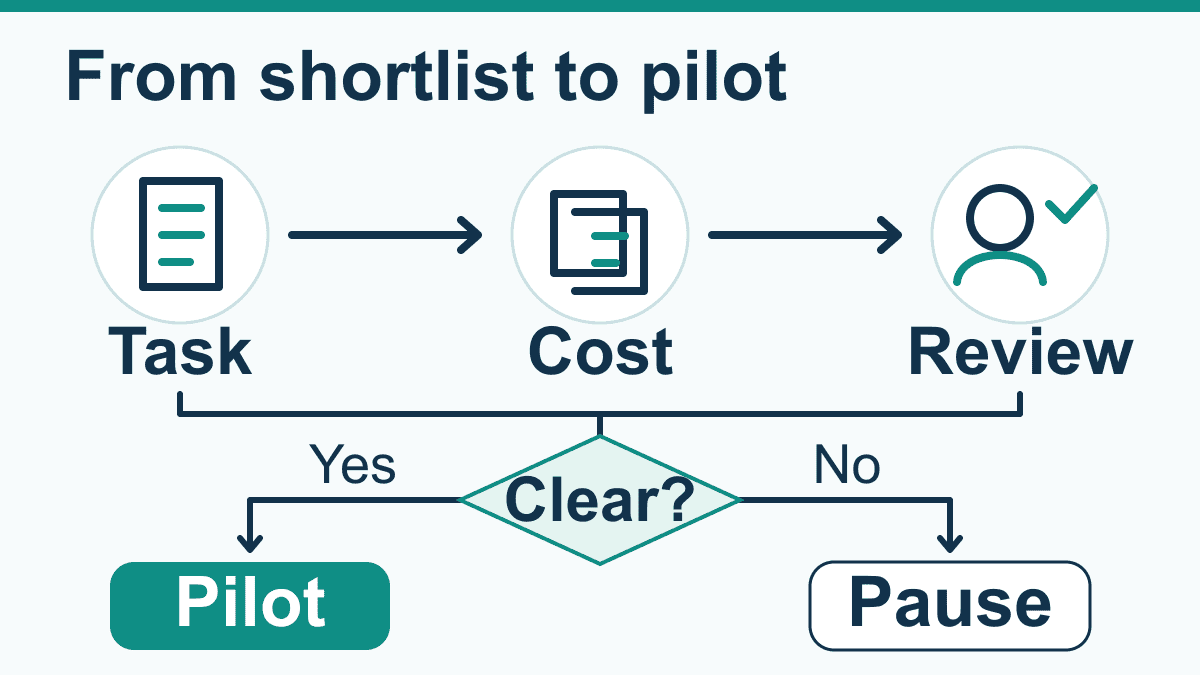
An AI chatbot for customer service is a buying decision about work, not a promise that a smaller subscription will replace a support team. Before choosing software, decide which questions it may answer, which decisions need a person, and what a completed conversation actually costs. A useful comparison keeps seats, AI usage, annual commitments and review time separate, so a low advertised starting price does not become an unexpected operating bill.
For a small business, the immediate goal might be a clear answer about opening hours, a useful first response after closing, or less copying of the same policy. Those are different jobs from approving refunds, changing bookings or deciding who owns an account. Start with one bounded task, then compare the cost and evidence needed to trust that task.
The public pricing and documentation below were reviewed on October 15, 2026. Prices are advertised USD amounts with the stated billing units, not account-specific quotes or verified checkout totals. The evaluation exercises are suggestions, not results from product testing. No shared test establishes a quality winner among these products.
Choose the customer-service task before choosing the chatbot
Write the intended job as a sentence that a teammate can accept or reject: “Answer questions about our published delivery areas, using the current delivery policy, and offer a person when an address needs judgment.” That is more useful than “automate support.” It identifies an answer source, an allowed boundary and an exception.
Separate answering from acting. Explaining a cancellation policy is not the same as cancelling a booking. Explaining a published refund window is not approval to issue a refund. A product demonstration that answers a question does not prove that the same product can safely change the associated customer record. Ask for a separate demonstration and permission review before adding any state-changing task.
- Information only: published hours, service areas and general policy explanations that do not require private account data.
- Information with a lookup: an order or appointment answer that needs an approved way to establish access and retrieve the right record.
- Request collection: gathering the minimum details a person needs to review a change, without implying that the change is approved.
- Human decision: exceptions, disputed charges, account access and sensitive complaints that stay with an authorized teammate.
For a hypothetical repair business, “What areas do you cover?” could be an information task. “Move my appointment to tomorrow” is a different task with availability, identity and approval questions. Keep them separate in the buying worksheet even if they arrive in the same conversation.
Choose the channel where that bounded task matters. A website visitor, a Facebook Page customer and an existing help-desk user may need different access and handoff arrangements. Do not assume that one advertised AI feature is included on every channel or plan. Put the required channel in the quote request and ask the seller to show the exact arrangement you would buy.
If the broader category is still unclear, use our guide to different chatbot service arrangements to distinguish software from managed help. Return to this worksheet with one job and one channel rather than expanding the first purchase into a replacement for every customer conversation.
Build a quote worksheet that separates seats, usage and commitment
Compare the chargeable unit before comparing the dollar amount. A seat pays for a person’s access. A conversation, session or outcome can meter a different part of the service. Similar labels do not establish equivalent allowances. Write each seller’s definition next to the price rather than translating everything into an imagined cost per ticket.
| Quote item | What to record | Question to resolve before purchase |
|---|---|---|
| Base software | Plan name, required seats and permitted channel | Does this plan include the specific task you need? |
| AI usage | Unit definition, allowance, refresh rule and overage | What event starts a charge, and what does not count? |
| Commitment | Monthly payment versus annual commitment | What is due now, and what is the cancellation arrangement? |
| Implementation | Required onboarding and optional service charges | Which costs are mandatory for this exact package? |
| Ongoing work | Answer maintenance, review and exception handling | Who owns this work, and how will you measure the hours? |
| Trial or allowance | Eligibility, duration, limits and what follows | Is this a one-time allocation, a recurring allowance or a paid trial? |
Ask for two written estimates using your own expected volumes: a normal month and a busier month. Keep the assumptions visible. If the seller cannot price a scenario until you identify the task, channel or seats, resolve those inputs first. A vague estimate is not a fixed total.
An annual rate expressed “per month” can help compare plans, but it does not necessarily mean monthly payment or a cancellable monthly agreement. Record the total commitment and payment schedule separately. Also ask how changing seat counts, exhausting an allowance or ending a trial affects the bill.
Do not add every starting price into a supposedly guaranteed package. A product may offer alternative purchasing arrangements, and an AI charge may apply only to eligible plans. Conversely, do not assume that a help-desk entry plan includes a separately metered AI product. The quote should identify one purchasable configuration rather than a mixture of attractive figures from different pages.
Keep an unanswered column. Marking a charge “not confirmed” is more useful than entering zero. Before approving the purchase, resolve each unknown or agree on a spending boundary with the person responsible for the account.

Compare seven options by their commercial terms, not an AI quality score
This comparison records dated public terms and a question to resolve, not a ranking. Published resolution percentages come from different vendor populations and definitions. They are not a common-sample benchmark, so none is used to promise your results. Confirm the applicable package before accepting a quote.
| Option | Advertised terms or current disposition | Buying question |
|---|---|---|
| Messenger Bot | Starter $29, Pro $99 and Agency $299 per month; advertised seven-day trial. Bring Your Own Key (BYOK) usage is separate from the software plan. | Which advertised plan and current account capabilities cover your chosen business conversation? |
| Tidio and Lyro | Starter $24.17 per month billed annually, or $29 monthly, with 100 billable conversations. Lyro starts at $32.50 per month annually, or $39 monthly, for 50 Lyro conversations. The first 50 free Lyro conversations are one-time, not a monthly refill. | Which conversations count toward Starter, and which consume Lyro? |
| Intercom and Fin | Essential advertises $29 per seat per month annually, plus Fin usage. Fin distinguishes $0.99 outcomes from $9.99 qualifications; an outcome is not limited to a resolution. | Which Fin package and chargeable outcome definitions apply to your task? |
| Freshchat and Freddy | Growth advertises $19 per agent per month annually. Freddy is $49 per 100 sessions. The 500 complimentary sessions are one-time for eligible paid plans; a session groups interactions over 24 hours. | Do current eligibility, preview usage and pack-expiry rules fit your expected volume? |
| HubSpot and Breeze customer agent | The legal catalog lists Service Hub Starter from $20 per Core Seat per month and Professional from $100 per Service Seat per month, with $1,500 required one-time Professional onboarding. Customer agent needs an applicable Professional or Enterprise subscription and uses credits; messaging advertises $0.50 per resolution. | What are the complete eligible subscription, seat, onboarding and credit charges? |
| Zendesk | The official English help page describes a Suite plus Copilot bundle for new Suite Professional-or-above customers through Sales. No current US bundle total is established here. | Can the quote separate base seats, AI-agent resolutions and agent-assistance charges? |
| Drift | Salesloft announced a gradual Drift sunset and referrals to successor 1mind on March 5, 2026. Treat this as a transition to investigate, not an unchanged current Drift purchase recommendation. | What availability, transition and contract terms apply to an existing or proposed account? |
Check the separate meters behind the starting price
Tidio’s help-desk allowance and Lyro allowance are not interchangeable. Its October 5 pricing explanation distinguishes the annual and monthly rates; the official allowance details describe the one-off free Lyro allocation. Do not interpret that first allocation as free AI service every month.
For Intercom, compare the official seat pricing with the separate Fin definitions. Fin’s $0.99 outcomes include specified resolutions and other defined events; $9.99 qualifications are a different category. A simple transfer without an outcome is not charged. A transcript that reaches a human therefore does not, by itself, tell you the billing result.
Freshworks’ official plan pricing and August 12 session guidance distinguish session charging from seats. Previews consume sessions too. Complimentary eligibility differs for new customers and legacy contracts, and unused packs follow applicable billing-cycle terms rather than becoming indefinite credit.
Resolve eligibility and transitions before treating an offer as available
HubSpot’s legal product catalog is not a standalone Breeze total. Compare it with the current customer-agent offer. The current access guidance describes 14-day access for eligible accounts, not a universal 28-day entitlement. Verify your eligibility and post-access terms before starting.
For Zendesk, use the official bundle guidance to frame a quote request. Do not reconstruct a US bundle by adding prices from unrelated offers. For Drift, read the dated transition announcement; it does not establish a universal shutdown date or prove that the successor fits your support task.
When a seller proposes ongoing implementation or operation rather than software alone, use our vendor-scoping and contract questions for that separate decision. A managed-service proposal needs its own responsibilities and deliverables, not just a seat-price comparison.
Review answer sources, permissions and human decisions before a pilot
A small answer library with a named owner is a more controllable starting point than an unreviewed collection of documents. For each intended answer, record the approved source, the date someone checked it and the person who can change it. If two policies conflict, resolve the conflict before asking a chatbot to choose between them.
NIST’s 2024 Generative AI Profile describes confidently false generated content and context-appropriate evaluation and oversight. That is a reason to examine unsupported answers, not a certification of any product. The published risk profile does not guarantee that supplying documents makes an answer correct.
- Source boundary: identify the approved pages or documents and remove irrelevant material from the proposed task.
- Change ownership: choose who checks prices, hours and policies when the business changes them.
- Permission boundary: distinguish reading general information from accessing a private record or making a change.
- Human review: name the person or team that handles exceptions, missing evidence and customer requests for help.
- Customer wording: explain what happens next without implying that a request has already been approved.
- Data restraint: use invented examples during evaluation and avoid adding private information just to make a demonstration look realistic.
Ask the seller to demonstrate a question the source cannot answer. A useful evaluation records whether the response admits the gap and offers the intended human path. A fluent sentence is not evidence that the underlying policy exists. Also check a contradiction: one approved document says one thing, another says something different. The expected response should follow a decision you have made, not a convenient guess.
Permission checks deserve their own questions. Who can edit approved answers? Who can connect a business channel? Who can approve a workflow change? Who can review stored conversations? Ask for the available controls in your proposed package, and mark unverified controls as unresolved rather than assuming them from a product category.
Keep sensitive decisions outside the initial task. A customer asking about an unexpected charge needs a person with the right authority, not a generated explanation presented as a completed investigation. Account access, privacy requests and safety concerns likewise need a separately reviewed process. This checklist is a planning aid, not legal advice or a security certification.

Run a small pilot with explicit pass and stop conditions
Choose a contained evaluation before connecting a broad set of customer interactions. The pilot should answer a buying question: can this exact configuration handle the approved task within the agreed boundaries? It does not need a promised launch duration to be useful. Finish the prerequisites before allowing real customer use.
- Choose an accountable reviewer. Give one person responsibility for recording results, resolving unclear answers and stopping the exercise.
- Prepare a fixed set of invented questions. Include direct questions, different wording, missing details, an unsupported topic and a request for a person.
- Write the expected answer or disposition first. Identify the source that supports an answer, or specify that a person should review it.
- Record the commercial meter. Note which conversations, sessions, outcomes or credits the exercise consumes under the applicable terms.
- Evaluate the whole path. Check the answer, the next action and the handoff description rather than stopping at the first plausible reply.
- Review errors before expanding. Separate missing-source problems, unclear business rules, permission gaps and product behavior that does not meet the requirement.
For example, an invented delivery question can be supported by a short approved service-area list. A question about a town absent from that list should not produce an invented delivery promise. A request to change an address should not be reported as completed when the approved exercise only collects a request. These are proposed cases, not observations about a particular platform.
Define the stop conditions before running the cases. An unsupported factual claim, an unintended account action or exposure of private information can require an immediate pause and review. A slower-than-desired but accurate answer might instead become an improvement item. Your business decides the threshold for the task; a vendor’s overall percentage does not make that decision.
Retest the same cases after a change so that a repaired answer does not hide a new problem elsewhere. Keep the question set and the version of the approved information together. Otherwise, a later comparison could confuse a changed source, changed question and changed product response.
For day-to-day handling beyond the purchase exercise, our guide to reviewing support answers and human handoffs covers that operational focus. Keep the buying decision here tied to the evidence and costs of your own bounded pilot.
Calculate capacity value without calling it guaranteed cash savings
Use measured work rather than a universal cost per interaction. Count the time spent answering, reviewing, correcting and maintaining the task before and during the pilot. If a chatbot collects useful details but a person still completes the case, measure the time difference instead of recording the entire case as eliminated.
The following is invented arithmetic to explain a worksheet, not a customer result, industry benchmark or forecast. Assume the same defined work took 50 staff hours before a pilot and 35 hours afterward, including human review, corrections and answer maintenance. At an assumed value of $25 per hour, the 15-hour difference represents $375 of modeled capacity value.
| Illustrative input or calculation | Invented amount |
|---|---|
| Hours before for the defined work | 50 hours |
| Hours afterward, including review and maintenance | 35 hours |
| Difference | 15 hours |
| Assumed hourly capacity value | $25 |
| Modeled capacity value: 15 × $25 | $375 |
| Assumed incremental software and usage costs | $100 |
| Modeled capacity value after those costs | $275 |
The $275 is not automatically a reduction in payroll or money received. Staff may use the time for other work while payroll stays unchanged. A cash-saving claim needs an actual avoided expense, supported by the business’s records. Keep capacity value, realized cash savings and any attributed sales in separate columns.
Run the worksheet again with less favorable assumptions. If review takes longer, usage costs increase or the task volume falls, does the purchase still meet your purpose? Include one-time onboarding separately from ongoing monthly expenses. Do not hide an annual commitment by spreading it across months and then describing the result as a cancellable monthly cost.
Use comparable work when evaluating the before and after periods. More easy questions, fewer complicated requests or a change in opening hours can change the result without proving that the chatbot caused it. When you cannot separate the effects, label the estimate provisional and collect a better comparison.
Measure completed work and customer experience together
A growing conversation count can mean greater use, repeated confusion or more customer demand. It does not establish successful support. Decide what counts as completion for the task, then examine the cases behind the number. Keep failures and requests for a person visible rather than treating every automated reply as a resolved issue.
| Measure | Working definition to agree | Check before drawing a conclusion |
|---|---|---|
| Supported completion | The defined question was answered from approved information or the required next step was completed | Was the evidence checked, and did the customer return with the same unresolved issue? |
| Human-review share | Cases that reached the agreed human path | Was the handoff appropriate rather than merely fewer? |
| Rework time | Time correcting answers, recovering missed context and finishing partial work | Is this time included in the capacity worksheet? |
| Customer feedback | Feedback gathered with the same question and method across periods | How many people responded, and who did not? |
| Total task cost | Applicable software, usage and measured staff work | Are units and commitments comparable? |
Keep the billing definition separate from your business definition of success. A vendor may legitimately charge for its defined outcome even when your team wants additional evidence before considering the customer’s problem solved. Record both. That avoids turning a billing report into an unsupported customer-satisfaction claim.
Sample the underlying cases, not only the headline totals. Include successful answers, human handoffs, abandoned conversations and repeated questions. Examine why a customer asked again. A repeated question may expose an unclear policy or a failed answer, but the count alone cannot distinguish them.
Use the same channel and comparable demand when reviewing a change. Note promotions, seasonal shifts, policy changes and staffing differences alongside the measurements. These are possible comparison factors to record, not explanations to assume. Report a result as causal only when the evidence supports that stronger conclusion.
Choose the next action from the specific finding. Missing approved information calls for a source review. A confusing handoff needs a clearer next step. An unexpected charge needs a billing-definition check. An unsupported answer needs a pause and investigation before wider use. A single summary percentage cannot replace that decision.
Check Messenger Bot plan fit against one business conversation
If your chosen task involves a business’s Facebook Messenger conversations, evaluate Messenger Bot against that task rather than assuming a feature list proves fit. Bring the required channel, answer sources, human-review boundary and expected usage to the plan decision. Confirm current account capabilities before treating a public description as a working configuration.
The public plans advertise Starter at $29, Pro at $99 and Agency at $299 per month, plus a seven-day trial. BYOK (Bring Your Own Key) usage is separate from the software plan. These advertised amounts do not establish trial eligibility or your checkout total. Check Current Pricing and resolve the applicable plan, usage and terms before subscribing.
Then Browse Our Tutorials for the current guidance relevant to your selected task. Use the same pilot worksheet: one approved question set, a named reviewer, a clear human path and a cost boundary. Expand only when the actual results justify the next task, not because a plan name or demonstration sounds broader.
Frequently asked questions about AI chatbots for customer service
How much does an AI customer service chatbot cost?
There is no single comparable starting total. Separate the software plan, required seats, AI usage, commitment and any mandatory onboarding. Messenger Bot advertises monthly plans at $29, $99 and $299 with BYOK (Bring Your Own Key) usage separate. Confirm current terms and model your own task volume before buying.
Can an AI chatbot fully replace human customer service agents?
Do not plan on a complete replacement from an advertised feature or demo. Define a bounded task, keep exceptions and sensitive decisions with an authorized person, and evaluate unsupported questions and human handoffs before expanding customer use.
What percentage of support tickets can AI chatbots handle?
No universal percentage is established by this comparison. Vendor figures use different definitions and customer populations. Measure supported completion, appropriate handoffs and rework on your own defined task instead of treating a marketing percentage as a forecast.
How long does it take to set up an AI customer service chatbot?
No fixed setup time is promised here. The work depends on the task, approved information, channel access, permissions, billing arrangement and human-review path. Complete a bounded pilot and resolve its failures before setting a launch date.
Which AI chatbot platform is best for small business customer service?
Choose by the task, required channel, commercial terms and evidence from a bounded evaluation. This comparison does not establish an AI quality winner. Check package eligibility and chargeable units, then compare the configuration you would actually buy against your written pass and stop conditions.
 English
 Tagalog
 简体中文
 العربية
 हिन्दी
 Português do Brasil
 Español de México
 Français
 বাংলা
 香港中文
 繁體中文
 Nederlands
 Deutsch
 Bahasa Indonesia
 日本語
 한국어
 Polski
 Русский
 Español
 Tiếng Việt