
Give Each Dealership Question a Clear Next Step
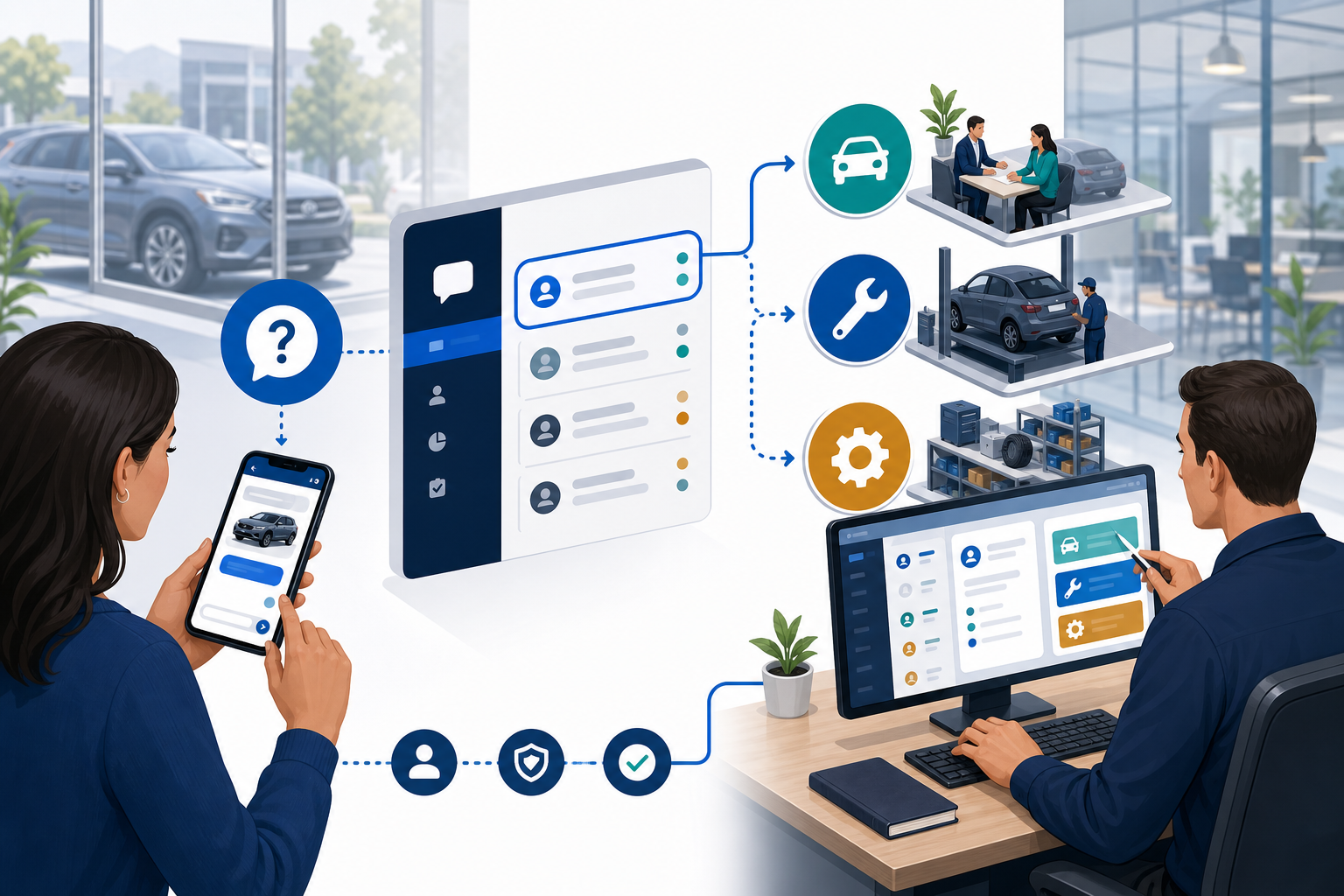
Help a vehicle shopper reach the right dealership team without turning a question into an invented promise. A sales enquiry, a service appointment request and a financing question need different answers and different staff ownership. Use this evaluation guide to decide what a proposed automotive chatbot may answer, what it should collect and when a person needs to take over.
Start with One Request Your Team Can Handle
Choose one department and one reader task before comparing tools. For example, a service team could assess whether an interface helps visitors ask for an appointment, while the sales team could assess whether it routes a vehicle question to an available representative. Keep a requested visit separate from an accepted booking, a vehicle listing separate from confirmed availability and a preliminary estimate separate from an agreed price. Define those distinctions in the replies that customers actually see.
For the bounded pilot described here, treat the interface as a way to share reviewed information and request staff follow-up. Do not give it authority to diagnose a vehicle, approve finance, negotiate a transaction or make a commitment on behalf of the dealership. This is a proposed evaluation boundary, not a statement that every chatbot has the same capabilities. The team still needs to check what its selected product and account actually support.
Cox Automotive’s car-buyer research discusses digital shopping tools. That industry survey is not a test of a particular chatbot or proof that your dealership will gain sales, satisfaction or faster replies. Judge a proposed workflow against your own verified requests, staff responses and customer outcomes instead of borrowing a study’s headline as a product promise.

The Mechanics of Question Routing
Give a vehicle shopper a route that matches the question they actually asked. Someone looking for a test drive needs a different receiving role from someone asking about a replacement key or service visit. Write down those common requests with sales, service and parts staff, then check where each request should arrive. Do not assume that a familiar department label proves the handoff works.
Offer clear choices when they help a visitor choose the next step. For example, a proposed menu could show “Sales Information,” “Service and Maintenance” and “Speak to a Person.” These are fictional labels, not a screenshot or a claim about a named product. Include an option for someone who is unsure, and check that free-text questions can reach a useful fallback rather than trapping the visitor in the menu.
Use the initial choice to narrow the next question. A visitor selecting service might need to request a visit, ask about a part or reach an adviser. Map each route to its actual receiving role and test the handoff; a menu label alone does not show where the information arrived. Keep a way to correct the department choice without restarting or repeating unnecessary details.
Ask the vendor to change one route during the demonstration and show who receives the revised request. The team should be able to maintain the wording, recipient and alternative contact route in the selected account. Record any permission, plan or integration dependency instead of assuming the builder can match every dealership process.
Compare a Useful Reply with a Decision That Still Needs Staff
Use this comparison as a worksheet for the proposed pilot, not as a list of features any vendor automatically includes. Fill in the dealership’s actual source and responsible role before configuring a reply.
| Customer question | Reviewed information or request | What remains unconfirmed | Responsible team |
|---|---|---|---|
| When is service open? | Approved service hours and date exceptions | An unlisted date or conflicting schedule | Service reception |
| Can I book a repair? | Requested work and preferred time | Accepted slot, work scope and price | Service adviser |
| Is this vehicle available? | Approved listing link or staff enquiry | Current stock, condition and appointment | Sales representative |
| What is my trade-in worth? | Request for the dealership’s valuation process | Estimate conditions or final offer | Authorized appraisal contact |
| Will I qualify for finance? | Official finance-team contact route | Eligibility, terms and approval | Finance representative |
| Can I speak to someone? | Available contact route and stated preference | Staff receipt or a response time not yet agreed | Named duty role |
For the visit-request row, the appointment request checklist explains why collecting a preferred time is separate from confirming a booking. Apply the same distinction to a test drive or service request, then confirm the actual dealership process with staff.
Providing Low-Risk Information
For this general-enquiry pilot, begin with information the responsible team can review and keep current. Hours, directions and department contact routes are useful starting points, but even a public fact needs a named source and an update process. Keep a request for a visit or quotation separate from the staff decision that confirms it.
Examples of low-risk information include:
- Dealership Hours: Providing the separate operating hours for the sales floor and the service drive.
- Location Details: Offering the physical address, cross streets, and general directions to the dealership.
- General Contact Information: Supplying the main phone numbers for different departments.
- Basic Inventory Availability: Confirming if a specific make and model is generally carried by the dealership, without guaranteeing specific trim availability or physical presence on the lot at that exact moment.
Keep trade-in questions outside the pilot’s automatic valuation path. Staff should explain how the dealership prepares an estimate, which information it needs and what conditions could change a later offer. A chat acknowledgement must not present a figure as a final appraisal or state that every valuation requires the same inspection process. Route the request to the responsible person without collecting unnecessary vehicle or identity documents in the general chat.
If the pilot displays a vehicle price, use only an approved source and preserve its conditions. Let staff confirm availability, included charges and any requested quotation before presenting an agreement. A customer asking for a total should receive a clear next step rather than a guessed out-the-door amount or a claim that an advertised figure covers every circumstance.

The Principle of Data Minimization
Collect only information the team has reviewed for the stated follow-up purpose. The FTC’s Privacy Rule guidance for auto dealers explains that personal information connected with potential financing or leasing can fall within that rule even without a formal application. General enquiry handling and a finance application are not interchangeable. Have the dealership’s qualified advisers assess the exact workflow; a short chat checklist does not establish legal compliance.
In the context of a conversational interface, the purpose is usually to facilitate a follow-up conversation with a human representative. Therefore, the interface should only request the information required to make that connection. Typically, this includes:
- The user’s first name.
- A preferred method of contact (either a phone number or an email address).
- A general description of what they are looking for (e.g., “Interested in a 2024 sedan” or “Need an oil change”).
Keep sensitive finance and identity records out of this general-enquiry pilot. Do not ask for Social Security numbers, driver’s license numbers, full financial histories or card details here. Test what happens if a visitor provides that information unexpectedly: the team needs a reviewed handling process, not another prompt requesting more. Limiting the enquiry does not certify the wider dealership’s privacy or security.
Explain the purpose of a requested phone number or email address and let the visitor state a preferred contact route. Do not treat the presence of a phone number as evidence that the person agreed to unrelated marketing or every available channel. Keep the enquiry, the stated contact preference and any permission evidence distinct. Staff should follow the dealership’s reviewed contact policy and respect a request to stop or change the conversation.
Structuring Human Follow-Up
Make the handoff useful to both the visitor and the receiving employee. Decide which request details staff need, which contact preference should travel with them and what the visitor will see while a decision is pending. Test the person-request option early; it should not depend on completing an unrelated sales questionnaire.
Agree who receives each request, what information they need and what the customer should see when the transfer succeeds or fails. A reply should say that a request was recorded only after the selected system has actually confirmed that result. If delivery or staff receipt cannot be checked, explain the uncertainty and provide the dealership’s approved alternative contact route. Do not turn a saved “sent” message into proof that a person has reviewed the request.
Give the receiving role a short, readable request summary rather than an unexplained conversation count. In a fictional service example, it could contain the requested work, the visitor’s preferred contact route and the fact that no time has been confirmed. Ask the service adviser to find that request using their normal access. If the dealership uses a Business Development Center or an internet sales team, include its actual receiving process in the test instead of assuming every dealership has the same staffing structure.
Managing After-Hours Expectations
Consumers conduct research at all hours, often browsing inventory or looking up service information late in the evening or early in the morning when the dealership’s physical doors are locked. A conversational interface can remain active during these periods, but it is imperative that it manages user expectations accurately.
When the responsible team is unavailable, say so accurately and identify the reply as automated. Do not describe the whole dealership as closed merely because one department cannot answer. Use approved department hours and date exceptions, and give a reviewed alternative contact route. A visitor should not have to guess whether a person is currently reviewing the request.
Example after-hours reply: “You are using an automated information service. The team is not currently available to confirm this request. You can leave the details needed for a follow-up or use the dealership’s published contact route.” Add actual department hours or a response commitment only when staff have approved and can maintain that information. Do not insert an invented next-business-day deadline.
Check the after-hours reply against the department receiving the enquiry. Sales and service may use different schedules, and a holiday exception may change either one. When the responsible team is unavailable, keep the request pending rather than displaying a successful booking or an assured callback time. An accurate limitation is more useful than a reassuring message the team cannot fulfil.
Accessibility Considerations in Digital Retail
As dealerships evaluate digital tools, accessibility should be a central review item. A dealership’s website serves as a digital storefront and should remain navigable for people who use keyboards, screen readers, magnification, or other assistive technology. The chatbot evaluation should include keyboard navigation, readable focus states, clear labels, understandable error messages, and a non-chat way to reach the dealership.
When reviewing a conversational interface, the dealership must assess its compatibility with screen readers. Users who are visually impaired may use software that reads the text on a screen aloud. The chat window must be coded in a way that allows a screen reader to parse the text, understand the available options in a routing menu, and navigate the interface using a keyboard rather than a mouse.
Check contrast, readable text and whether an important status is explained in words rather than color alone. Ask the dealership’s web team to assess the actual interface against the accessibility requirements relevant to its service. A vendor’s general accessibility statement is useful evidence to investigate, not a substitute for testing the selected chat, error and contact paths.
Establishing Finance and Privacy Boundaries
Decide with the dealership’s qualified finance, privacy and security advisers which questions belong in a reviewed application or staff process. For this general-enquiry pilot, keep credit applications, approval decisions and payment collection outside the chat. A route labelled “finance” should explain where a person can obtain help, not imply eligibility or approval.
If a visitor begins providing sensitive financial details, the reply should redirect the conversation to the dealership’s approved process rather than requesting more. Staff need to decide how inappropriate submissions are handled and who can access them. Do not promise that a notice, a routing button or a particular product automatically makes the handling secure.
The FTC’s Safeguards Rule FAQs for automobile dealers describe covered dealers’ information-security and service-provider oversight obligations. The exact activities and information matter. Use that guidance with qualified advice when assessing the proposed vendor and workflow; keeping the pilot away from finance data does not by itself certify the dealership or its wider systems.
Record the approved destination for a finance enquiry and test that it leads to the intended team or application. Check the wording, access arrangements and failure path before enabling the route. Leave any unverified capability or process marked as unresolved rather than describing it as a protection the dealership already has.
Conducting Pilot Tests
Before executing a full-scale deployment of any new digital tool, a prudent dealership will conduct a pilot test. A pilot test involves rolling out the technology in a limited, controlled environment to evaluate its performance and identify potential issues before they impact the broader customer base.
A dealership might choose to pilot the conversational interface only on specific pages of their website, such as the general “Contact Us” page or a specific inventory category, rather than deploying it site-wide. During this pilot phase, management should closely monitor the interactions. They should review transcripts to ensure the question routing is functioning correctly, that the interface is adhering to the established boundaries regarding low-risk information, and that the data minimization protocols are effective.
Crucially, the pilot test allows the dealership to evaluate internal team readiness. Are the BDC representatives receiving the information clearly? Is the process for following up on the interactions well-understood and efficient? If the pilot reveals that the internal team is struggling to manage the incoming information, the dealership can pause the deployment and refine their internal training before proceeding.
Run a Request-to-Staff Acceptance Checklist
Use fictional requests and the people who will maintain the service. A demonstration is not complete just because a reply appears. Follow the request to the receiving role, inspect the information that arrived and check what the customer was told.
- Choose one purpose. Write down the question the pilot should answer and the decisions it must leave to staff. Do not add another department midway through the test without reviewing its own boundaries.
- Bind the approved facts. Identify the current schedule, listing or contact source, who may change it and how a date exception reaches the reply. Test an unanswered question as well as the ordinary case.
- Use incomplete requests. Try a service enquiry without a preferred time and a sales question without a vehicle link. The reply should ask only for useful missing details, not manufacture them or force a finance application.
- Ask for a person. Try that request at the start, halfway through a route and after a misunderstanding. Confirm which role receives it and whether the conversation can stop safely.
- Test an unavailable recipient. Check what happens when the usual adviser is absent or the destination cannot receive the request. The customer-facing wording must reflect the observed result, with a usable alternative.
- Check preferences and access. Inspect whether only necessary information arrives, whether staff see the stated contact choice and whether access follows the dealership’s reviewed policy. Do not put real customer records into a demonstration.
- Trace the final decision. A staff member should be able to distinguish requested, received, awaiting review and confirmed. Check the public reply against that record before calling the handoff successful.
- Record the change decision. For each failed check, note the observation, responsible role and corrective action. Keep the pilot limited until staff have retested the actual failed path.
An example evaluation record might say: “Fictional service request received by the nominated adviser; requested time remains unconfirmed; no finance details collected.” A different record might say: “Reply displayed, but staff receipt not verified; retain the alternative contact route and investigate.” Neither entry is a real dealership result or evidence that a product has passed these checks.
When reviewing the pilot, separate the number of messages from useful outcomes. Count requests that staff could understand, requests that reached the intended role and requests that received an actual decision. Keep duplicate, cancelled and unresolved requests visible. Compare equivalent periods and staffing conditions before discussing improvement; a change in enquiry volume alone does not show better service or increased sales.
Vendor Verification and Selection
Compare the same request-to-staff checks across shortlisted tools. Ask each vendor to identify which functions are included in the proposed account, which depend on an integration and which remain manual. Keep a written answer beside the observed demonstration so the team can distinguish a documented capability from a sales promise or an unresolved assumption.
Use our broader guide to chatbot services to compare service models, handoff design, data questions, and total operating cost before applying this dealership-specific checklist.
Use the same fictional after-hours, missing-detail and person-request examples for each demonstration. Ask the vendor to show the customer reply and the staff receiving screen, then explain what happens when delivery fails. Request current accessibility and data-handling documentation for the exact service being considered. Leave unanswered questions visible before choosing the workflow.
Compare a vendor’s documented behaviour with the worksheet and pilot results. Messenger Bot is one customer-conversation product to consider, not a verified dealership integration or finance system. Review the current Messenger Bot features, ask about the exact account and supported workflow, and Check Current Pricing before making a purchase decision. Leave any unsupported action with staff rather than assuming a feature label proves it.
Ask each shortlisted vendor to demonstrate the same fictional requests and explain what the test did not establish. Record unresolved questions alongside the results. Choose only a workflow the dealership can review and maintain; comparing vendors does not guarantee a safe integration or a successful customer outcome.
Choose a Workflow Staff Can Own and Maintain
Begin with one reviewed question-to-person path. Give its facts an owner, explain what remains unconfirmed and make an alternative contact route easy to find. Expand only after staff can maintain the information and account for the request’s actual outcome. The useful decision is whether a specific workflow fits the dealership—not whether a vendor can display a convincing conversation.
Questions Dealership Teams Ask Before a Pilot
What should an automotive chatbot do for a dealership?
For a limited pilot, use reviewed information and clear routes to the responsible sales, service or parts team. Keep availability, prices, bookings and finance decisions unconfirmed until the authorized process or person has checked them. Verify the selected tool’s actual capabilities.
What information should a dealership request in chat?
Ask only for details needed for the stated enquiry, such as the requested department and a preferred contact route. Keep permission evidence separate from the presence of a phone number. Do not request sensitive finance or identity records in this general-enquiry pilot.
Can a chatbot confirm a service appointment after hours?
Receiving a preferred time is not an accepted appointment. Use approved department hours, describe the reply as automated and keep the request pending until the reviewed booking process confirms it. Give no invented callback or next-business-day promise.
Should customers apply for vehicle financing in chat?
Keep this general-enquiry pilot outside credit applications, approval decisions and payment collection. Give the dealership’s reviewed finance contact or application route. Qualified advisers should assess the actual workflow; a routing message does not establish compliance or security.
How can a dealership test a chatbot before buying?
Use fictional requests to check the approved facts, missing information, request for a person, unavailable recipient and actual staff receipt. Record what happened and retest failures. A demonstration, message count or reassuring reply is not proof of a completed customer outcome.
If Messenger Bot is on your shortlist, Browse Our Tutorials and compare the documented steps with the workflow your team has reviewed. A tutorial is a place to check current instructions, not proof that a particular integration, booking action or plan entitlement is available to your dealership.
 English
  Tagalog
  简体中文
简体中文  العربية
  हिन्दी
  Português do Brasil
  Español de México
  Français
  বাংলা
বাংলা  香港中文
香港中文  繁體中文
繁體中文  Nederlands
  Deutsch
  Bahasa Indonesia
  日本語
日本語  한국어
한국어  Polski
  Русский
  Español
  Tiếng Việt