
A quiet customer is not necessarily a lost customer. Before sending another offer, check whether they are still buying, are between service visits, or need help with an unresolved issue. A useful customer retention plan starts with the relationship itself: reliable service, accurate records and follow-up that fits what the person actually needs.
This practical plan is for small-business owners reviewing existing customers, not prospects who have never purchased. It separates customer history from marketing activity, offers suggested staff-reviewed follow-up examples, and shows how to measure a return without claiming a message caused it. Source documentation was reviewed on October 13, 2026. The examples are hypothetical, not tested performance results or promises of automated Messenger Bot features.
Separate customer retention from marketing inactivity
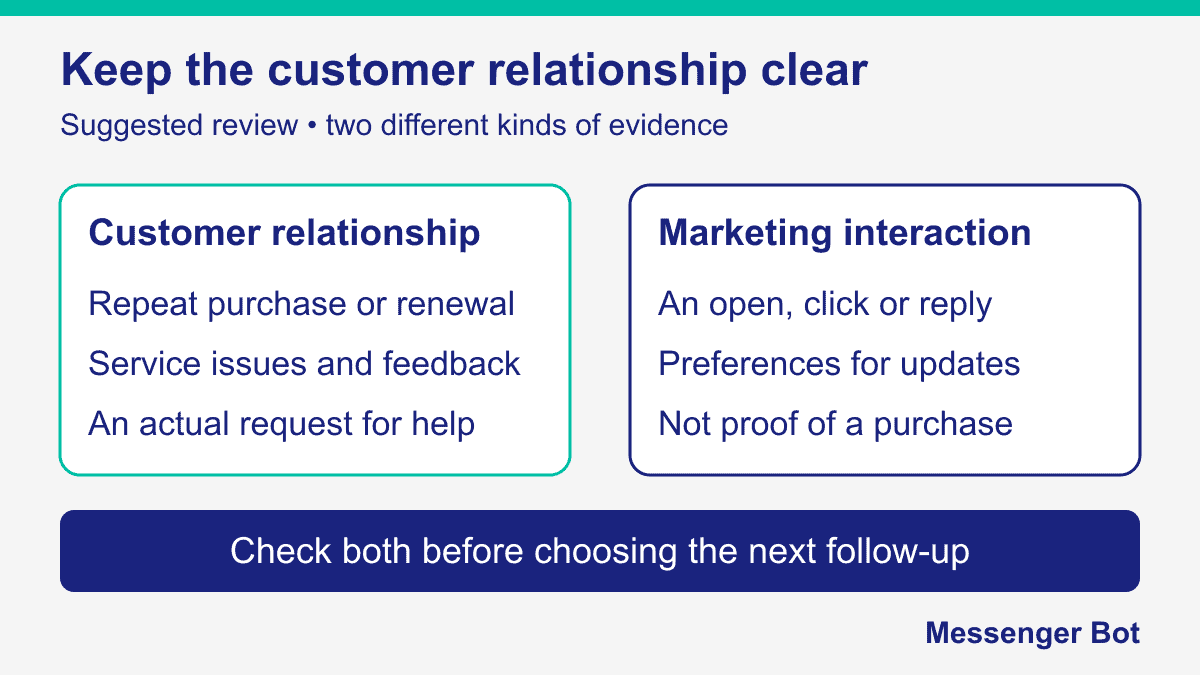
Customer retention concerns an ongoing customer relationship. That might mean a repeat purchase, a completed return appointment, a renewal or continued use of a contracted service. Decide what counts for your business before marking someone active or lost. A person who has never purchased belongs in a prospect group, even if they regularly read your updates.
Marketing inactivity answers a narrower question: has a contact interacted with recent messages? In its subscriber-activity documentation, Mailchimp describes inactivity within an opted-in marketing audience and explains that the appropriate interval depends on communication frequency and the product or service. It does not supply a universal waiting period for every business.
The address-status documentation also distinguishes not contacting someone recently from contacting them without receiving opens or clicks. A person can still interact with a business elsewhere. Check purchase and service records rather than using message engagement as a substitute for them.
Consider three hypothetical situations. A repair-shop customer may have no reason to book again until another service is due. A repeat-purchase customer might order by phone rather than click an email. A maintenance client may remain under contract without sending a message that month. None of those situations establishes churn simply because a newsletter goes unopened.
| What you know | What it does not establish | Useful next review |
|---|---|---|
| A recent repeat purchase | Permission for every marketing channel | Service quality and documented preferences |
| A gap between appointments | That the customer has left | The normal service cycle and any open concern |
| No recent message interaction | No purchases elsewhere | Customer history separately from message activity |
| An unresolved complaint | That another offer will resolve it | A responsible person’s service follow-through |
| Incomplete customer records | Either retention or loss | What can be verified; leave the rest unknown |
Write the business definition in a sentence your staff can apply consistently. For example: “For this review, a returning customer is someone from our original customer group who completed another paid service during the stated observation period.” This is a suggested definition, not an industry standard. A subscription business may need a renewal definition instead. Changing the definition halfway through a report makes the comparison unreliable.
Keep a separate label for relationships you cannot assess. Missing order history, an unlinked phone purchase or an incomplete service record is a data gap, not a reason to report zero retention. Note the gap and decide who can investigate it without collecting unnecessary personal information.
Check customer context, permission and preferences
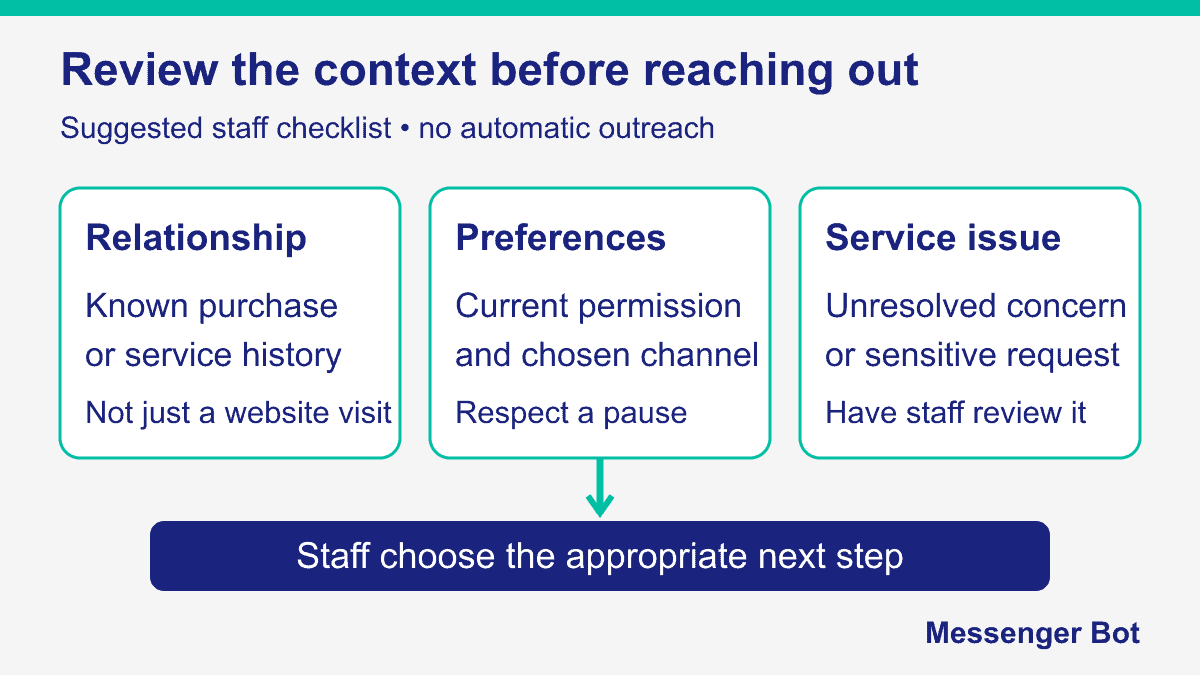
Review the last verified interaction before deciding what to do next. Was the product delivered? Was the appointment completed? Did the customer ask for a reminder or say they would contact you when ready? A suggested follow-up should answer that actual situation rather than reuse the same sales message for every quiet account.
- Relationship: Check the purchase, appointment or service history that establishes this person as an existing customer.
- Preferences: Look for the channel and type of updates the person chose, including any pause or stop request.
- Permission: Verify the applicable permission for the proposed contact. Do not treat a past purchase or a stored phone number as proof of blanket marketing permission.
- Open issues: Identify unfinished support, account-access, refund or billing questions that need a responsible person.
- Accuracy: Check that the information you plan to mention is current and that you have the correct recipient.
If permission or the recipient’s preference is unclear, do not fill the gap with a guess. Hold that proposed marketing contact for review. This is a suggested business safeguard, not a legal determination; requirements differ by channel and jurisdiction. Use appropriate advice for your own circumstances.
Keep the review proportionate. A staff note that says “asked for quarterly service information by email” may be enough to guide a relevant decision when accurate and applicable. Copying a full complaint, payment details or private conversation into a marketing worksheet does not make the review better. Refer the issue to the person responsible for resolving it and keep sensitive details out of general planning documents.
Assign ownership before inviting replies. If an update asks customers to contact you, someone needs to read those responses and act on a pause, question or complaint. A useful message with no follow-through can create another unresolved issue. Write down who will cover replies and what happens when that person is unavailable.
For a hypothetical appointment business, a customer may have explicitly requested a future reminder after completing a visit. For a repeat-purchase business, a buyer may prefer product information only when requested. For an ongoing service relationship, the right next step might be an agreed review meeting rather than marketing at all. Let those differences shape the plan.
Fix service friction before adding promotion
A discount does not answer a missing delivery, confusing invoice or unanswered question. Review the reason for a customer’s concern before deciding that the solution is another offer. Sometimes the useful retention work is an ordinary service correction: explain the next step, confirm what happened or connect the person to someone who can resolve the issue.
Look for specific friction your staff can verify. Possible areas to review include unclear appointment instructions, a booking request that was never confirmed, conflicting information about an order, or a customer having to repeat the same concern to several people. These are suggested inspection points, not findings about your business or proven causes of any particular customer’s departure.
For a hypothetical service business, suppose a returning customer asks whether a repair is covered by a previous agreement. Do not add them to a promotional message because their recent spending is low. Give the question to a person who can check the agreement and provide an accurate answer. Record the outcome separately from any future sales activity.
Use a short service review: what happened, what information is confirmed, who owns the next action, and how the customer will learn the result. If a resolution is still unknown, say so internally and avoid describing the customer as satisfied. Completion of an internal task is not the same as confirmation that the customer’s concern is resolved.
After an actual service experience and resolution of an open issue, an optional request for honest feedback can help you understand that experience. Use the review-request guide to make the invitation clear and respectful. Do not condition rewards on a positive rating or use pressure to shape the response. A review invitation is not a substitute for resolving a complaint.
When several customers mention the same difficulty, check the underlying process rather than rewriting only the follow-up message. Staff might need clearer instructions, a reliable handoff or a current answer to a repeated question. Choose a small, observable correction and verify that it works. Avoid announcing broad service improvements that have not actually been delivered.
Offer a respectful re-engagement invitation
Customer reactivation is one possible part of retention, not the entire plan. Consider an invitation only when the relationship, contact context and relevant permission have been reviewed. The aim is to offer something useful and let the customer choose—not to make silence uncomfortable or demand an immediate order.
The re-engagement documentation discusses relevant content for subscribed contacts and checking the results. It also notes that some people with little email activity remain interested in the brand. That supports a context-led review; it does not establish a predicted response rate or a Messenger Bot automation capability.
Build the invitation around a recognizable business name, accurate context and one useful next action. If you mention a resource, check that it is available and answers the customer’s likely question. If you offer human help, confirm someone can provide it. Make the preference path understandable and use only instructions your team can actually honor.
These hypothetical patterns need adaptation to the verified relationship and your working contact process before use:
- Appointment business: “Hello, this is [business]. You asked for information about your next service visit. You can check our current appointment details at [reviewed link]. If your plans have changed, let us know whether you would prefer a pause or help from our team.”
- Repeat-purchase business: “Hello from [business]. We have updated the care instructions for [relevant product]. If that would be useful, the current guide is at [reviewed link]. You can also tell us if you would rather pause these updates.”
- Service relationship: “Hello, this is [business]. Would you like help arranging the review we discussed? Our team can answer questions before you choose a date. If now is not a useful time, let us know your preference.”
Bracketed details are placeholders, not an instruction to invent history. Do not write “you asked” unless the record supports it. Do not promise an immediate preference update or a particular reply time unless your actual process can deliver that promise. These are suggested copy patterns, not messages activated by this article.
Remove false scarcity, guilt and threats of account deletion. Avoid fixed sequences that continue regardless of a customer’s response. There is no universal follow-up interval: a suitable decision depends on the relationship, business cycle, request and preference. If the useful next action is unclear, improving the context may be better than sending another message.
Continue, pause or offer human help
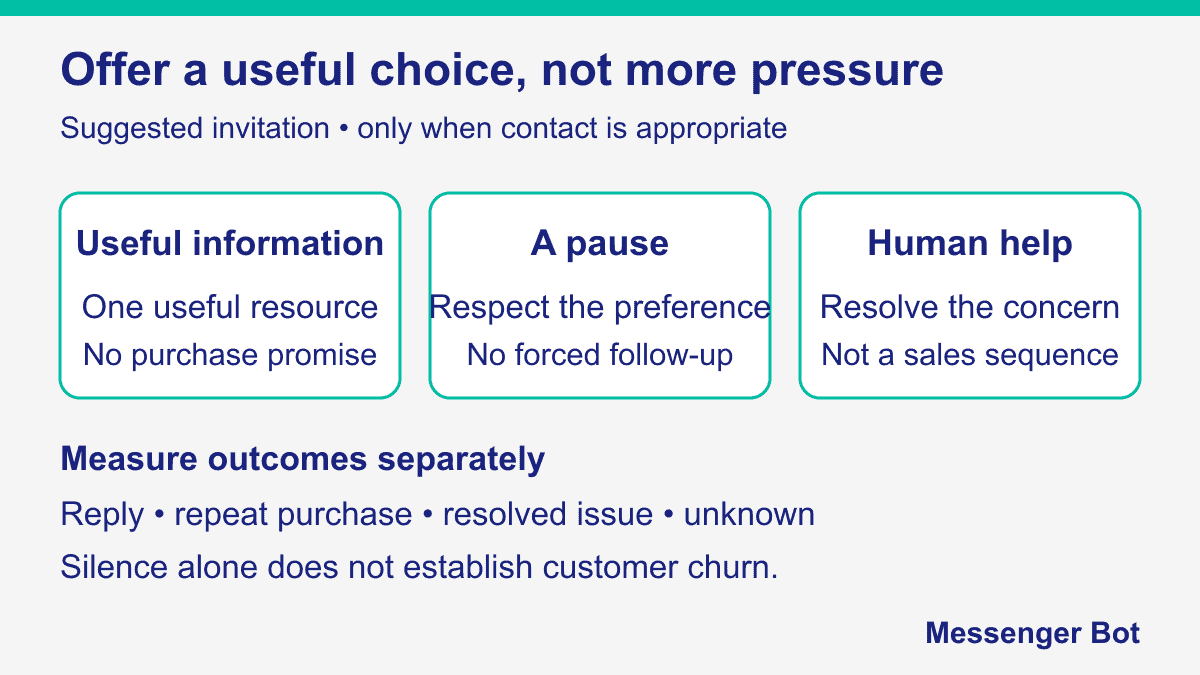
Plan the response handling before any invitation goes out. An interested reply, a request to pause, a support question and no reply are different outcomes. Combining them into a single “engaged customer” total hides what the person actually wanted and what the team still needs to do.
Continue with relevant information. Answer the question the customer asked using current facts. If they request appointment availability, give the appropriate booking information; do not change the conversation into an unrelated upsell. Confirm the next action without presenting an enquiry as a completed appointment or sale.
Respect a pause or stop request. Follow the person’s stated preference through your actual process. Do not argue with the decision or require an explanation. A brief, accurate acknowledgement may be appropriate, but do not promise that all channels have changed unless that has been verified. Preference updates and commercial outcomes belong in separate records.
Offer human help. Account access, billing, refund requests, unresolved support and sensitive information need a person with the right responsibility. If someone asks for a correction, do not answer with a promotional script. Explain the useful next step without exposing private account details in a general message.
Leave silence uncertain. No response does not establish a lost customer or permission for escalating contact. Check the agreed contact plan and applicable preferences before any further decision. A person can return later through a different channel. Keep an unknown outcome unknown until actual records support a clearer conclusion.
Use the lead-nurturing plan for new prospects when someone is still deciding whether to make their first purchase. Retention begins with an existing relationship. Keep those groups separate in the plan and the measurement so new-customer acquisition is not reported as recovered repeat business.
A short staff handoff can identify the question, the confirmed context and the responsible person’s next step. Avoid copying unnecessary customer details into every workspace. If the handoff cannot be completed, record that limitation rather than telling the customer the issue has been resolved. Clear ownership matters more than giving every contact the same sequence.
Measure comparable customers and real outcomes
Define the customer group and observation window before evaluating a plan. A suggested customer-return measure is the number of verified returning customers divided by the number of customers in the defined original group. Specify what counts as a return: a completed appointment, repeat purchase or renewal, rather than a click or an enquiry.
For a hypothetical calculation, start with 100 verified customers from one stated period. Suppose 18 complete another qualifying purchase during the chosen observation window. The observed return proportion is 18 ÷ 100, or 18%. Those are invented arithmetic inputs, not a benchmark, a forecast or evidence that follow-up caused the purchases.
Keep the original customer denominator separate from the contact-review group. If only 60 of those 100 customers were eligible for the proposed marketing contact, that does not turn the whole customer cohort into 60 people. You can report results for that subset separately, but label its membership and denominator. Do not compare a contactable subset with an all-customer baseline as though they were the same population.
- Customer outcome: A verified repeat transaction, appointment or renewal from a member of the stated original group.
- Contact outcome: A documented reply, pause request or request for human help, kept separate from buying behavior.
- Service outcome: Whether the specific issue was resolved, remains open or has not been confirmed.
- Data gap: An unlinked transaction, unavailable record or uncertain attribution, reported as unknown.
A zero denominator makes the rate not calculable, not 0%. If your records cannot link purchases reliably to the original group, explain the limitation instead of filling missing outcomes with zeros. Confirm that each person is counted once for a customer measure; several orders from one customer are not several returning customers.
Compare like periods and give people comparable time to return. A recently contacted group has had less observation time than an older one. A seasonal business may need a same-season comparison rather than the previous quiet week. Note changes in opening hours, inventory, prices, service availability and data collection that could affect the result.
Observed return is still not causal proof. Customers might return without a message, or return through an unrelated channel. Do not turn a before-and-after increase into a claimed retention lift without a design that can support that conclusion. Report what happened, what is missing and what further comparison would be needed.
Choose the next review from those findings. If replies reveal a repeated service concern, prioritize that concern. If purchase records are incomplete, improve the measurement before making a performance claim. If the plan produces little useful information, reconsider its relevance rather than increasing contact simply to raise an engagement count.
Use a practical staff-review checklist
Keep the plan small enough for your team to understand and review. A written decision checklist makes the next action clear without pretending that a document itself resolves a service problem or authorizes marketing contact. These are suggested review steps to adapt to your own operations:
- Confirm the group. Identify actual existing customers, the relationship definition and the relevant service cycle. Separate prospects and unknown records.
- Check the context. Review accuracy, applicable permission, preferences and any unresolved issue. Hold uncertain marketing contacts for a responsible person.
- Review the invitation. Check each factual detail, link and promised next step. Offer something relevant with a respectful preference choice.
- Assign follow-through. Identify who handles replies, pauses and support questions. Verify the process before promising a response or change.
- Define the measurement. Record customer and contact denominators separately, observation dates, qualifying outcomes and known gaps.
Have another responsible person read the proposed message before use. They should be able to identify the audience, the useful outcome, the facts behind the message and the next action. If a placeholder or historical reference is uncertain, resolve it rather than sending it unchanged.
Choose a manageable review group based on actual staff capacity, not an invented universal batch size. Keep a record of what was approved and make it possible to pause further contact if the information is wrong or responses reveal a problem. A pause cannot recall a delivered message; reversibility means controlling future decisions and correcting the process.
For business conversation examples, explore Messenger Bot use cases. To assess the available plans for your needs, Check Current Pricing. Verify the specific workflow and support arrangements before making customer promises; this suggested retention plan does not establish that a particular automation is active.
Frequently asked questions about customer retention
What is the difference between retention and reactivation?
Retention concerns the ongoing relationship with existing customers. Reactivation is a selective effort to reconnect with a past customer when the context supports it. Both need accurate history, relevant service and respect for preferences; a new prospect is a different audience.
Does an unopened message mean a customer has left?
No. Message activity is not purchase history. Check actual repeat purchases, appointments or renewals separately. Someone may buy through another channel or simply not need a service yet. If the records are incomplete, leave the relationship outcome unknown.
When should I consider a re-engagement invitation?
There is no universal waiting period. Review the normal business cycle, verified relationship, current preferences, applicable permission and any unresolved issue. If the proposed contact is not clearly relevant or the context is uncertain, hold it for staff review.
What should the invitation include?
Use a recognizable business name, accurate context and one useful next action. Make preference choices and human help understandable through processes your team can honor. Avoid guilt, false urgency, invented history and unsupported promises of immediate action.
How do I know whether the plan improved retention?
Track verified customer returns in a defined group and observation window, separately from message replies or clicks. Use comparable periods and report missing outcomes as unknown. An observed return rate alone does not prove that follow-up caused the customer to buy again.
 English
  Tagalog
  简体中文
简体中文  العربية
  हिन्दी
  Português do Brasil
  Español de México
  Français
  বাংলা
বাংলা  香港中文
香港中文  繁體中文
繁體中文  Nederlands
  Deutsch
  Bahasa Indonesia
  日本語
日本語  한국어
한국어  Polski
  Русский
  Español
  Tiếng Việt