
La mayoría de los errores al comprar chatbots ocurren antes de que compares proveedores. Un equipo de negocios abre cinco pestañas de precios, ve algunas demostraciones atractivas y comienza a preguntar cuál plataforma es “best.” Esa suele ser la primera pregunta equivocada. La verdadera decisión llega antes: ¿estás construyendo un chatbot basado en reglas, un chatbot de IA, o un híbrido que toma de ambos?
Esa distinción es importante porque estas arquitecturas fallan de maneras completamente diferentes. Un bot basado en reglas falla cuando el usuario se sale del camino que diseñaste. Un bot de IA falla cuando suena seguro pero se pierde la regla de negocio, inventa una respuesta o toma la fuente equivocada. Uno es predecible pero limitado. El otro es flexible pero necesita una gobernanza mucho más fuerte.
Revisé las páginas de precios públicos y la documentación del producto el 12 de abril de 2026 para los números de plataforma en este artículo. Donde cito proveedores como Intercom, HubSpot, Tidio, Freshchat, Zendesk, ManyChat, Landbot y MessengerBot, considera esas cifras como puntos de referencia públicos actuales, no como una promesa de que tu factura final coincidirá con el ejemplo de la página de inicio. Los asientos, contactos, resultados de IA, sesiones, canales y descuentos anuales cambian la factura. Si deseas un panorama más amplio de proveedores después de esta guía de arquitectura, comienza con nuestro comparación completa de chatbots.
Mi versión corta es simple. Si el camino de la conversación debe permanecer fijo, auditable y orientado a la conversión, un bot basado en reglas sigue siendo difícil de superar. Si los clientes hacen preguntas abiertas en lenguaje natural y esperan respuestas útiles a las 2 a.m., la IA es ahora la opción predeterminada más fuerte. Y si estás comprando para un negocio real en lugar de una demostración, probablemente terminarás con una pila híbrida de todos modos.
Dos arquitecturas de chatbot con compensaciones operativas completamente diferentes
Un chatbot basado en reglas es una máquina de estados con una cara amigable. Mueve al usuario a través de botones, disparadores de palabras clave, ramas, formularios, etiquetas y condiciones codificadas. Tú decides el camino de antemano. El bot no “entiende” la pregunta de la misma manera que lo hace un LLM. Reconoce un disparador, verifica una regla y dirige al usuario al siguiente paso.
Un chatbot de IA funciona de manera diferente. En lugar de depender de un árbol completamente guionado, utiliza un modelo de lenguaje para interpretar la intención, generar una respuesta, elegir una herramienta o recuperar una respuesta de una fuente de conocimiento. En 2026, eso generalmente significa uno de tres patrones: chat LLM simple, generación aumentada por recuperación (RAG) o una pila híbrida donde la IA maneja el lenguaje y un motor de reglas maneja las acciones.
Esa división arquitectónica crea diferentes compensaciones en todas partes:
- Bots basados en reglas son más fáciles de probar, más fáciles de gobernar y generalmente más rápidas de lanzar para casos de uso específicos.
- bots de IA cobren más variedad de lenguaje, más volumen de soporte fuera de horas y más conversaciones con alto contenido de conocimiento sin forzar a los clientes a menús rígidos.
- Sistemas híbridos reduce la principal debilidad de cada enfoque permitiendo que la IA interprete y explique mientras las reglas aprueban, dirigen y ejecutan.
Una vez que ves el problema de esa manera, la decisión de compra se vuelve más clara. No estás eligiendo entre chatbots antiguos y nuevos chatbots. Estás eligiendo entre sistemas de control.
Cómo funcionan realmente los chatbots basados en reglas en 2026
Los chatbots basados en reglas no desaparecieron cuando la IA generativa explotó. Simplemente se trasladaron a los trabajos donde el determinismo aún importa más que el rango conversacional. En 2026, los mejores bots basados en reglas no son las feas trampas de palabras clave que la gente recuerda de 2018. Son más limpios, rápidos, mejor integrados y generalmente construidos con herramientas de flujo visual que los no desarrolladores pueden mantener.
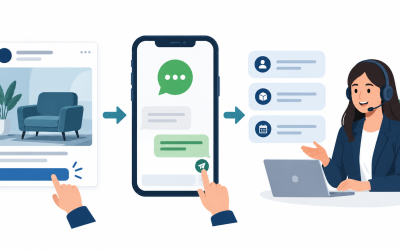
Bajo el capó, la lógica sigue siendo explícita. Un usuario hace clic en una opción de menú, envía una frase de activación, completa un campo de formulario o aterriza en un segmento etiquetado. El bot verifica las condiciones que definiste y las empuja a la siguiente rama. Si la persona dice algo inesperado, el sistema muestra opciones de respaldo, reinicia, transfiere o cae en una respuesta predeterminada segura.
Eso suena limitado, y a veces lo es. Pero cuando el objetivo está bien definido, esa limitación se convierte en una fortaleza. Si tu negocio necesita recopilar un nombre, correo electrónico, número de teléfono, interés en un producto, fecha de reserva o ID de pedido en el formato correcto cada vez, un camino guionado a menudo convierte mejor que un chat de IA abierto. El bot no está adivinando cuál debería ser la siguiente mejor acción. Ya decidiste.
Los chatbots basados en reglas son más fuertes en cinco situaciones comunes de 2026:
- Captura de leads de tráfico pagado: clic en el anuncio a calificación instantánea a formulario de reserva.
- Automatización de Messenger e Instagram: comentarios, mensajes directos, secuencias de bienvenida y respuestas automáticas.
- Enrutamiento de soporte simple: consulta de pedidos, horas de atención, ubicación de sucursales, política de devoluciones, disponibilidad en tienda.
- Flujos de citas y reservas: elegir servicio, elegir hora, confirmar detalles, pasar si es necesario.
- Flujos de trabajo sensibles a la conformidad: approved wording, controlled disclosures, fixed disclaimers.
The pricing in this category is still attractive because you are mostly paying for channels, contacts, and automation capacity instead of every AI-generated outcome. ManyChat’s updated pricing model, introduced March 2, 2026 for newer accounts, starts at $17 por mes para Esencial y $39 por mes for Pro, with contact-based overages. MessengerBot’s current public pricing starts at $19.99 cada 30 días para Premium y $49.99 cada 30 días for Pro. Landbot’s Starter plan is currently EUR 40 per month, o EUR 32 per month billed annually, for website and Messenger chatbots.
The real catch is maintenance drift. Every time your offer changes, your menu changes, your policy changes, your handoff logic changes, or a new use case appears, someone has to update the flow manually. Rule-based bots do not generalize well. They stay good because you keep them narrow.
Why Rule-Based Still Wins More Often in Sales Than People Admit
Buyers do not usually want poetic conversations when they click an ad. They want a clear next step. A structured bot can qualify budget, location, use case, timeline, and contact details without letting the conversation drift into interesting but low-converting detours. That is why many marketing teams still trust scripted flows more than pure AI for top-of-funnel lead capture.
There is another reason: testing. If you want to A/B test an opening offer, button order, follow-up question, or booking CTA, rule-based systems are easier to measure because every branch is discrete. AI can personalize more, but rule systems are easier to optimize with confidence.
How AI Chatbots Work in 2026: RAG, LLMs, and Hybrid Control Layers
An AI chatbot in 2026 is rarely just “ChatGPT on your website.” Serious business deployments usually have at least three layers: a model that interprets language, a source of truth that grounds the answer, and a control layer that decides when the bot should escalate, act, or stay quiet.
The plain LLM version is the easiest to understand and the least safe for business-critical workflows. You send the user’s message to a model, the model replies, and maybe some prompt instructions shape the tone. This can feel magical in a demo. It also creates the biggest hallucination risk because the model is relying on its training and prompt context more than your approved business content.
RAG is the more practical pattern for support, presales, and knowledge-heavy tasks. Instead of asking the model to answer from general memory, the system first retrieves relevant content from your FAQ, help center, knowledge base, policy docs, website pages, product documentation, or internal notes. The model then writes the reply using those retrieved passages. If the retrieval layer is good, accuracy climbs and hallucinations drop.
The strongest systems go one step further and become hybrid. The model still handles the messy language problem, but a rules layer controls execution. That means the AI can understand “my package still hasn’t arrived and I need it before Friday” while the system decides whether it should show an order-status action, escalate to a human, or refuse to promise a refund automatically. This is where most production bots are heading because it keeps the AI useful without letting it freestyle business policy.
Here is how the main AI architectures break down in practice:
| AI pattern | Cómo funciona | Main strength | Main risk |
|---|---|---|---|
| LLM-only chatbot | Model replies directly from prompt context and general training | Fastest way to get natural conversation | Highest hallucination and policy drift risk |
| RAG chatbot | Retrieves business content first, then generates the answer | Much stronger factual grounding | Bad retrieval still creates wrong answers |
| Hybrid AI plus rules | AI understands language, rules approve actions and handoffs | Best balance of flexibility and control | More setup and governance work |
This is also where vendor pricing starts to look very different from classic chatbot software. Tidio’s customer service platform starts at $24.17 por mes, while Lyro AI Agent starts at $32.50 per month and Tidio says Lyro can solve up to 67% of customer problems. Intercom’s current pricing starts at $29 por asiento por mes billed annually, plus $0.99 por resultado de Fin. HubSpot Service Hub Starter begins at $15 per seat per month, but Breeze Customer Agent is available on Professional and Enterprise tiers and moves to $0.50 por conversación resuelta starting April 14, 2026. Freshchat has a free plan, Growth from $19 por agente por mes billed annually, and Freddy AI Agent after the included trial quota at $49 por 100 sesiones. Zendesk’s current AI-focused public package starts at $155 per agent per month billed annually for Suite + Copilot Professional, while Advanced AI Agents are sales-priced.
That pricing structure tells you something important about the architecture. Rule-based software usually charges for access and scale. AI software increasingly charges for successful work: outcomes, sessions, conversations, resolutions, or credits. If the bot does more, the bill moves with it.
Why RAG Became the Default Instead of a Nice-to-Have
If you deploy AI without grounding it in current business content, you are asking for avoidable mistakes. A support or sales bot has to know your current shipping window, refund policy, pricing pages, feature limits, onboarding steps, and escalation rules. A model trained on the internet cannot reliably know that. RAG exists because production teams learned this the hard way.
That is also why serious business AI is not a “no sign up required” category. Consumer demos can be free and no sign up required. Production chatbots need accounts, permissions, data sources, rate limits, analytics, handoff settings, and human governance. If a business AI tool looks effortless in a demo, the setup work is just hidden behind the scenes.
Where AI Chatbots Actually Save Time
AI shines when people ask the same thing in different words. A human may type “where is my order,” “tracking has not moved,” “has this shipped yet,” or “I still did not receive my package.” A rule tree can catch some of that, but an AI layer can understand all of it and route the person to the same resolution path without forcing a rigid menu first.
That is why AI does especially well in customer support, internal help desks, SaaS onboarding, multi-product knowledge bases, and consultative presales where buyers ask natural-language questions before they are ready to click a button.
AI Chatbot vs Rule-Based Chatbot: The Architecture Comparison Table That Actually Matters
If you only remember one part of this article, make it this table. The differences below affect budget, staffing, QA, deployment speed, and customer experience much more than the logo on the platform homepage.
| Decision area | Chatbot basado en reglas | chatbot de IA |
|---|---|---|
| Answer method | Predefined branches, triggers, and conditions | LLM-generated replies with retrieval, tools, or prompt logic |
| User input style | Buttons, quick replies, limited free text | Open-ended natural language |
| Predictability | Very high if the flow is maintained properly | Lower unless grounded with RAG and strong guardrails |
| Coverage of unexpected phrasing | Weak | Strong |
| Best launch speed | Fastest for narrow use cases | Slower because data, testing, and fallback matter more |
| Maintenance pattern | Manual branch edits when logic changes | Continuous content, retrieval, and prompt tuning |
| Hallucination risk | Near zero if every response is scripted | Real unless controlled by grounding and policy rules |
| Fallback behavior | Usually obvious and rigid | Can stay helpful longer before escalation |
| Testing burden | Branch coverage and form validation | Retrieval quality, prompt behavior, edge cases, and escalation |
| Best channel fit | Messenger, Instagram, SMS, landing pages, booking widgets | Website chat, help desk, app support, knowledge-heavy web flows |
| Lead capture consistency | Excellent | Good if forms or actions are enforced |
| Knowledge-base question handling | Poor unless every answer is prewritten | Excellent with strong RAG |
| Human handoff | Simple and explicit | More context-rich when designed well |
| Localization and tone variation | Labor intensive | Easier to adapt across tone and language |
| Compliance control | Strong because outputs are fixed | Needs approval logic, red lines, and monitoring |
| Analytics clarity | Easy to attribute by branch and conversion step | Needs stronger instrumentation to understand why replies worked |
| Cost model | Usually fixed subscription plus contact or seat scaling | Often seat pricing plus variable AI usage or outcomes |
| Best fit overall | Deterministic flows and high-intent conversion paths | Flexible support and knowledge-heavy conversations |
The practical takeaway is not that one is modern and one is outdated. It is that they solve different operational problems. If your business problem is “people ask the same question in 25 different ways,” AI wins. If your problem is “I need every lead routed into the right funnel with clean data,” rule-based still wins more often than people expect.
Accuracy and Error Handling: Predictable Answers vs Flexible Retrieval
This is where most architecture choices live or die. Teams often overfocus on whether a bot sounds natural and underfocus on how it fails. That is backwards. A chatbot should be judged less by its best response and more by its failure behavior.
A rule-based bot is easier to trust because it cannot invent a refund policy you never wrote. If the branch exists, the answer is consistent. If the branch does not exist, the failure is visible: the user hits a dead end, gets a fallback prompt, or gets transferred. That can be annoying, but it is usually safer than a polished wrong answer.
An AI bot is more flexible because it can interpret sloppy wording, long questions, mixed intent, and conversational context. The tradeoff is that flexibility increases the number of ways the system can be partially wrong. The model may retrieve the wrong article, combine two policies incorrectly, or answer an adjacent question instead of the actual one. The answer can sound excellent and still be operationally dangerous.
That is why strong AI error handling now looks a lot like classic engineering discipline:
- Ground answers in approved content. If the answer is not in an allowed source, do not let the bot improvise.
- Force escalation on risk topics. Billing disputes, refunds, legal, medical, privacy, and account-security issues should rarely stay fully autonomous.
- Log and review failed threads weekly. The failure patterns tell you whether the issue is content, retrieval, routing, or policy.
- Measure real resolution, not just engagement. A bot that talks a lot but solves little is just cheaper confusion.
In practice, rule-based accuracy is higher on flows you can fully specify. AI accuracy is higher on broad question sets you cannot realistically script. That is the honest comparison. Saying one architecture is “more accurate” without specifying the job is sloppy.
If the interaction has one correct next step, rule-based is safer. If the user needs the bot to understand language variety and surface the right content from a large body of knowledge, AI is safer once RAG and handoff rules are in place.
The Real Failure Patterns to Watch
Rule-based bots most often fail by being too narrow. Users choose the wrong menu, type outside the expected flow, or abandon because the path feels mechanical. AI bots most often fail by being too broad. They answer with too much confidence, skip a business rule, or stay in the conversation too long when a human should have taken over.
That is why a hybrid model is usually easier to defend to leadership. AI handles interpretation. Rules handle red lines. Humans handle exceptions.
What It Costs to Build, Run, and Maintain Each Type
Sticker price alone is a bad way to compare chatbots because the billing models are different. Rule-based software often looks cheap because you pay a flat subscription and do more of the design work yourself. AI software can look affordable at entry level and then get expensive fast when you add seats, AI outcomes, session packs, or enterprise governance.
Here is the current public pricing picture I confirmed on April 12, 2026:
| Plataforma | Architecture bias | Current public entry pricing | AI pricing model | Free option |
|---|---|---|---|---|
| MessengerBot | Rule-based / hybrid social automation | Premium $19.99 per 30 days; Pro $49.99 per 30 days | Included in plan-level feature mix, not outcome-priced on public page | No permanent free tier shown; paid offer pricing and trial messaging |
| ManyChat | Rule-based / hybrid social automation | Essential $17 per month; Pro $39 per month | AI assist is packaged into higher plans rather than public outcome billing | Yes, Free plan |
| Landbot | Rule builder moving toward hybrid | Starter EUR 40 per month monthly, EUR 32 per month annually | Includes 100 AI chats on Starter; extra AI chats at EUR 1 per AI chat | Yes, Sandbox free tier |
| Tidio | AI-first SMB support | Starter $24.17 per month; Growth starts at $49.17 per month | Lyro AI Agent from $32.50 per month | Yes, Free plan and first 50 Lyro conversations free |
| HubSpot | Hybrid AI plus CRM | Service Hub Starter from $15 per seat per month | Breeze Customer Agent available on Pro and Enterprise; $0.50 per resolved conversation from April 14, 2026 | Yes, Free plan and 28 days free access for first Customer Agent setup |
| Intercom | AI-first service platform | Esencial $29 por asiento por mes facturado anualmente | Fin AI Agent $0.99 per outcome | 14-day free trial, no ongoing free tier |
| Freshchat | Hybrid service platform | Crecimiento $19 por agente por mes facturado anualmente | Freddy AI Agent first 500 sessions included, then $49 per 100 sessions | Yes, Free plan |
| Zendesk | Enterprise AI service platform | Suite + Copilot Professional $155 per agent per month billed annually | Advanced AI Agents are sales-priced; Copilot included in bundle | Free trial only |
That table shows why “AI chatbot vs rule based” is really a finance question as much as a product question. A rule-based builder can often stay on a predictable monthly subscription for quite a while. AI platforms increasingly shift the bill toward usage or successful resolution. That can be great if the bot is doing meaningful work. It can also punish sloppy implementation.
The cleaner way to think about cost is in three layers:
- Build cost: conversation design, integrations, content cleanup, QA, and setup time.
- Run cost: platform subscription, seats, contacts, AI outcomes, sessions, credits, and channels.
- Maintenance cost: updating flows, training sources, reviewing failures, and improving handoffs.
| Cost layer | Chatbot basado en reglas | chatbot de IA |
|---|---|---|
| Typical no-code software cost | Often $17 to $50 per month at SMB entry levels | Often $32.50 to $99 plus seats or usage before you reach serious volume |
| Implementation effort | Lower if the flow is short and deterministic | Higher because content grounding and testing matter more |
| Marginal cost of extra conversations | Usually low until contact or tier limits kick in | Can rise directly with resolutions, sessions, or credits used |
| Ongoing labor | Branch edits and campaign tweaks | Knowledge updates, retrieval tuning, prompt governance, failure review |
For most SMBs, the build-side math usually lands like this:
- Rule-based launch: cheapest if your use case is lead capture, appointment booking, FAQ routing, or social DMs.
- AI launch: more expensive if you need a clean help center, content ingestion, escalation logic, and quality monitoring.
- Hybrid launch: highest setup cost, but often the lowest long-run regret because it lets you automate without giving up control.
If you are still modeling costs, our guía de precios de chatbot goes deeper into seat pricing, usage-based billing, and the point where a starter plan stops being the cheap option.
How Fast You Can Deploy Each Architecture Without Creating a Mess
Speed to deploy is one of the few areas where rule-based chatbots still win decisively. If the flow is narrow and the inputs are known, you can launch a respectable scripted bot in days, not months. That is why agencies and in-house marketers still use flow builders for campaign launches, lead capture pages, and Messenger sequences.
A realistic launch window looks like this:
| Deployment type | Typical timeline | What usually causes delay |
|---|---|---|
| Simple rule-based FAQ or lead bot | 1 to 5 days | Copywriting, branch logic, and channel permissions |
| Structured rule-based multichannel flow | 1 a 3 semanas | CRM sync, tags, forms, testing, and analytics setup |
| AI chatbot with website content and basic handoff | 2 to 4 weeks | Source cleanup, retrieval quality, guardrails, and QA |
| AI plus RAG plus actions | 4 to 8 weeks | Tool integrations, policy rules, monitoring, human handoff |
| Enterprise hybrid stack | 2 to 4 months | Security review, multiple systems, legal review, and process change |
If your CEO wants something live next week, rule-based wins. If your support lead wants a bot that can handle thousands of question variants without rewriting twenty branches every Friday, AI wins even though launch takes longer. Fastest is not the same as best. It only means the initial setup burden is lower.
The cleanest deployment habit I know is boring on purpose:
- Start with one high-volume use case, not the whole business.
- Define the handoff rule before you write the first response.
- Test on mobile and after hours, not just from the admin preview.
- Review the first 50 to 100 live conversations manually.
- Expand only after the failure patterns are obvious.
That process works for both architectures. The only difference is whether you are reviewing broken branches or broken retrieval.
Which Architecture Wins for Customer Support
Winner for customer support in 2026: AI-first or hybrid.
Support is where AI has the clearest advantage because customers do not phrase the same problem the same way. They ramble, skip details, mix two questions together, and ask after hours. A rule-based bot can route some of that, but once the question set gets wide enough, natural-language understanding matters more than menu design.
That does not mean AI should own every ticket. It means AI should usually own first response, intent recognition, FAQ retrieval, and low-risk resolution. Rules should still own billing boundaries, escalation thresholds, and workflow actions that need approval. Humans should still own exceptions, angry customers, and edge cases.
The vendor market reflects that shift. HubSpot says Customer Agent handles about 65% of conversations without a human. Intercom prices Fin around resolved outcomes because that is the economic unit support teams actually care about. Zendesk is openly selling AI agents as a service-layer product, not a toy add-on. Tidio markets Lyro on resolved problems, not just live-chat widgets.
Rule-based support still makes sense in a few narrow cases:
- Local service businesses with highly repetitive FAQs and simple booking flows.
- Compliance-heavy environments where every customer-facing answer must be preapproved.
- Very small teams that need quick triage, not broad-language support.
For everyone else, AI or hybrid support is the better fit because the value is not just automation. It is better coverage. If your team is exploring the support side specifically, our bots de servicio al cliente de IA guide goes deeper into support cost math and rollout order.
The Support Routing Model That Usually Works Best
The strongest support stack in 2026 usually looks like this:
- AI handles the front door: understand the message, ask clarifying questions, retrieve the best answer.
- Rules protect the risky lanes: refund, billing, legal, privacy, fraud, and repeated failure trigger escalation.
- Humans take the expensive cases: complaints, retention saves, exceptions, and sensitive issues.
If you force a pure rule tree into a broad support environment, it feels like a maze. If you force pure AI into a policy-sensitive support environment, it feels smart right up until it becomes expensive. That is why the winner is AI-first, not AI-only.
Which Architecture Wins for Sales and Lead Generation
Winner for sales and lead generation in 2026: structured rule-based flows, with AI added behind them when needed.
This is the use case where lazy commentary gets it wrong. People assume the more conversational technology must be the better sales technology. That is not how conversion systems work. Sales and lead-gen flows usually perform best when the next step is crystal clear: qualify, capture, book, route, or buy.
A rule-based bot is excellent at that. It can ask budget, company size, service area, product interest, timeline, and preferred contact method in a strict order. It can send the right person to the right calendar or CRM stage. It can keep the conversation short. That matters because conversion often drops when a chatbot becomes too chatty.
Where AI helps is the messy middle. If the buyer asks product-comparison questions, wants clarification on pricing, or needs help choosing between plans, an AI layer can answer naturally and keep the lead warm. But I still would not let pure AI own the full top-of-funnel path for most SMB campaigns. Too much variation is bad for measurement.
The better model is usually:
- Rule-based opening: control the CTA and the qualification path.
- AI assist in the middle: answer nuanced presales questions or pull relevant product details.
- Rule-based close: booking, form completion, plan selection, or routing.
That is why tools with strong flow builders still keep their place. ManyChat and MessengerBot remain useful for social lead funnels because they turn conversations into measurable branches. Landbot still makes sense when you want a website flow that feels interactive without giving up full control. AI-first platforms are better once the knowledge burden grows, but rule systems still convert better at the point of commitment.
If your next step is a short list of tools rather than a pure architecture choice, our guide to the mejor chatbot para pequeñas empresas is the more useful buying companion.
Why Most Businesses Actually Deploy a Hybrid Stack
The market argument is already over. The best production systems are hybrid because hybrid fixes the core weakness of both extremes.
A pure rule-based bot is too rigid once the language gets messy. A pure AI bot is too risky once policy, compliance, or conversion discipline matters. The hybrid model gives AI the part it is good at, which is interpreting natural language and drafting helpful replies, while keeping hard rules around actions, forms, segmentation, routing, and escalation.
In practice, that usually means:
- AI for understanding: classify intent, summarize the question, surface likely answers, detect frustration.
- RAG for truth: pull current business content instead of relying on model memory.
- Rules for execution: validate data, choose the workflow, route the lead, create the ticket, enforce policy.
- Humans for exceptions: step in when the system reaches ambiguity or risk.
That hybrid setup is also the easiest path for businesses migrating from scripted bots to AI. You do not need to throw away everything that already works. Keep the deterministic flows that protect revenue or compliance. Add AI where customers are currently breaking the flow or where your team is stuck answering the same knowledge questions by hand.
If you are making the decision this quarter, this is the checklist I would use:
- Choose rule-based first if your main KPI is booked meetings, clean lead capture, or fixed-path routing.
- Choose AI-first first if your main KPI is support coverage, natural-language handling, or knowledge retrieval.
- Choose hybrid immediately if you need both conversational flexibility and business-rule control.
- Avoid pure AI for high-risk actions unless a rules layer approves the move.
- Avoid pure rule-based if users keep typing outside the flow and support volume is language-heavy.
That is the honest answer to “ai chatbot vs rule based” in 2026. The winning architecture is not whichever sounds more advanced. It is the one whose failure mode you can afford.
Where MessengerBot Fits If You Want a Messenger-First Hybrid Starting Point
If your business gets most of its conversations through Facebook Messenger, Instagram DMs, comment automation, and web chat widgets, a visual flow builder with optional AI layers is often a better starting point than buying a heavyweight enterprise service stack on day one. That is where MessengerBot is relevant: not as the universal answer for every support desk, but as a practical fit for social messaging, lead flows, and structured automation that can expand into hybrid use cases. If that matches your channel mix, Ver precios de MessengerBot and compare it against ManyChat, Tidio, and HubSpot with the architecture rules from this article in mind.
Preguntas frecuentes
¿Cuál es mejor, un chatbot de IA o uno basado en reglas en 2026?
Para un amplio soporte al cliente, la IA o híbrido es mejor en 2026 porque maneja el lenguaje natural, la recuperación de conocimientos y la cobertura fuera de horario de manera más efectiva. Para la captura de leads, la reserva de citas y los caminos de conversión fijos, el basado en reglas sigue siendo mejor porque mantiene el viaje controlado y más fácil de optimizar. La mayoría de las empresas terminan combinando ambos en lugar de mantenerse puras de un solo lado.
¿Cuánto cuesta un chatbot de IA en comparación con uno basado en reglas?
Rule-based chatbot software usually starts lower and stays more predictable. Current public examples include ManyChat Essential at $17 per month and MessengerBot Premium at $19.99 per 30 days. AI stacks usually add usage-based charges on top of seats or platform fees, such as Intercom at $29 per seat per month billed annually plus $0.99 per Fin outcome, HubSpot Customer Agent at $0.50 per resolved conversation starting April 14, 2026, and Freshchat Freddy AI Agent at $49 per 100 sessions after the included quota. In short: rule-based is cheaper to start, AI can be cheaper per solved support case than human labor, and hybrid often lands in the middle.
¿Qué plataforma tiene mejores características de IA en 2026?
For advanced AI support features, Intercom and Zendesk are the strongest pure service choices, with HubSpot especially strong when CRM context matters and Tidio the easiest SMB-friendly option. If your main job is social automation or fixed-path lead capture, platforms such as ManyChat and MessengerBot are still stronger on flow control than on deep AI support. The better AI feature set depends less on hype and more on whether you need open-ended support, CRM-aware sales automation, or scripted social funnels.
¿Puedo cambiar fácilmente entre las dos plataformas?
You can switch between rule-based and AI-oriented platforms, but it is rarely one-click. Flows, tags, CRM mappings, knowledge sources, analytics, and handoff logic all need to be rebuilt or remapped. If your content and routing logic are documented well, migration is manageable. If they live only inside one vendor’s visual builder, switching gets slower and more expensive.
¿Cuál es mejor para las pequeñas empresas?
For most small businesses, the best starting point is whichever architecture matches the first bottleneck. If the business loses leads because nobody replies fast enough, a rule-based or hybrid lead bot is usually the better first move. If the business is drowning in repetitive support questions, AI or hybrid support is the better first move. Small businesses usually get the best return by starting narrow, proving one use case, and only then expanding to a broader hybrid stack.
 Español de México
  English
  Tagalog
  简体中文
简体中文  العربية
  हिन्दी
  Português do Brasil
  Français
  বাংলা
বাংলা  香港中文
香港中文  繁體中文
繁體中文  Nederlands
  Deutsch
  Bahasa Indonesia
  日本語
日本語  한국어
한국어  Polski
  Русский
  Español
  Tiếng Việt