
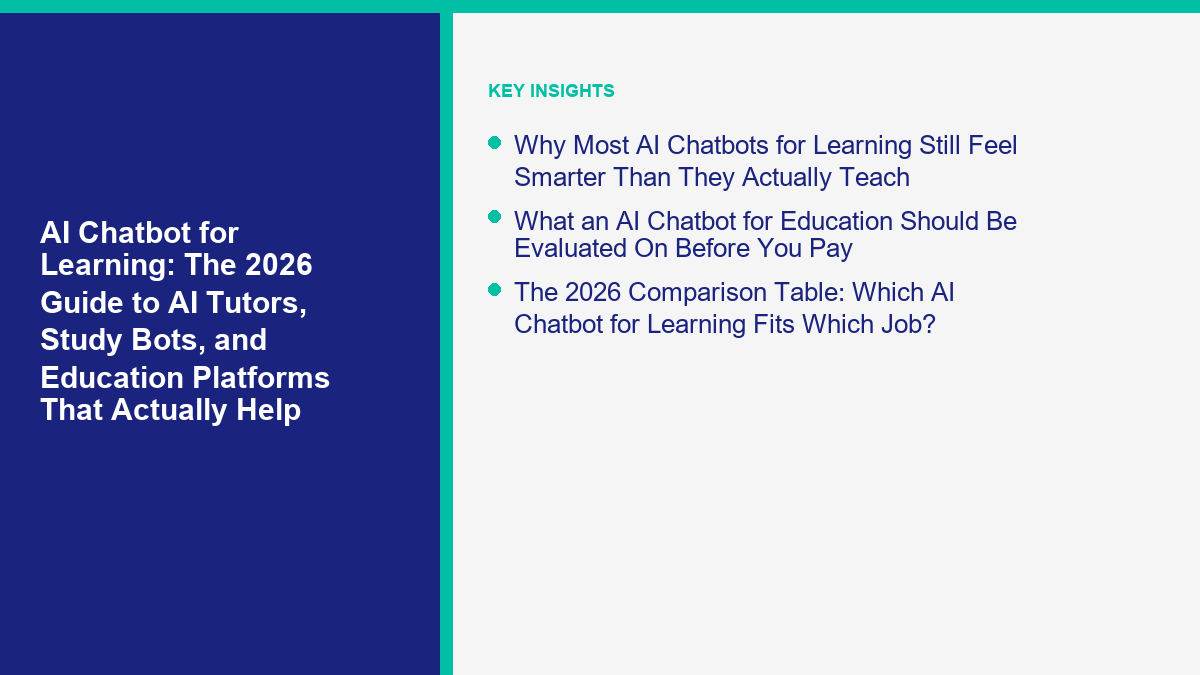
If you are looking for an ai chatbot for learning in 2026, the first thing to get straight is that the market split into three very different products. There are general AI assistants with better study modes. There are purpose-built tutor tools that are trying to teach instead of just answer. And there are school platforms that care less about one brilliant reply and more about safety, dashboards, policy controls, and whether 500 teachers can use the thing without creating a governance mess.
That split is why so many people buy the wrong tool. A college student doing literature review does not need the same thing as a parent buying algebra help, a district leader rolling out AI safely, or a course creator trying to drip lessons through Facebook Messenger and Instagram. One product can be great at one of those jobs and mediocre at the others.
I checked the public pricing, help, and product pages for the tools in this article on April 12, 2026. A few details matter right away. OpenAI says 900 million people use ChatGPT each week and that one in three college-aged young adults in the United States use ChatGPT regularly. Google says Gemini for Education is available free of charge in Google Workspace for Education, with premium add-ons layered on top. Khan Academy still positions Khanmigo as guided tutoring rather than answer vending, and its public pages still show $4 per month tutoring for adult learners plus district licensing for schools.
There is also a separate category mistake that matters for MessengerBot.app readers. If your real job is not to build a genius all-purpose tutor, but to deliver micro-lessons, answer admissions questions, send reminders, route tutoring requests, or keep students moving through a course on Messenger, Instagram, or your website, then you are not only shopping for an AI tutor. You are also shopping for a delivery layer. That is where it helps to Browse Our Tutorials before you confuse a smart chat model with an education workflow.
Why Most AI Chatbots for Learning Still Feel Smarter Than They Actually Teach
The easiest way to tell whether a tool is good for learning is simple: ask what it does when the user wants the answer fast. Weak learning bots dump the answer, wrap it in confident prose, and move on. Better ones slow the interaction down, ask a question back, surface the source material, or help the learner work through the next step without pretending the work is already done.
That sounds obvious, but it is still the main difference between a useful study bot and a glorified autocomplete tab. If a learner is preparing for a test, writing a paper, or trying to understand a math concept, fast answer generation can actually be the wrong behavior. It feels magical in the moment and weakens recall later.
The tools that help most in 2026 usually do at least four things well:
- They guide the learner instead of immediately replacing the learner.
- They stay grounded in source material, curriculum, or uploaded notes when accuracy matters.
- They make the next action obvious, whether that is a flashcard, a quiz, a rewritten explanation, or a teacher handoff.
- They fit the real environment around the student, which may mean a classroom dashboard, a campus login, or a messaging channel students already answer.
This is also why broad model intelligence does not automatically win the education category. A very capable general assistant can still be a poor ai tutor chatbot if it has no source grounding, no learner pacing, no teacher visibility, and no built-in way to stop itself from writing the whole assignment for the student.
What an AI Chatbot for Education Should Be Evaluated On Before You Pay
Before you pick any ai chatbot for education, run it through the same checklist. This matters more than the marketing page.
1. Does it teach, or just answer?
OpenAI’s Study Mode and Khanmigo both explicitly frame the interaction around guided learning rather than pure answer delivery (OpenAI Study Mode; Khanmigo). That matters. If the system never slows down, it is probably better for productivity than learning.
2. Can it stay grounded in real materials?
NotebookLM, Perplexity Education Pro, and district-safe classroom platforms are strong here because they either anchor the chat in uploaded sources or expose citations aggressively (NotebookLM limits; Perplexity Education Pro).
3. Does it fit a solo learner, a classroom, or an institution?
ChatGPT Free and Quizlet are easy individual buys. MagicSchool, SchoolAI, Google Workspace for Education, and ChatGPT for Teachers make more sense when there are admins, classes, or school policies involved (MagicSchool pricing; View MessengerBot Pricing; ChatGPT for Teachers).
4. Is the pricing honest?
Some education tools publish clean self-serve pricing. Some only price the entry tier. Some become sales-led the moment you need student accounts, SSO, privacy paperwork, or district-wide controls. If you are comparing a consumer subscription to a school rollout, you are comparing two different cost models.
5. What happens when the bot should stop talking?
This is where real educational quality shows up. Good systems have clear moments for teacher review, escalation, moderation, or source checking. Weak ones pretend every question should be solved in the same chat window.
The 2026 Comparison Table: Which AI Chatbot for Learning Fits Which Job?
Prices and plan details below were checked against public pages on April 12, 2026. Where a vendor does not publish a full self-serve price, I say that directly.
| Tool | Public pricing snapshot | Best fit | Why it actually helps | Main limitation | Source |
|---|---|---|---|---|---|
| ChatGPT with Study Mode | Free plan at $0; Plus at $20/month; Edu pricing is sales-led | General study help, uploaded materials, college-level explanation, coding and writing support | Study Mode uses guiding questions, breaks topics into chunks, and works with uploaded PDFs and images | Still a general assistant first; without good prompting it can over-answer or invent weak sources | OpenAI Study Mode; ChatGPT Plus |
| Khanmigo | $4/month for adult learners; district Starter from $10/student/year for 1,000 or fewer student licenses | K-12 math and structured guided tutoring | Built around tutoring behavior and Khan Academy content, not generic answer generation | Student access is still tightly controlled outside district and homeschool contexts | Khanmigo pricing; District pricing |
| Gemini for Education + NotebookLM | Gemini for Education is free for qualifying institutions; Google AI Pro for Education is $20/user/month annual or $24 billed monthly | Source-grounded study, school-managed AI, research packets, Workspace-heavy campuses | Institutional controls, NotebookLM integration, and no-cost base access are strong for large rollouts | Premium value shows up mostly inside Google’s ecosystem | Gemini for Education; Google AI Pro for Education |
| NotebookLM | Included at no cost; Pro capabilities come through Google AI Pro, Google AI Ultra, Google Cloud, or qualifying Workspace plans | Reading-heavy classes, research packets, citation-backed revision | Free tier already includes 100 notebooks, 50 sources each, and citation-backed chat on your own materials | It is strongest when you already have material to upload; it is not a general free-form tutor | NotebookLM limits |
| MagicSchool | Free; Plus at $8.33/user/month billed annually or $12.99 billed monthly; Enterprise custom | Teacher workflows, classroom-safe student tools, district visibility | Includes 80+ teacher tools, 50+ student tools, Raina chatbot, and learning insights | Better for managed classroom use than for a solo learner buying one study companion | MagicSchool pricing |
| SchoolAI | Free teacher tier; Pro and Scale are quote-based | Teacher-monitored student spaces, classroom personalization, district deployment | Public pages emphasize 200,000+ premade Spaces, critical alerts, and use in over 1 million classrooms | Beyond the free tier, budgeting requires a sales conversation | View MessengerBot Pricing; SchoolAI classroom platform |
| Quizlet | Quizlet Plus at $2.99/month billed at $35.99/year; Quizlet Plus Unlimited at $3.74/month billed at $44.99/year | Flashcards, exam prep, AI-generated practice tests, study guides | Cheap, familiar, and fast for memorization-heavy subjects | Q-Chat is gone, so it is no longer the same kind of live tutor product it once marketed | Quizlet pricing; Q-Chat update |
| Perplexity Education Pro | $10/month for verified students and faculty | Research-heavy higher education, citation-first study, academic scanning | Includes 10x citations, uploads, Learn Mode, and guided flashcards and quizzes | Not a classroom governance platform and not the safest pick for younger learners on its own | Perplexity Education Pro |
| MessengerBot | Premium $19.99/30 days; Pro $49.99/30 days; Agency $299.99/30 days on the public pricing page | Lesson delivery, reminders, admissions chat, parent updates, and course funnels across Messenger, Instagram, and websites | It is a strong education delivery layer when you need real messaging workflows instead of one more browser tab | It is not a pedagogy model by itself; you need your own content, rules, or AI layer behind it | View MessengerBot Pricing |
ChatGPT Study Mode Is the Best General-Purpose AI Chatbot for Learning Right Now
If you want one broad answer for most adults, college students, career switchers, and self-directed learners, ChatGPT with Study Mode is still the strongest general-purpose ai chatbot for learning in 2026. Not because it is the cleanest school platform. It is not. And not because it is the most curriculum-bound tutor. Khanmigo is better there. It wins because it combines decent free access, uploaded-material workflows, strong multi-step reasoning, and an explicit learning mode that nudges the interaction toward understanding.
OpenAI says Study Mode is available to users in Free, Plus, Pro, and Teams plans globally, and that it can guide understanding with Socratic questions, open-ended checks, and uploaded PDFs or images. OpenAI’s current help article still lists ChatGPT Plus at $20 per month. On top of that, OpenAI’s March 5, 2026 education update says college-age adults are the biggest adopters among age groups, but also says even advanced student users still operate well below power-user behavior. That tracks with what actually happens: students know how to ask for answers, but not always how to use the tool for real learning.
Here is where ChatGPT genuinely helps:
- turning messy notes into a step-by-step study plan
- explaining code, math, economics, or statistics one move at a time
- rewriting hard readings in plainer language without losing the structure
- creating practice questions from uploaded material
- roleplaying oral exams, interviews, or language drills
Here is where it still needs adult supervision:
- citation accuracy in formal research writing
- high-stakes subjects where a wrong answer looks polished
- school environments that need auditability, SSO, and policy controls
- younger learners who need tighter guardrails than a general assistant provides
One useful nuance in 2026 is that OpenAI is now treating educators as a separate product path too. OpenAI’s teacher announcement says ChatGPT for Teachers is free for verified U.S. K-12 educators through June 2027, with a secure workspace and admin controls. That does not make consumer ChatGPT a school deployment plan by default. It does show that OpenAI knows the learning market is not one thing anymore.
If you are buying for yourself, start free, turn on Study Mode, and test it against one real class or skill goal for a week. If you are buying for a school, do not confuse that personal workflow with a district rollout.
Khanmigo Is Still the Closest Thing to a True AI Tutor Chatbot
If your mental model is not “I need a smart assistant” but “I want an AI tutor that behaves more like a teacher,” Khanmigo is still the clearest answer. Khan Academy’s own public blog post keeps the pitch blunt: unlimited tutoring for $4 per month for adult learners, with the major distinction being that Khanmigo is supposed to tutor, not dump answers.
That difference is not marketing fluff. In math especially, Khanmigo still feels closer to what parents and teachers mean when they say ai tutor chatbot. The interaction is designed around prompting the student forward, not flattening the whole assignment into one screen.
The district story matters too. Khan Academy Districts now publicly lists an Enterprise Starter plan at $10 per student per year for 1,000 or fewer student licenses, while larger deployments are quote-based. Khan Academy also says its district partnerships serve 56 million learners globally and 600+ partner districts. Those are real scale signals, not hobby-project numbers.
The catch is access. Khan Academy’s February 3, 2026 help article says students can get Khanmigo only if they:
- attend a school in an official Khan Academy Districts partnership,
- are homeschooled by a parent who grants access, or
- are above 18 and purchase it for themselves.
That limitation matters because it makes Khanmigo less universal than ChatGPT or Quizlet. But it is also part of why the product feels more education-shaped. The platform is trying to stay inside more controlled learning contexts rather than acting like a universal answer app.
If I were advising a parent paying out of pocket for K-12 math help, Khanmigo would be one of the first tools I would test. If I were advising a university student doing research synthesis, it would not be my first pick. The product is strongest where there is a real curriculum and a real need for guided struggle.
Gemini for Education and NotebookLM Are Better When the Learning Has To Stay Grounded in Sources
There is a different kind of learning problem where the best answer is not “use the smartest tutor.” The best answer is “use the system that stays closest to the source packet.” That is where Google’s education stack is stronger than many people realize.
Google’s public education pages now say Gemini for Education is available free as a standalone app for qualifying institutions and included in Google Workspace for Education editions free of charge. If an institution wants the expanded premium layer, Google AI Pro for Education is publicly listed at $20 per user per month with a one-year commitment or $24 billed monthly, with additional discounts for some Education Plus customers.
That alone makes Google’s stack unusually interesting for schools. Most competitors either push everyone toward a consumer subscription or go straight into quote-only enterprise territory. Google is making the base layer easier to deploy broadly.
Then there is NotebookLM. Google’s help pages say standard NotebookLM gives users 100 notebooks, up to 50 sources per notebook, and daily limits of 50 chat queries, 3 audio generations, 3 video generations, 10 reports, 10 quizzes, and 10 flashcards. Pro capabilities raise that materially. For reading-heavy courses, that matters more than raw model IQ. A student can upload lecture slides, articles, transcripts, and their own notes, then work from that packet instead of hoping a general model remembers the right source.
This makes Gemini for Education and NotebookLM especially good for:
- history and humanities courses with dense readings
- law and policy classes where source grounding matters
- research seminars with a growing paper stack
- faculty and graduate students organizing long source collections
- schools that already live in Docs, Drive, Classroom, and Meet
The bigger reason I take Google’s education push seriously is not only pricing. It is product shape. Google’s own education materials keep framing Gemini around teaching and learning workflows, and its AI Pro add-on explicitly bundles Gemini in Workspace, expanded Gemini app access, and NotebookLM. That is a real education stack, not just a repackaged chatbot landing page.
If your learning depends on your own source materials, this is one of the safest parts of the market to test first.
MagicSchool and SchoolAI Are Built for Classroom Operations, Not Just Clever Answers
A lot of edtech buyers are not actually asking, “Which bot is smartest?” They are asking, “Which platform will save teacher time, stay inside policy, and still give students something useful?” That is where MagicSchool and SchoolAI deserve a separate category from consumer AI chat apps.
MagicSchool’s public pricing is refreshingly direct. The site currently lists Free at $0, Plus at $8.33 per user per month billed annually or $12.99 billed monthly, and Enterprise as custom. The same pricing page says the free tier includes 80+ teacher tools, 50+ student tools, the Raina chatbot, student learning insights, and privacy/security features. That is not a minor feature list. It is a full teacher workflow product.
SchoolAI comes from a similar angle but with more emphasis on teacher-monitored student interaction spaces. Its pricing page shows a View MessengerBot Pricing, then Pro and Scale as sales-led plans, while its classroom pages emphasize 200,000+ premade Spaces, use in over 1 million classrooms, and immediate alerts for critical safety concerns. That is a very different posture from a general consumer chatbot.
These products are useful when the workflow looks like this:
- a teacher wants lesson support, rubric help, feedback drafting, or differentiated materials
- students need guided activities inside teacher-defined spaces
- school leaders need dashboards, privacy documentation, and implementation support
- the institution wants to avoid a free-for-all where every student just opens a separate public AI tab
They are less useful when the buyer is a solo learner who just wants the best help for one exam or one skill. That buyer usually gets more value from ChatGPT, Khanmigo, NotebookLM, or Quizlet depending on the subject.
So the right read is simple. If you are buying for one learner, these may be overkill. If you are buying for teachers and students across a school, consumer AI chat subscriptions are usually underpowered.
Quizlet Still Matters, but Its AI Tutor Story Changed After Q-Chat
Quizlet is a good example of why you need current facts before you buy. A lot of older roundup posts still talk about Q-Chat like it is the center of Quizlet’s AI story. It is not. Quizlet’s own official Q-Chat blog post now carries the update that Q-Chat is no longer available as of June 2025.
That does not mean Quizlet stopped being useful. It means the value shifted away from “live AI tutor persona” and back toward tools Quizlet is already good at: flashcards, Learn mode, AI-generated Practice Tests, Study Guides, and Expert Solutions.
Current web pricing on Quizlet’s official upgrade page lists Quizlet Plus at $2.99 per month billed at $35.99 per year and Quizlet Plus Unlimited at $3.74 per month billed at $44.99 per year. Quizlet’s help center says Practice Tests turn uploaded notes or flashcard sets into AI-powered full-length practice tests, and Study Guides do the same kind of conversion into structured review material (Study Guides).
That means Quizlet is still a strong buy when the learner needs:
- memorization support
- low-cost exam drilling
- AI-generated practice tests from class notes
- quick study guide generation with a familiar interface
It is no longer the best answer if you specifically want a long-form conversational tutor that can coach through ambiguous reasoning. That is a different category now. The smart way to use Quizlet is to treat it like an AI-powered study engine, not a teacher substitute.
Perplexity Education Pro Is a Sleeper Pick for Citation-Heavy College Work
Perplexity is not usually the first name people think of when they search ai chatbot for learning, but it probably should be for a specific kind of user: the student or faculty member who cares a lot about source visibility.
Perplexity’s help center says Education Pro gives verified students and faculty everything in Pro plus 10x as many citations, file and image uploads, Learn Mode for guided learning and interactive flashcards and quizzes, and a $10 per month education discount. That is one of the clearest verified academic discounts in this category right now.
The best use case here is not younger learners who need classroom-safe guardrails. It is higher education, adult learning, and research-heavy study where the learner wants to move quickly from question to cited source to follow-up question.
Perplexity Education Pro is especially good when the job is:
- building a reading list fast
- scanning competing arguments before opening the original papers
- creating citation-heavy prep notes
- using Learn Mode to turn research into flashcards or quizzes
The downside is also clear. It is still not a full classroom platform. It does not replace Khanmigo for tutoring behavior or MagicSchool for institution-wide teacher workflows. It is best seen as a research-first study bot for advanced learners, not a full ai chatbot for education stack.
The Best AI Chatbot for Learning Depends on What You Are Actually Learning
The cleanest buying shortcut is to match the tool to the learning job, not to the loudest brand.
| If you need… | Best first pick | Why |
|---|---|---|
| K-12 math tutoring that acts like tutoring | Khanmigo | It is the most tutor-shaped product here and is built around guided help instead of answer dumping. |
| One flexible study assistant for college or adult learning | ChatGPT Study Mode | It is the broadest tool for explanation, uploads, writing help, coding, and multi-step tutoring. |
| Reading-heavy study from your own sources | NotebookLM | It stays grounded in uploaded materials and already has a useful free tier. |
| Classroom-safe teacher and student workflows | MagicSchool or SchoolAI | They are built around classrooms, guardrails, insights, and institutional needs rather than solo chat. |
| Cheap exam prep, flashcards, and practice tests | Quizlet | It is still one of the cheapest, fastest ways to turn notes into drills. |
| Research-heavy higher-ed learning with strong citations | Perplexity Education Pro | The citation density and Learn Mode make it strong for academic scanning and review. |
| Learning to code as a verified student | ChatGPT or GitHub Copilot Student | GitHub says verified students get free access to Copilot’s premium features, which is unusually good if your learning environment is the IDE. |
| Delivering lessons, reminders, quizzes, and support in chat channels learners already answer | MessengerBot | It is the best fit when the problem is distribution, follow-up, and conversation workflow across Messenger, Instagram, and websites. |
That last row matters because education buyers often lump “teaching intelligence” and “delivery workflow” into one box. They should not. A fantastic tutoring model can still be useless if students never return to it, teachers cannot trigger the right reminders, or your course business needs a better onboarding and follow-up system than email alone can provide.
Where MessengerBot Actually Fits in an Education Stack
MessengerBot is not the direct answer if your whole question is, “Which AI tutor is best at teaching calculus?” It becomes relevant when the real problem looks more like this:
- you run a course, coaching program, tutoring business, or training company
- your leads come in through Facebook Messenger, Instagram DMs, or a website widget
- you need lesson delivery, reminders, and qualification flows to happen inside those channels
- you want structured conversation, forms, tags, broadcasts, and handoff logic around the learning content
That is a different job from pure tutoring. It is closer to course operations and educational content delivery. In that context, MessengerBot can do work that Khanmigo, Quizlet, or NotebookLM are not trying to do at all.
MessengerBot’s public pricing page currently lists View MessengerBot Pricing at Premium $19.99 per 30 days, Pro $49.99 per 30 days, and Agency $299.99 per 30 days. The feature list on that page is why it fits this article: visual flow building, website chat, forms, comment automation, integrations, broadcasts, and multi-step messaging workflows are exactly the tools that matter when education content needs to be delivered on channels people already use.
Practical education use cases include:
- daily micro-lessons for language learning or exam prep
- automated lesson reminders and streak nudges
- course onboarding and orientation flows
- admissions and enrollment FAQs
- lead qualification for tutoring services
- office-hours triage that routes harder questions to a real teacher or coach
- certificate or webinar follow-up after a live session ends
The key is to treat MessengerBot as the delivery and engagement layer. You can keep the pedagogy narrow and structured, or you can connect it to a broader AI layer through integrations if you need more adaptive responses. What you should not do is expect any messaging platform to magically become a trustworthy education brain without careful content design behind it.
How to Build an AI Chatbot for Education Content Delivery With MessengerBot
If your goal is to use MessengerBot as an ai chatbot for education content delivery, start narrower than you think. The safest first version is not a giant “ask me anything” tutor. It is one well-defined learning path that solves one real outcome.
- Pick one course or topic unit. Good starters are “7-day IELTS vocabulary warm-up,” “first-week onboarding for new students,” “SAT math daily question,” or “parent FAQ plus booking flow.”
- Define the entry point by channel. Messenger is good for existing community traffic, Instagram is good for creator-led learning offers, and website chat is good for people already evaluating your program.
- Build a welcome choice that narrows intent fast. For example: “Do you want today’s lesson, the practice quiz, or help from a tutor?” That one menu removes a lot of confusion.
- Chunk the lesson into short messages. One concept, one example, one quick check, one next step. Learners stop replying when the bot sends mini-essays.
- Add a mastery check after each chunk. Use quick replies, a short multiple-choice question, or a “reply with your answer” prompt. This is what turns chat delivery into learning instead of passive reading.
- Route edge cases to a human or a richer AI layer. If the learner gets stuck twice, asks for grading, or raises an account issue, stop the automation and escalate.
- Measure completion, not only opens. The real metrics are lesson completion rate, quiz response rate, repeat return rate, handoff rate, and lead-to-enrollment conversion if the bot is tied to sales.
This build order is more useful than starting with fancy prompts because it respects how learning actually happens in chat. People reply in bursts. They get distracted. They need a simple next move, not a full AI manifesto in the first message.
If you are testing MessengerBot for a program that is already bigger than one Facebook Page or one basic site widget, this is also the point where it is worth comparing the higher tiers and deciding whether to Upgrade to MessengerBot Pro before you stack too many workflows onto a starter setup.
Message Designs That Improve Learning Completion Instead of Just Inflating Clicks
The fastest way to ruin an educational chatbot is to optimize it like a generic marketing bot. A learner is not a lead form with a pulse. Completion behavior is different.
These message patterns work better for education delivery:
Use short teaching turns
One idea per message. One example. One check. Chat is not a good place to paste a full lecture transcript.
Use quick replies for self-placement
Give people an easy way to say “beginner,” “review,” or “I am stuck.” That makes the rest of the sequence more useful and reduces dropout.
Use spaced reminders without sounding like a nag
Reminder copy should sound like progress support, not guilt. “Ready for today’s 2-minute drill?” works better than “You missed yesterday’s lesson.”
Make the quiz part of the flow, not a separate app jump
If the learner has to leave the chat too early, completion drops. Keep the first check-in inside the conversation whenever possible.
Design the fallback on purpose
A bad fallback kills trust fast. If the bot does not know the answer, say so, offer a narrower path, or route to a person. Educational trust is harder to rebuild than marketing trust.
This is also where MessengerBot has a practical edge over many standalone AI study tools. The platform is built around flow control, not only model cleverness. That makes it better for pacing, reminders, segmentation, and moving a learner from “saw the post” to “completed the module.”
Privacy, Safety, and Handoff Rules Matter More in Education Than in Almost Any Other Chatbot Category
If you are deploying an ai chatbot for learning around minors, coursework, or protected student information, the technical question is only half the job. The operational rules matter just as much.
Google explicitly says Gemini for Education is covered by education terms and, on its public education pages, says data in the core service is not human reviewed or used to train AI models. OpenAI’s teacher workspace says teacher materials shared there are not used to train models by default. MagicSchool and SchoolAI both foreground FERPA, COPPA, SOC 2, and district controls on their public pages (MagicSchool; View MessengerBot Pricing).
That should shape your deployment rules:
- Do not let a public chatbot improvise around grades, accommodations, discipline issues, or sensitive student data.
- Do not promise “always correct” answers in academic or advising contexts.
- Do not store more learner data than you need for the workflow.
- Do not automate high-stakes judgments that should belong to a teacher, counselor, or administrator.
- Do define a visible handoff path for billing questions, academic exceptions, and stuck learners.
If you are using MessengerBot for education delivery, the same rule applies. Let the bot handle structured lesson delivery, FAQs, reminders, intake, and narrow checks. Hand off anything sensitive, ambiguous, or personal. Good educational chat design is not about maximizing automation at all costs. It is about keeping the automation in the lane where it is actually helpful.
The Best AI Chatbot for Learning in 2026 Is the One Matched to the Right Job
If you want the shortest answer, here it is.
ChatGPT Study Mode is the best overall ai chatbot for learning for most self-directed adults and college students because it is flexible, good enough across subjects, and easy to start using. Khanmigo is the best ai tutor chatbot when what you actually want is tutoring behavior, especially in structured K-12 work. Gemini for Education plus NotebookLM is the strongest source-grounded school stack when the institution already leans on Google. MagicSchool and SchoolAI are better for classroom operations than for solo learners. Quizlet is still worth paying for if your problem is drilling and exam prep, not deep conversation. Perplexity Education Pro is the better research-first buy for higher education.
And MessengerBot fits when the problem is not only teaching, but getting the learning flow delivered and completed where people already message you. That is a real education problem in 2026, especially for tutors, course creators, training businesses, and schools that need better student communication rather than one more isolated AI tab.
Sources and Pricing Pages Used for This Guide
- OpenAI Help Center: ChatGPT release notes and Study Mode details
- OpenAI Help Center: What is ChatGPT Plus?
- OpenAI: Ensuring AI use in education leads to opportunity
- OpenAI: A free version of ChatGPT built for teachers
- Khan Academy Blog: Unlimited math tutoring for $4/month
- Khan Academy Districts pricing
- Khan Academy Help Center: Student access to Khanmigo
- Google for Education: Gemini for Education
- Google for Education: Google AI Pro for Education
- Google NotebookLM Help: Upgrade NotebookLM and usage limits
- MagicSchool pricing
- View MessengerBot Pricing
- SchoolAI classroom platform
- Quizlet pricing
- Quizlet blog: Q-Chat update
- Quizlet Help: Practice Tests
- Quizlet Help: Study Guides
- Perplexity Help Center: Education Pro
- GitHub Docs: Access GitHub Copilot for free as a student
Use AI to Teach Better, Then Put the Lessons Where Students Actually Reply
If your next move is not only choosing a tutor bot but building a real lesson-delivery system on Messenger, Instagram, or your website, start with View MessengerBot Pricing. If you are building larger education flows with more channels, handoffs, and automation depth, compare whether it is time to Upgrade to MessengerBot Pro. And if you teach chatbot strategy, build education funnels for clients, or publish training content around conversational learning, Join Our Affiliate Program so the implementation work can compound instead of ending at one deployment.
Frequently Asked Questions
What is the best AI chatbot for learning in 2026?
For most adults and college learners, ChatGPT with Study Mode is the best all-around option because it balances free access, uploaded materials, guided explanation, and broad subject coverage. For K-12 tutoring, Khanmigo is often the better fit. For source-grounded study, NotebookLM and Gemini for Education are stronger.
Which AI tutor chatbot is best for K-12 math?
Khanmigo is the best current pick for many K-12 math use cases because it is designed to tutor rather than simply reveal answers. It is strongest when the learner needs guided help inside a structured curriculum instead of open-ended chat.
What is the difference between an AI chatbot for learning and an AI chatbot for education?
An AI chatbot for learning usually describes the student-facing experience: tutoring, quizzes, explanations, and study support. An AI chatbot for education is broader and can include teacher tools, district platforms, admin controls, safety policies, and content delivery systems used by schools or training businesses.
Can MessengerBot work as an AI chatbot for education?
Yes, when the job is educational content delivery rather than pure tutoring. MessengerBot is useful for lesson drips, reminders, admissions questions, tutoring lead capture, quiz prompts, and routing students to a human or an external AI layer across Messenger, Instagram, and websites.
Which platform is best if I need citations and source-grounded answers?
NotebookLM is the strongest source-grounded option when you already have readings, notes, or course materials to upload. Perplexity Education Pro is better when you need fast citations and research discovery on the open web. ChatGPT is useful too, but it should not be trusted as your sole citation source.


 English
  Tagalog
  简体中文
简体中文  العربية
  हिन्दी
  Português do Brasil
  Español de México
  Français
  বাংলা
বাংলা  香港中文
香港中文  繁體中文
繁體中文  Nederlands
  Deutsch
  Bahasa Indonesia
  日本語
日本語  한국어
한국어  Polski
  Русский
  Español
  Tiếng Việt