
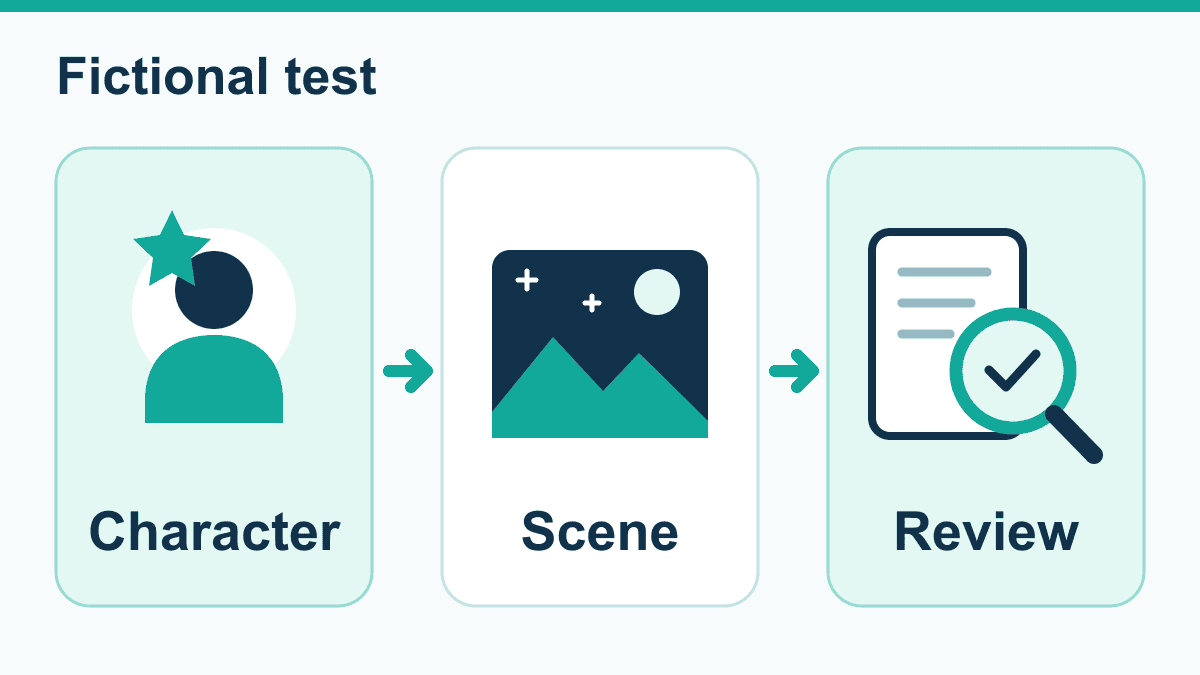
The Perchance AI chatbot is worth investigating if you want to shape a fictional character, set a scene and review how a conversation develops. Start with a small creative task, not a promise that one tool will remember everything or produce a finished story. A useful first result is a scene you can assess: does the character sound right, respect the information you supplied and leave room for your next line?
The official AI Chat & Roleplay interface advertises free access without sign-up. In the interface reviewed on October 15, 2026, the visible controls included participant names, character descriptions, scenario information, an editable conversation, writing guidance, speaker choices and save, load and share controls. Those controls were inspected; generated replies and saving behavior were not tested for this guide. Free access should not be read as a guarantee of speed, uninterrupted availability or identical behavior on every community-created page.
This guide helps you prepare a fictional character, use the visible setup fields deliberately and compare alternatives without relying on guessed prices or unmeasured winners. If you are choosing tools for customer conversations rather than fiction, Browse Our Tutorials for the separate business-setup path. A creative conversation exercise is not evidence that an assistant is ready to handle customers.
How the Perchance AI chatbot setup fits together
Think about the setup as a short brief for a scene. You supply who is speaking, what each person knows, where they are and what should happen next. The visible fields give you places to separate those decisions instead of putting every instruction into one long opening message.
- Participant names: give the two sides distinct fictional names so you can follow who is meant to speak.
- Character descriptions: prepare a voice, motive and relevant background for each role. Avoid copying a real person’s private history.
- Scenario information: describe the immediate setting, relationship and unresolved problem. Keep facts about the world separate from the character’s opinions.
- Conversation text: inspect the visible exchange and decide which lines belong in your working draft. An editable transcript is useful for revision, but it does not establish what any later reply will remember.
- Writing guidance and speaker choices: decide whose turn you want to explore and suggest a style. Treat those instructions as something to evaluate, not an enforced guarantee.
- Save, load and share: pause before using them. Check the page’s own explanation of what is retained, where it goes and who can access it.
Perchance’s official text-generation documentation describes instructions, starting text, stopping conditions and streamed output. It also describes advertising support for logged-out use and warns that simultaneous requests can involve waiting. Those statements help explain why free access is not the same as a performance commitment. They do not establish a particular current model, a measured response time or a capacity limit for your session.
For a first comparison, choose a task you can judge without needing a long history. A two-character disagreement over a missing map is more manageable than an entire novel’s continuity. Write down the facts the reply must respect before you open the tool: who holds the map, who knows it is missing and what information must stay undisclosed in the scene. Then you have something concrete to check rather than a general feeling that the chat sounds convincing.
Keep three things separate in your notes: what the interface visibly offers, what the operator’s documentation says and what you actually observe after trying your own fictional example. A button establishes that a control is present. It does not, on its own, prove successful export, cross-device recovery, private storage or reliable long-term memory.
Prepare a character and scenario you can actually evaluate
A useful character brief contains choices, not just adjectives. Instead of “a clever, mysterious person,” specify how the character speaks, what they want from this conversation and one thing they will not yet reveal. The following cards are original fictional suggestions for an exercise. They are not generated Perchance outputs or evidence of successful tests.
A fictional repair-bay conversation
- Character: Kaelen, a mechanic on an imaginary orbital station, speaks in short, dry sentences and wants a clear explanation before accepting a repair.
- Your role: Vance, a transport pilot, needs help with a navigation fault but has not explained the cargo.
- Scene: the docking bay is noisy and an inspection is approaching. The immediate question is whether Kaelen will examine the damaged part.
- Information boundary: Kaelen has not seen the cargo manifest. Do not write it into the character’s background if the scene depends on that uncertainty.
- Suggested opening: “Can you inspect this unit before the docking inspection? I can explain the damage, but I need you to ask before opening the case.”
- Suggested guidance: “Keep the reply brief. Ask one question about the damage. Do not resolve the whole problem in this turn.”
Review whether a reply gives you something useful to answer. If it invents knowledge of the cargo, mark that as a problem in the exercise. Do not excuse it just because the prose is vivid. If it solves the fault immediately, decide whether your instructions were unclear or whether the result failed the task; change one part of the brief before comparing another attempt.
A fictional archive conversation
For a different voice, try Elinor, a careful archivist in an invented town, and Julian, a visiting researcher asking about an uncataloged letter. Elinor values preservation and speaks formally. Julian wants to understand an old trade dispute. Place them at a reading-room desk with the letter still sealed, and make the next task a discussion of permission to inspect it—not an instant discovery of its contents.
A suggested instruction is: “Use measured language and ask what Julian hopes to learn. Do not describe the letter’s contents before it is opened.” This lets you look for a different kind of mistake: a character can sound formal while inventing the very evidence the scene says is unavailable. Treat invented dates, quotations and historical details as fiction to review, not research.
Keep the working card short enough to inspect
Use a separate note with five entries: voice, motive, relationship, known facts and the next conversational task. If you cannot explain why a detail matters to the current scene, leave it out of the first attempt. This is an editing method, not a verified Perchance input limit. You can add details later when you have a reason to test them.
Do not change the character, scene, opening line and style guidance all at once when assessing a problem. Keep the original fictional card, record the one change you made and compare the replies against the same task. That gives your own evaluation a useful reference point without pretending it is a controlled benchmark of every model or platform.

Try one fictional scene and review what changes
Once your brief is ready, use the visible fields to place the relevant material. Names belong with the roles; background belongs with the character descriptions; the immediate situation belongs with the scenario. Where the interface gives you writing guidance, state the next task plainly. Before submitting anything, remove real names, contact details and material you would not want disclosed.
If you choose to generate a reply, read it as a draft. The official text documentation warns that output can be inappropriate. Do not treat fluency as proof of truth, consent, safety or suitability for a particular reader. For the fictional repair scene, judge the response against the brief rather than against how confident the mechanic sounds.
- Check who spoke. Did the reply use the intended role, or did it write both sides of an exchange you wanted to control?
- Check what the character knew. Highlight any detail that was not supplied and should not have been available within the scene.
- Check the next action. Did the reply leave a useful question or decision for you, or finish the entire scene prematurely?
- Check the voice. Look for specific wording that fits or conflicts with the character card. “Sounds good” is less useful feedback than naming the sentence that drifted.
- Check the boundaries. Remove unsuitable material and stop if the exercise moves into content you do not want to continue.
A small worksheet can make this review repeatable. Write the task at the top, followed by “matched the brief,” “needs editing” and “not assessed.” Put actual examples under the first two headings. Use “not assessed” for things you did not test, such as recovery after closing the browser or the handling of a much longer conversation. Avoid turning an untested feature into either a strength or a missing capability.
Use revision to answer a specific question
Suppose Kaelen answers with a long explanation when you wanted a short question. A useful revision might be: “Ask about the visible damage before suggesting a repair.” Compare that with the same character card. Do not add a promise such as “this instruction forces compliance”; you are trying a clearer request and checking the result.
For Elinor, you might notice a reply inventing the letter’s contents. Revisit the distinction between what exists in your fictional world and what the character has actually seen. A suggested reminder is: “The letter is sealed. Ask about the researcher’s request without quoting it.” If the output still contradicts that boundary, keep the contradiction in your notes rather than presenting the tool as reliable on that task.
The editable conversation field also gives you a visible place to revise the working text. Keep your original example separately if comparing versions matters to you. We have not verified the tool’s undo, backup or recovery behavior, so do not make the only copy of an important creative draft depend on an assumed recovery feature.
Apply the same discipline to continuity. Introduce a harmless fictional fact, continue the scene if you wish and check whether later replies preserve it. Record the conditions you actually tried. One successful exchange is not proof of unlimited memory; one mistake is not proof that the platform lacks every continuity feature.
Decide what to save or share before using those controls
The key privacy distinction is between the text-generation component and the particular page or sharing feature you use. Perchance’s official text documentation states that its component does not store prompt and response data. The official privacy policy separately explains that optional upload or sharing features can retain material, and warns against entering sensitive information on untrusted community generators. Treat those as operator statements, not an independent security certification.
That distinction matters even for an apparently harmless story. A fictional character card can contain a copied customer conversation, a real address or a private workplace incident if you paste material without reviewing it. Start with invented people and situations. Remove account details, passwords, financial information and identifiable personal histories before using a creative tool.
The observed chat interface has save, load and share controls. This review did not exercise them, establish their storage destinations or verify who can access a shared item. Do not assume a label means “only on my device,” “permanently recoverable” or “private to the recipient.” Read the explanation for the exact action and page you are using; where the destination or audience is unclear, leave the action unused.
- Before saving: identify what is included and where the saved material is expected to go. Use an expendable fictional sample if you decide to test recovery.
- Before loading: confirm that you recognize the material and intended page. Keep your own working notes separate from anything whose origin you have not reviewed.
- Before sharing: review the complete text, not just the character name. Check the described audience and access conditions before creating a link or upload.
- On a shared device: do not rely on closing a tab as proof that data has been removed. Use the device’s normal privacy controls and avoid entering sensitive material in the first place.
If your requirement includes confidential records, verified deletion, access controls or a contractual privacy commitment, establish those requirements before choosing a tool. This guide does not certify Perchance or any comparison service for those uses. A non-retention statement about one component does not establish that content is excluded from every other processing activity or that every community page behaves identically.
Keep creative examples original and consider other people’s rights before publishing an edited result. A tool’s availability is not a guarantee that a character, quotation, image or generated passage is cleared for commercial use. Seek appropriate advice for a rights-sensitive project rather than treating a general tool comparison as legal clearance.

Compare Perchance with Character.AI, AI Dungeon and PolyBuzz
A useful comparison begins with your task, not a universal winner. The table separates what the reviewed official sources advertise from what you should verify for your own fictional exercise. It does not rank response quality, memory, privacy or mobile usability. Exact subscription prices are omitted because the reviewed displays did not establish a consistent current US-dollar comparison.
| Tool | What the reviewed official source shows | What to check for your task |
|---|---|---|
| Perchance | The inspected chat page advertises free, no-sign-up access and exposes character, scenario, conversation and writing controls. | Whether the particular page and its current terms meet your needs; how your fictional reply, continuity and save/share checks turn out. |
| Character.AI | The subscription page distinguishes Free, lite and c.ai+ packages, with advertised differences involving memory, ads and access. | Which advertised benefits apply to the current plan and your account, and whether they help with the same scene you are evaluating. |
| AI Dungeon | Official help describes a free account with basic features and optional paid features; the pricing surface describes storytelling-related options. | Current plan availability, any usage conditions and whether the story format fits the kind of interaction you want to write. |
| PolyBuzz | The membership page advertises several tiers and memory-, voice- and ad-related benefits. | Current regional price, the exact tier conditions and whether any advertised voice or memory benefit is useful for your exercise. |
Use the Character.AI subscription details, AI Dungeon free-account explanation and PolyBuzz membership details for their current advertised terms. Package names and descriptions are not evidence that one service outperformed another. For the distinct Character.AI topic, our Character.AI guide provides related reading without replacing this Perchance-focused evaluation.
If comparing tools yourself, keep the same fictional names, relevant background, opening line and task. Record the plan and date, then note what you actually observed. If a service requires an account, payment or permission you do not want to provide, record that as a decision boundary rather than guessing how the paid experience would behave.
Consider the work needed after a reply, too. A vivid paragraph that requires extensive factual or stylistic correction may be less useful to your project than a plainer draft. Conversely, an exploratory story exercise may allow more improvisation than a tightly constrained scene. Decide your acceptance criteria before comparing results so an attractive answer does not quietly change the task.
Is the free Perchance chatbot worth trying?
It is a reasonable candidate for an adult creative-writing exercise if you want to inspect the visible setup controls and try a fictional scene under the current terms. That is a narrower recommendation than saying it is the best free chatbot, the fastest option or a substitute for an account-based writing workflow you already depend on.
Choose one useful result to pursue: a more distinctive opening exchange, a clearer character motive or a list of dialogue problems to revise yourself. You do not need to judge every possible feature in one sitting. If the exercise produces nothing worth keeping, you can still identify whether the problem was unclear input, an unsuitable result or a requirement you have not yet verified.
Before committing important work, write a short acceptance list. For example: the reply must preserve the sealed-letter premise; it must not invent the letter’s contents; the voice must fit the card; and you must understand any save/share action you plan to use. Those are proposed criteria, not claims that Perchance passed them. Add your own requirements where the project needs continuity, accessibility or a particular way of reviewing material.
Pause if the service’s current terms do not meet your needs, the output is unsuitable or a required behavior remains unclear. Do not infer a guarantee from “free” or “no sign-up.” You can try a different tool using the same fictional task, or continue drafting manually. The aim is a useful writing decision, not proving that one brand wins every comparison.
Keep creative experiments separate from business replies
A character card can help you think about tone, but it does not establish that a system is ready to answer customers. Before any business use, verify the exact supported channel and action, permission requirements, approved business information, review process and route to a person. Do not move private customer conversations into a creative experiment or assume that a plausible reply is an authorized business answer.
For a business evaluating Messenger Bot, Check Current Pricing and review the setup guidance for the specific workflow you need. Confirm the available account features and how replies will be reviewed before committing to a customer-facing process.
Keep that decision separate from the creative-tool comparison. A writer may only need a scene to edit; a business needs a verified process for real conversations. If you are exploring a more structured build, the related no-code chatbot builder guide is a next research step, not proof that a particular product meets your requirements.
Your next creative-chat check
Use this short sequence to finish with a decision rather than an open-ended comparison:
- Choose one fictional scene and write down the fact that must not change.
- Prepare distinct roles, motives and a brief opening line.
- Check the exact page and current access terms before entering material.
- If you try generation, review the reply against the same scene criteria.
- Record any contradiction, unsuitable content or behavior you did not assess.
- Understand save/share behavior before using it, and remove private details.
- Decide whether to revise the draft, try a clearer instruction or compare another tool.
For business setup rather than fiction, continue with Step-by-Step Tutorials and verify the workflow relevant to your account. For creative writing, keep the fictional card and your own assessment notes. They give your next attempt a clearer starting point without depending on a promised result.
Frequently asked questions about the Perchance AI chatbot
Is the Perchance AI chatbot free without sign-up?
The official AI Chat and Roleplay page reviewed on October 15, 2026 advertises free access without sign-up. That describes the reviewed page, not guaranteed future availability or identical terms on every community generator. Check the current page before using it.
What should I put in a Perchance character description?
For a fictional exercise, prepare a voice, motive, relevant background and a clear boundary about what the character knows. Add a separate scene and opening line. These are suggested writing inputs, not a guarantee that a generated reply will follow every instruction.
Does a save or share button mean my conversation stays private?
No such guarantee follows from the button alone. Perchance’s privacy policy distinguishes the text-generation component from optional upload and sharing features. Check the exact action’s storage and audience explanation, avoid sensitive information and leave it unused if the destination is unclear.
Is Perchance better than Character.AI, AI Dungeon or PolyBuzz?
This guide does not establish a performance winner. Compare current access and plan terms, then assess the same fictional task against your own criteria. Advertised memory, voice or access features are not a measured comparison of reply quality or reliability.
Can I use a fictional character exercise as a customer-support bot?
A fictional exercise is not evidence of customer-support readiness. Verify the exact supported channel and action, permissions, approved information, human review and handoff before any business use. Do not put private customer conversations into the exercise or assume that an integration exists.
 English
 Tagalog
 简体中文
 العربية
 हिन्दी
 Português do Brasil
 Español de México
 Français
 বাংলা
 香港中文
 繁體中文
 Nederlands
 Deutsch
 Bahasa Indonesia
 日本語
 한국어
 Polski
 Русский
 Español
 Tiếng Việt