
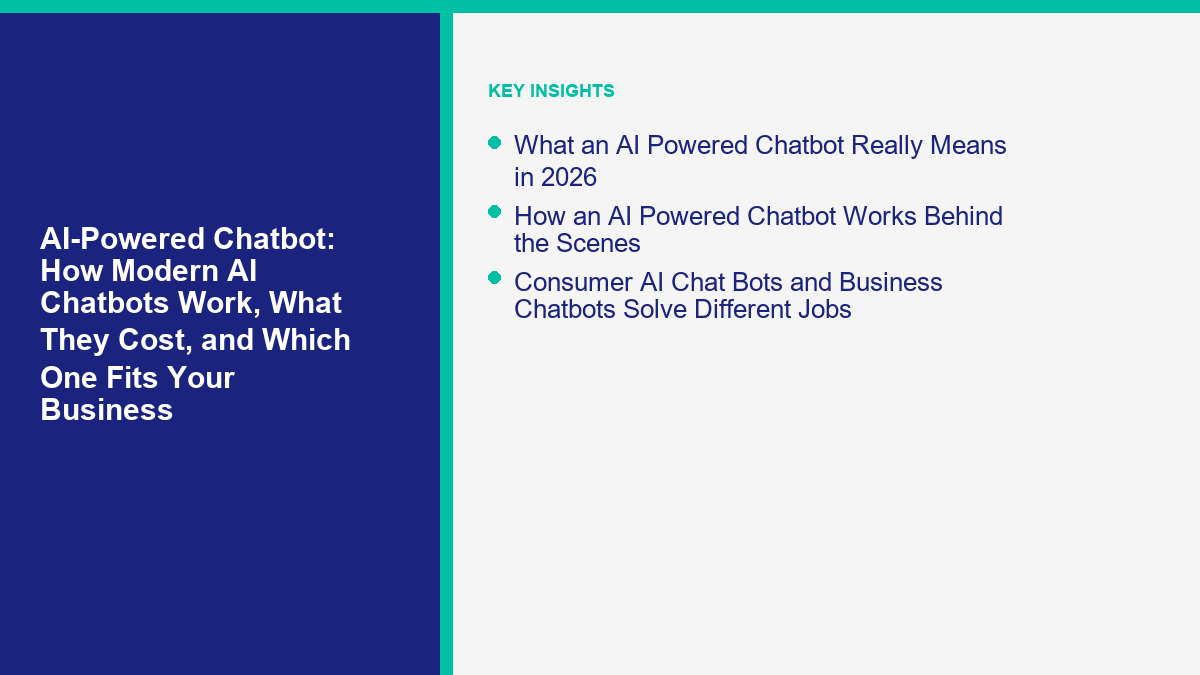
Search for an ai powered chatbot in 2026 and you land in a market that mixes three very different products under one label. One group is personal AI assistants such as ChatGPT, Claude, and Gemini. Another group is social and messaging automation builders such as MessengerBot, ManyChat, and Chatfuel. A third group is service software with an AI agent layered into a help desk, like Tidio, Intercom, Zendesk, and HubSpot.
That category confusion is why so many buying guides feel useless in practice. A five-person ecommerce brand answering Facebook page messages is not solving the same problem as a SaaS support team trying to automate 20,000 tickets a month. A local clinic that wants after-hours replies on Messenger needs something different again. If you compare all of them as if they were interchangeable, you either overpay for features you will never use or underbuy and end up rebuilding the whole system three months later.
I reviewed the public pricing and plan pages linked in this article on April 12, 2026. The quick snapshot is already enough to show how different the market is: ChatGPT Plus remains $20 per month, Claude Pro remains $17 per month with annual billing or $20 monthly, Google AI Pro is $19.99 per month, MessengerBot Premium is $19.99 per 30 days, ManyChat Essential is $17 per month, Tidio Starter is $24.17 per month, and Intercom’s Fin is billed at $0.99 per resolved outcome.[1][2][4][6][8][12][14]
The practical question is not which chatbot is the smartest in a benchmark. It is which one matches your channel, your workflow, and your billing tolerance. If Facebook Page messages are a major lead source for you, flat plan limits matter more than abstract model rankings. Start there, then View MessengerBot Pricing against the cost models you see elsewhere so you are comparing the right things.
What an AI Powered Chatbot Really Means in 2026
An ai powered chatbot is not just a chat window with a large language model behind it. In production, a useful chatbot is a stack. It needs an interface, a model, business rules, memory, access to the right data, logging, and a clean path to a human when the bot should stop talking.
The easiest way to think about it is this: the model writes the sentence, but the system decides whether the model should answer at all. That distinction is where good bots separate themselves from expensive demos. A solid bot does not let the model freestyle through refund policy, eligibility rules, pricing exceptions, or account recovery when those answers should come from structured data or a deterministic flow.
By 2026, most serious chat bot ai deployments use a hybrid design:
- Rule-based logic handles known workflows such as lead capture, menu routing, scheduling, opt-ins, tagging, and handoff triggers.
- Retrieval pulls the right article, FAQ, product detail, or CRM record so the model is grounded in current business information.
- Generative AI turns that information into a natural answer, asks clarifying questions, or summarizes a messy request.
- Tool use lets the bot perform actions such as looking up order status, sending a follow-up email, or writing data into Sheets or a CRM.
- Human escalation takes over when confidence drops, a policy edge case appears, or a customer clearly wants a person.
That is why a business chatbot should not be judged only on raw language quality. A brilliant model with poor routing still creates bad outcomes. A slightly less impressive model with strong flow design, better data access, and tighter guardrails often resolves more real customer conversations with less damage.
The other thing worth saying plainly: truly useful customer-facing AI chat bots are almost never “no sign up required.” That phrase still applies to lightweight consumer chat tools. It does not describe production messaging software, because production software needs permissions, channels, saved state, analytics, and admin control.
How an AI Powered Chatbot Works Behind the Scenes
Under the hood, modern chatbots follow a fairly repeatable pipeline. The details change by platform, but the architecture is consistent enough that you can evaluate any tool with the same checklist.
- An event arrives. A visitor sends a website chat, a customer replies on Facebook Messenger, an Instagram DM lands, or an email hits the support inbox.
- The router classifies the request. The system decides if the message is a known workflow, a general question, a high-risk issue, or something that should go straight to an agent.
- The bot retrieves context. That might be a knowledge base article, a product page, a CRM record, a Google Sheet row, or past conversation context.
- The model generates a response. The LLM turns the grounded context into a human-readable answer, often with instructions about tone, limits, and escalation rules.
- Tools are called when needed. The bot may fetch a shipment status, create a lead, add a tag, write to a webhook, or schedule a follow-up.
- Safety rules run before delivery. Confidence thresholds, blocked topics, fallback copy, and human-handoff rules decide whether that answer should be sent as-is.
- Everything is logged. The system stores transcripts, tags, outcomes, and resolution signals so the team can improve prompts, flows, and knowledge quality.
In practical terms, most businesses end up with three memory layers:
- Session memory for the current chat so the bot can follow the conversation.
- Profile memory for customer attributes such as email, language, purchase status, or location.
- Business memory for policies, FAQs, catalogs, and process documents that should shape answers every time.
The biggest technical improvement since the first wave of AI chat bot hype is retrieval quality. Modern systems do not just stuff your full website into a prompt and hope for the best. They break documents into chunks, embed them for semantic search, rank the best matches, and then pass only the relevant context to the model. That makes answers cheaper, faster, and less likely to drift.
For MessengerBot users, this architecture matters because the platform already covers the parts many small businesses forget to budget for: visual flow control, tags, opt-in forms, website chat, Google Sheets sync, JSON API access, and message sequencing.[6] In other words, you do not need to make AI generate every single answer to get an “AI powered chatbot” result. Often the better design is to let the model handle the messy text while the platform handles the workflow.
Consumer AI Chat Bots and Business Chatbots Solve Different Jobs
This is the fork most buyers need to get right first. Consumer AI chat bots optimize for broad usefulness: writing, summarizing, coding, studying, brainstorming, and file work. Business chatbots optimize for routing, channel permissions, user identity, lead capture, automation, analytics, and handoff. The overlap is real, but the job is different.
If your team says, “We need a chatbot,” ask one harder question: Who is the user?
- If the user is your staff, tools like ChatGPT, Claude, and Gemini are often the right first purchase.
- If the user is your customer in Messenger, Instagram, or website chat, a messaging or support platform is usually the better first purchase.
- If both are true, the best setup is often a two-layer stack: an internal AI assistant for agents and a customer-facing automation platform for actual conversations.
That is why personal AI subscriptions look cheap compared with service platforms. ChatGPT Plus, Claude Pro, and Google AI Pro are priced like consumer or prosumer productivity tools. Intercom, Zendesk, HubSpot, Tidio, ManyChat, and MessengerBot are priced around channel volume, seats, active contacts, or outcomes because they are carrying workflow, support, and operational load, not just generating text.[1][2][4][14][16]
A good rule is simple. Use a consumer AI assistant when the output is mainly text for your team. Use a business chatbot when the output changes a customer workflow, captures revenue, resolves support, or touches a channel with permissions and service obligations.
The Pricing Models That Decide What Your Chatbot Really Costs
Most ai powered chatbot pricing pages look simple until you map the actual billing trigger. That is where costs move from “looks cheap” to “why is finance asking questions.”
| Pricing model | How it works | Where it shows up | What usually gets expensive |
|---|---|---|---|
| Flat plan | You pay a fixed amount for a feature bundle and usage ceiling | MessengerBot Premium and Pro | You outgrow page, widget, or team limits and need the next tier |
| Per seat | You pay for each full agent or admin | Intercom, Zendesk, HubSpot, Claude Team | Cross-functional stakeholders suddenly need access |
| Per active contact | You pay based on how many engaged contacts are stored or touched | ManyChat | Campaigns work and your engaged audience compounds |
| Per conversation or quota pack | You buy a bundle of AI conversations or billable chats | Tidio, some Chatfuel pages | Volume spikes and you start paying for success |
| Per resolved outcome | You pay when the AI resolves a conversation | Intercom Fin, HubSpot Breeze Customer Agent | Containment rises, and the AI line item rises with it |
| Add-on AI layer | The help desk is one bill and the AI module is a separate bill | Tidio, Zendesk, HubSpot | Teams underestimate how often they will actually use the AI |
Here is the practical math behind those models. MessengerBot is easier to forecast because the public plans are tiered and feature-based. Premium is $19.99 per 30 days and Pro is $49.99 per 30 days on the public pricing page, with clear limits around pages, chat widgets, ecommerce stores, and advanced features.[6] ManyChat is harder to forecast because contacts can quietly grow faster than revenue if you run frequent DM campaigns. Intercom and HubSpot are easy to model in a spreadsheet but can get very expensive if your AI actually resolves at scale, because success is the billing event.[8][9][14][18]
There are also two hidden cost layers that never show up cleanly on the pricing page:
- Setup cost. Someone has to clean knowledge sources, design flows, write handoff rules, and test edge cases.
- Switching cost. Exporting contacts is easy compared with rebuilding triggers, tags, prompts, workflows, fallback logic, and analytics.
That second point is where a lot of teams make bad decisions. They pick the cheapest starter plan instead of the cleanest long-term billing model. The result is usually one of two painful outcomes: a migration project, or a year of working around the platform instead of using it properly.
AI Powered Chatbot Pricing Comparison for 2026
The table below compares the main platforms that come up in real buying conversations. I am grouping consumer AI assistants, messaging automation tools, and support platforms together on purpose because that is what buyers actually do in search results. The difference is that here the categories are explicit.
| Platform | Public paid entry | Main billing trigger | Best fit | What to watch |
|---|---|---|---|---|
| ChatGPT | Plus at $20/month | Subscription, then seats for Business | Internal AI assistant for mixed work | Not a customer messaging platform by itself |
| Claude | Pro at $17/month annual or $20 monthly | Subscription, then seats and usage for team/enterprise | Document-heavy work and careful writing | Consumer app limits are usage-based and not fully fixed like API pricing |
| Gemini | Google AI Pro at $19.99/month | Subscription | Google-centric teams | Plan packaging changes more often than most buyers expect |
| MessengerBot | Premium at $19.99 per 30 days | Plan tier | Facebook Messenger-first automation | Less ideal than service suites for enterprise help desk governance |
| ManyChat | Essential at $17/month or Pro at $39/month | Active contacts, seats, channel tier | Instagram and creator-style DM funnels | Growth can raise billing faster than expected |
| Chatfuel | English page shows $69/month; some localized pages still show $23.99 plus overages | Depends on page or region shown | Fast multichannel social automation | Public pricing inconsistency is a real procurement risk |
| Tidio | Starter at $24.17/month; Lyro from $32.50/month | Billable conversations plus AI quota | Website-first support for SMBs | AI cost can sit on top of the base help desk cost |
| Intercom | Essential at $29/seat/month billed annually | Seats plus $0.99 per Fin outcome | AI-first support teams | Outcome pricing scales fast if containment is high |
| Zendesk | Suite + Copilot Professional at $155/agent/month billed annually | Seats plus add-ons | Mature help desk operations | Advanced AI agent pricing is still sales-led |
| HubSpot | Service Hub Starter at $15/month promo; Pro at $100/seat | Seats plus $0.50 per resolved conversation for Breeze Customer Agent from April 14, 2026 | CRM-centric businesses | The best value shows up only if you already want HubSpot around the bot |
Pricing references reviewed April 12, 2026: OpenAI, Anthropic, Google One, MessengerBot, ManyChat, Chatfuel, Tidio, Intercom, Zendesk, and HubSpot official pages.[1][2][4][6][8][9][10][11][12][14][16][17][18]
The big headline from this table is not that one tool beats the others at everything. It is that the cheapest-looking product is often the wrong comparison. ChatGPT, Claude, and Gemini are bargain subscriptions for internal productivity. Intercom, Zendesk, and HubSpot are operational systems. MessengerBot, ManyChat, and Chatfuel live in the middle, where channel coverage and marketing automation matter more than enterprise workflow control.
ChatGPT vs Claude vs Gemini for Teams That Need General AI Chat
If your team mainly needs an internal AI assistant, the first shortlist is still ChatGPT, Claude, and Gemini. The differences are not just about output style anymore. They now include model access, context window size, research limits, business connectors, and how deeply the tool plugs into your existing software.
ChatGPT is still the easiest broad recommendation because the product does the widest mix of jobs well. The paid entry point remains $20 per month for Plus, and OpenAI’s current pricing page shows useful context tiers even for non-enterprise users: 54K for GPT Instant on Plus, 128K on Pro, and 256K reasoning context on Plus and Business.[1] That makes it a good fit for mixed writing, coding, spreadsheet, research, and internal operations work. The main limitation is that you still need another platform if you want governed customer messaging across Facebook Messenger, Instagram, or a support inbox.
Claude is the best fit when your workflow is document-heavy and tone-sensitive. Anthropic still keeps Claude Pro at $17 per month on annual billing or $20 monthly, and the Pro plan now includes Claude Code, Claude Cowork, projects, research, and access to more models.[2] On the API side, Anthropic documents a 1M token context window for Claude Sonnet 4, but that is not the same thing as a fixed claude.com consumer limit, which remains governed by usage caps and session-level limits.[3] That distinction matters because a lot of buyers see the model context headline and assume the consumer chat product behaves like the API. It does not.
Gemini makes the strongest case if your team already lives inside Google Workspace. Google One’s public plans page keeps Google AI Pro at $19.99 per month, bundled with 5 TB of storage and Gemini in Gmail, Docs, Vids, and more.[4] Google’s Gemini limits page is also more explicit than many vendors about capacity tiers: the basic plan sits at a 32 thousand token context window, while higher paid tiers scale up to 1 million, with Deep Research, image, video, and agent limits broken out by plan.[5] The catch is packaging churn. Google changes tier names and bundled benefits more often than most procurement teams like.
My short version is blunt:
- Pick ChatGPT if you want the strongest all-around internal assistant.
- Pick Claude if long reading, editing, and careful writing dominate the workload.
- Pick Gemini if your company runs on Gmail, Docs, Drive, and Google search habits already.
What I would not do is expose one of these directly to customer-facing channels and call the job done. They are excellent brains. They are not, by themselves, a support operation or a Messenger automation system.
MessengerBot vs ManyChat vs Chatfuel for Messenger and Social DM Automation
This is the comparison that matters for a lot of SMBs because customer conversations still start in DMs far more often than enterprise buyers like to admit. Facebook pages, Instagram replies, click-to-message ads, and comment-triggered conversations are still where a lot of real sales and support work happens.
MessengerBot is the cleanest fit when Facebook Messenger is the center of gravity. On the public pricing page, the Premium plan is $19.99 per 30 days and the Pro plan is $49.99 per 30 days. Premium includes one Facebook account, five Facebook pages, unlimited subscribers, one chat widget, one ecommerce store, sequence messaging, website chat, JSON API plus Zapier, Google Sheets integration, forms, comment tools, and more. Pro expands that to ten pages, five chat widgets, five ecommerce stores, Instagram chatbot features, team members, and broader operational depth.[6] The biggest advantage is cost clarity. You are not doing active-contact math every week.
ManyChat remains the smoothest social growth tool if Instagram and creator-style funnels matter more than Facebook page support. But its March 2, 2026 pricing reset made the economics more important to understand. The Free plan covers up to 25 active contacts. Essential is $17 monthly or $14 annual for up to 250 active contacts, with $0.10 per extra contact on monthly billing. Pro is $39 monthly or $29 annual for up to 2,500 active contacts, then overage applies at a lower rate. Pro also unlocks AI-powered automation and channels like WhatsApp, SMS, and Email.[7][8][9] That structure works if you are intentionally building social funnels. It gets painful if you treat contact growth as free.
Chatfuel is harder to recommend cleanly right now for one reason that has nothing to do with bot quality: the public pricing is inconsistent across its own pages. The main English pricing page currently presents a single $69 per month AI Business Assistant offer for WhatsApp, Instagram, and social messaging. A localized pricing page still shows a conversation-based Business tier starting at $23.99 plus $0.02 for each extra conversation.[10][11] That suggests either a transition, a regional split, or different product packaging. Any one of those can be legitimate, but if you are comparing vendors for a finance-signoff purchase, that ambiguity is a real mark against it.
Here is the practical way to separate the three:
- Choose MessengerBot if your business lives inside Facebook Page messages and you want clearer plan tiers.
- Choose ManyChat if Instagram-centric growth and creator funnels drive your revenue.
- Choose Chatfuel only after you confirm which pricing page and product packaging applies to your region and channel mix.
If you already know you need Instagram bot access, more pages, and more widgets, compare those limits in Upgrade to MessengerBot Pro before you default to a contact-priced competitor.
Tidio vs Intercom vs Zendesk vs HubSpot for Support Teams
Once the job moves from “answer DMs” to “run customer service,” the stack changes. Support teams care about queues, ticketing, ownership, reporting, multilingual content, auditability, and the exact meaning of a so-called resolved conversation. This is where support platforms start to matter more than social automation builders.
Tidio is the easiest SMB recommendation in the help-desk category. The public pricing page shows Starter at $24.17 per month, Growth starting at $49.17, Plus starting at $749, and a standalone Lyro AI Agent package from $32.50 per month starting at 50 AI conversations. Tidio also gives every account 50 free Lyro conversations lifetime, and its AI page publicly pitches Lyro at $0.5 per conversation.[12][13] That hybrid structure works well for smaller website-first teams, but you need to budget both the help desk layer and the AI layer.
Intercom has the clearest AI billing in the enterprise support group. Essential is $29 per seat per month billed annually, Advanced is $85, Expert is $132, and Fin AI Agent is priced at $0.99 per outcome. Intercom’s own help page defines an outcome as a conversation Fin resolves or a Procedure that ends in a resolution or intentional handoff, and you are billed once per conversation even if multiple questions are resolved inside it.[14][15] That transparency is a serious strength. It is also the reason CFOs will inspect the model closely at scale. A 3,000-outcome month is $2,970 before seats.
Zendesk is still the safest choice for organizations already built around ticketing discipline. The current public pricing page shows Suite + Copilot Professional at $155 per agent per month billed annually and Enterprise at $209, while Advanced AI agents remain custom-priced.[16] That is not cheap, but Zendesk buyers are usually not looking for cheap. They are looking for operational control, governance, mature workflows, and a platform the support org can standardize on.
HubSpot makes the most sense when the CRM is the real buying center. Service Hub Starter is currently shown from $15 per month per seat on the product page, Professional from $100, and Enterprise from $150.[17] The AI twist is more interesting: HubSpot announced on April 2, 2026 that Breeze Customer Agent moves to outcome-based pricing on April 14, 2026 at $0.50 per resolved conversation, and HubSpot says the product already resolves 65% of conversations and cuts resolution time by 39% across more than 8,000 activated customers.[18] That performance data is vendor-reported, so treat it as directional, not neutral benchmarking. Still, the pricing change is real and unusually concrete.
The simplest buying rule here is this:
- Choose Tidio for smaller website-first teams that want a lighter stack.
- Choose Intercom if you want transparent AI outcome billing and a modern AI-first support platform.
- Choose Zendesk if your team already operates like a disciplined ticketing organization.
- Choose HubSpot if customer service sits inside a broader CRM-led operating model.
How to Design an AI Chatbot That Does Not Hallucinate or Trap Users
Most chatbot failures are not model failures. They are systems failures. Teams ask the model to behave like a complete support stack, then act surprised when it improvises around missing data, unclear policy, or an impossible customer request.
If you want a production chatbot that feels reliable, design around these six rules:
- Use deterministic flows for risky tasks. Pricing, refunds, account security, and anything with legal or payment implications should be rule-led first.
- Ground the bot in current business data. Retrieval beats memory. If the answer changes, store it in a source the system can refresh.
- Set confidence thresholds. A bot should know when it is guessing and escalate before damage happens.
- Separate explanation from execution. Let AI explain policy. Let workflows and tools actually perform the action.
- Make handoff visible. Customers should never feel trapped in an endless “I can help with that” loop.
- Log failures by intent, not just by CSAT. You need to know which topics break the system, not just that a conversation went badly.
A lot of small businesses get the best result from a two-lane design. Lane one is structured automation: greetings, menu choices, lead capture, tags, appointment prompts, and post-click follow-up. Lane two is AI-assisted free text for FAQ-style questions, qualification, and summarization. MessengerBot is well suited to that pattern because visual flows, forms, tags, comment tools, website chat, and integrations already exist around the conversation layer.[6]
What I would not do is let an LLM answer everything with one giant system prompt. That makes demos look magical and production logs look expensive. Good chat bot ai deployments are opinionated about when the model is allowed to talk.
A 14-Day Launch Plan for Your First Production AI Chatbot
If you are starting from zero, do not try to automate your entire customer journey in week one. Launch the smallest useful bot first, then expand. This is the rollout I use when the goal is to get a real system into production fast without creating a cleanup project.
| Days | What to do | What success looks like |
|---|---|---|
| 1-2 | Collect 50 to 100 recent transcripts and identify the top five intents | You know what customers actually ask, not what the team guesses they ask |
| 3-4 | Clean the source material: FAQ, policies, shipping info, product details, escalation rules | The bot has trustworthy grounding data |
| 5-6 | Build deterministic flows for risky or repetitive tasks | Refunds, scheduling, order lookup, and handoff are controlled |
| 7-8 | Add AI only to free-text questions and lead qualification | The model helps where flexibility matters, not everywhere |
| 9-10 | Connect tags, CRM fields, Sheets, webhooks, or inbox handoff | Conversations create usable downstream data |
| 11-12 | Red-team the bot with messy wording, edge cases, and impossible requests | You know where it fails before customers do |
| 13-14 | Soft launch on one channel with clear agent backup | You collect live data without risking the full operation |
If you are building this inside MessengerBot, a practical starter stack is straightforward: welcome flow, menu, top-intent quick replies, tag capture, human handoff, one fallback AI answer block, and a Sheet or CRM sync for leads. That is enough to learn from real usage without turning the first version into a maze. If you want setup examples before you touch production traffic, Browse Our Tutorials and borrow a working pattern instead of improvising your first flow tree.
The launch metric that matters most early is not “AI usage.” It is one of these three: resolved conversations, qualified leads captured, or support deflection with acceptable customer satisfaction. Pick one. Otherwise you will spend two weeks admiring transcripts instead of measuring business value.
Where MessengerBot Fits Best for Facebook Messenger, Instagram, and Website Chat
MessengerBot is strongest when the business problem is channel-specific rather than model-specific. If your buyers spend time in Facebook Messenger, your support team lives in page inboxes, or your funnel depends on comment replies, DMs, broadcasts, forms, and follow-up sequences, that is where the product makes sense.
The current public pricing structure is simple enough to budget without gymnastics. Premium at $19.99 per 30 days is a reasonable entry point for a single-account operation that needs up to five Facebook pages, one website chat widget, one ecommerce store, unlimited subscribers, flow building, website chat, email tools, JSON API plus Zapier, Google Sheets sync, forms, and core post or comment automation. Pro at $49.99 per 30 days is where the platform becomes more useful for heavier operators, because it expands pages and widgets, adds Instagram chatbot capabilities, supports more team-oriented work, and opens a wider operational footprint.[6]
That makes MessengerBot a particularly good fit for:
- Local businesses that get repeated Messenger questions about hours, pricing, availability, and bookings
- Ecommerce brands using Facebook and Instagram comments to trigger DMs and recover abandoned interest
- Agencies managing multiple small-business pages without wanting active-contact pricing surprises
- Teams that want a visual builder and integrations without standing up a custom app stack
It is a weaker fit when your primary operating model looks like a large-scale help desk with strict ticket queues, advanced enterprise security review, or heavy phone and email service orchestration. That is not a flaw. It is product positioning. MessengerBot does not need to beat Intercom or Zendesk at enterprise help-desk governance to be the right answer for Messenger-first growth and support.
There is also a business model angle worth noting if you build flows for clients. If you are packaging chatbot setup as a service, flat tier pricing is easier to margin than contact-driven pricing, and the partner upside is more straightforward too. In that case, it can make sense to Join Our Affiliate Program while you are rolling chatbot builds into your client offer.
The Mistakes That Make AI Chat Bots Look Smart in a Demo and Weak in Production
I see the same failure pattern repeatedly across chatbot rollouts. The team does not buy the wrong technology because they are careless. They buy the wrong technology because the demo rewards the wrong thing.
These are the mistakes that hurt most often:
- Buying on model hype instead of channel fit. The smartest model in a screenshot is useless if your real problem is Facebook permissions, inbox routing, or active-contact billing.
- Letting the LLM answer everything. Good bots use AI selectively. Bad bots hope the model will invent workflow discipline.
- Ignoring the actual billing trigger. Per contact, per conversation, per outcome, and per seat are not interchangeable.
- Skipping handoff design. A bot that cannot fail gracefully creates more work than it saves.
- Feeding the system bad source material. If your policies are outdated or contradictory, retrieval just makes wrong answers faster.
- Not logging intent-level failures. You need to know whether returns, billing, delivery, or product fit questions are breaking the system.
- Treating free plans as production plans. Free is good for evaluation. It is rarely the right place to stop.
The Chatfuel pricing inconsistency is a good real-world example of why this matters. A lot of comparison posts would quietly pick whichever number makes the table look neat. That is the wrong move. If the public pricing picture is inconsistent, the correct takeaway is not “cheap.” The correct takeaway is “verify before you buy.”[10][11]
The same principle applies everywhere. If a vendor bills per resolved conversation, model your resolved conversations. If a vendor bills per active contact, model contact growth. If a vendor bills per seat, count the people who will really need access six months from now, not just the pilot team.
Which AI Powered Chatbot Fits Your Business Right Now
If you want the shortest usable answer, use this decision matrix instead of another generic top-10 list.
| Your situation | Best first pick | Why |
|---|---|---|
| You need one internal AI assistant for writing, research, and mixed team work | ChatGPT | Best all-around balance of tools, context, and general utility |
| Your work is document-heavy and you care a lot about tone and analysis quality | Claude | Strong writing, project organization, and long-document handling |
| Your company runs on Gmail, Docs, Drive, and Google’s ecosystem | Gemini | Integration leverage matters more than benchmark debates |
| Your leads and support requests mainly arrive on Facebook Messenger | MessengerBot | Messenger-first workflows, flat tier pricing, visual automation, and website chat support |
| You sell through Instagram DMs and creator-style funnels | ManyChat | Strong social growth automations, but watch active-contact billing |
| You need a lighter website support stack with AI for a smaller team | Tidio | Good SMB fit with clear website chat orientation |
| You want AI-first support and are comfortable paying per successful resolution | Intercom | Transparent outcome pricing and mature service workflow |
| You already run a structured ticketing organization and want heavy governance | Zendesk | Mature help-desk operations matter more than a cheap entry tier |
| Your CRM is the center of your operation and service should live there | HubSpot | Best fit when the bot is part of a bigger CRM decision |
If your use case is specifically Messenger, Instagram, and website chat for a small or midsize business, the market narrows fast. That is where MessengerBot, ManyChat, and Tidio deserve most of the attention. If you are answering Facebook page questions, collecting leads, and routing to human support when needed, the “best” chatbot is usually the one that keeps your channel operations simple, not the one with the most dramatic AI branding.
Ready to Build a Messenger-First AI Powered Chatbot?
If your next step is not more theory but an actual build, keep it simple. Start with one live use case, verify the billing trigger before launch, and make the handoff path obvious. For Messenger-first teams, the fastest path is usually to compare plan limits, copy a proven flow structure, and only then add AI where free text actually helps.
Use these three pages in that order: View MessengerBot Pricing, Browse Our Tutorials, and Upgrade to MessengerBot Pro if you already know you need broader page, widget, or Instagram coverage. If you are building chatbot setups for clients, the fourth step is simple too: Join Our Affiliate Program.
Sources and Pricing References
All pricing and plan details below were checked on April 12, 2026. When a source describes a future pricing change, I note the exact effective date in the article.
- OpenAI – ChatGPT Pricing
- Anthropic – Claude Pricing
- Anthropic Docs – Claude API Pricing
- Google One – Plans and Pricing
- Google – Gemini Apps Limits and Upgrades
- View MessengerBot Pricing
- ManyChat – Free Plan
- ManyChat – Essential Plan
- ManyChat – Pro Plan
- Chatfuel – Pricing (English)
- Chatfuel – Pricing (localized conversation-based page)
- Tidio – Pricing
- Tidio – Lyro AI Agent
- Intercom – Pricing
- Intercom Help – Fin AI Agent Resolutions
- Zendesk – Pricing
- HubSpot – Service Hub
- HubSpot – Breeze Customer Agent Outcome-Based Pricing Update
Frequently Asked Questions
What is an AI powered chatbot?
An AI powered chatbot is a conversation system that uses AI to interpret user messages and generate or assist responses, but the useful versions also include routing logic, data retrieval, business rules, and human handoff. In other words, the model is only one part of the product.
How much does an AI powered chatbot cost in 2026?
The honest answer is “it depends on the billing trigger.” Consumer AI assistants still start around $17 to $20 per month. Messenger-focused automation tools can start around $19.99 to $39 per month. Support platforms can start at $24 to $29 per month but then add seat, contact, conversation, or outcome charges. Enterprise support stacks often move into the hundreds or thousands per month quickly.
Is ChatGPT a business chatbot?
Not by itself. ChatGPT is an excellent internal AI assistant and can absolutely help agents draft replies, summarize tickets, or analyze files. But if you need governed customer messaging across Messenger, Instagram, a website widget, or a ticket queue, you still need a business platform around it.
Should a small business choose flat pricing or contact-based pricing?
If your channel volume is predictable and Facebook Messenger is central, flat pricing is usually easier to manage. If your growth engine depends on social engagement and list-building, contact-based pricing can work well, but only if you model what success does to your bill. The wrong pricing model can turn a working chatbot into a budgeting problem.
Can MessengerBot use AI and rule-based flows together?
Yes, and that is usually the best design. Use rule-based flows for menus, tagging, lead capture, broadcasts, and handoff. Use AI where customers type unpredictable questions or where your team benefits from summarization and more natural replies. That hybrid approach is more reliable than trying to let AI handle every conversation branch on its own.
 English
  Tagalog
  简体中文
简体中文  العربية
  हिन्दी
  Português do Brasil
  Español de México
  Français
  বাংলা
বাংলা  香港中文
香港中文  繁體中文
繁體中文  Nederlands
  Deutsch
  Bahasa Indonesia
  日本語
日本語  한국어
한국어  Polski
  Русский
  Español
  Tiếng Việt