
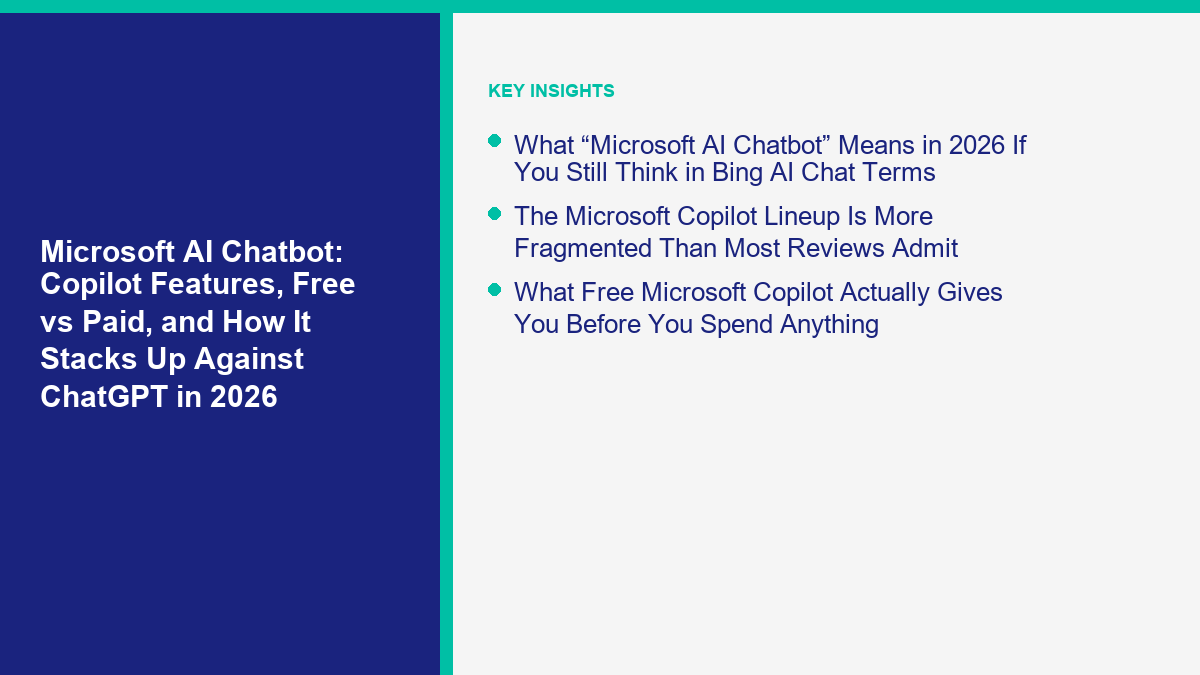
The fastest way to get confused about the microsoft ai chatbot market in 2026 is to watch an old Copilot review. Microsoft changed the branding, changed the packaging, changed the business entry point, and changed the way paid AI shows up inside Microsoft 365. If you still think this is just “Bing AI Chat versus ChatGPT,” you are already working with the wrong map.[12][1]
I reviewed Microsoft’s current support articles, pricing pages, and admin documentation, plus OpenAI’s current pricing and plan documentation, on April 12, 2026. The headline is simple: Microsoft now has at least four meaningful Copilot lanes to think about. There is the free consumer Copilot, paid consumer Copilot inside Microsoft 365 subscriptions, Microsoft Copilot Chat at no additional cost for many work accounts, and the paid Microsoft 365 Copilot add-on for businesses and enterprises. Those are not the same product, and most comparison posts still blur them together.[1][2][4][6][7]
That distinction matters because Microsoft Copilot is strongest when your work already lives inside Outlook, Teams, Word, Excel, PowerPoint, OneDrive, and SharePoint. If your real need is a customer-facing bot on Facebook Messenger, Instagram, or website chat, Copilot is usually not the first product you should buy. For that side of the stack, compare purpose-built channel automation separately and View MessengerBot Pricing against what Microsoft actually includes instead of assuming one AI assistant solves every chat job.
This review is written for people making a real tooling decision: marketers inside Microsoft 365, operations teams trying to automate internal work, founders deciding between Copilot and ChatGPT, and agencies trying to figure out where Microsoft’s AI fits once actual customers need to message the business on external channels.
What “Microsoft AI Chatbot” Means in 2026 If You Still Think in Bing AI Chat Terms
If you still search for bing ai chat, you are looking for Microsoft Copilot. Microsoft made that rebrand official in late 2023, explicitly saying Bing Chat and Bing Chat Enterprise would become Microsoft Copilot to simplify the product experience. That matters for search intent because a lot of older comparison pages still describe the older names as if they were separate products.[12]
The current Microsoft support language is much clearer than the older marketing pages. Microsoft describes Copilot as an AI technology built across different Microsoft products and services, with free access at copilot.com, in the Copilot apps on Windows and macOS, on mobile, and from Microsoft Edge. In other words, “Microsoft AI chatbot” is not one boxed product anymore. It is a family of copilots that share a brand and some core AI behavior, but live in different pricing and licensing buckets.[1]
That is why people keep talking past each other in reviews. One person is really reviewing the free web Copilot. Another is reviewing Copilot in Word and Excel through a home Microsoft 365 subscription. Another is talking about microsoft copilot chat with a work account. Another is talking about the paid Microsoft 365 Copilot add-on with Teams recaps, Graph grounding, and admin controls. They are all using the word “Copilot,” but they are not reviewing the same thing.
The Microsoft Copilot Lineup Is More Fragmented Than Most Reviews Admit
The cleanest way to evaluate the microsoft ai chatbot offering right now is to separate it into consumer, work, and build-your-own layers. Once you do that, the packaging starts to make sense.
| Copilot tier | Who it is for | What you get | Public 2026 price signal | Main catch |
|---|---|---|---|---|
| Microsoft Copilot (free) | Individuals | Web-grounded AI chat, writing help, image creation, Edge integration, voice when signed in | $0 | Not work-grounded, limited compared with paid tiers |
| Microsoft 365 Personal | One person | Copilot in Word, Excel, PowerPoint, Outlook, higher usage than free | $9.99/month or $99.99/year | AI benefits are for the subscription owner only |
| Microsoft 365 Family | Households | Shared Microsoft 365 value, Copilot benefits for the owner | $12.99/month or $129.99/year | Family members do not get shared Copilot app benefits |
| Microsoft 365 Premium | Power users | Highest consumer usage, advanced AI features, more agent access | $19.99/month or $199.99/year | Still not the same as business Copilot |
| Microsoft 365 Copilot Chat | Eligible Entra work accounts | Secure AI chat, file upload, Pages, image generation, limited in-app Copilot, metered agents | Included at no additional cost with eligible Microsoft 365 plans | Advanced work-grounded features still need the add-on |
| Microsoft 365 Copilot Business | Organizations up to 300 users | Work-grounded Copilot in Teams, Outlook, Word, Excel, PowerPoint, agents, analytics | $18/user/month yearly promo or $25.20 monthly | Requires a qualifying Microsoft 365 base license |
| Microsoft 365 Copilot | Enterprise customers | Enterprise-grade privacy, compliance, app integration, work-grounded Copilot | $30/user/month paid yearly | You still need the right Microsoft 365 licensing underneath |
| Copilot Studio | Teams building custom agents | Build internal or external agents across channels | $200 for 25,000 Copilot Credits/month or pay-as-you-go | Separate build and governance layer, not a simple chat app upgrade |
The current public pricing pages back up that split. Microsoft’s individual pricing hub lists Microsoft 365 Personal at $99.99/year, Family at $129.99/year, and Premium at $199.99/year, while the business pricing hub positions Copilot Chat as included and Microsoft 365 Copilot Business as a separate paid add-on. On the enterprise side, Microsoft still shows the main Microsoft 365 Copilot add-on at $30 per user per month paid yearly.[2][6][7][17]
That means the old “free vs Copilot Pro” mental model is too narrow for 2026. Paid Copilot now mostly shows up as a benefit inside broader Microsoft 365 plans for home users and as a layered add-on for work accounts. If a review does not make that clear, it is skipping the part that most affects your budget.
What Free Microsoft Copilot Actually Gives You Before You Spend Anything
Free Copilot is better than many people assume, but it is also easier to misread than ChatGPT Free because Microsoft hides some of the distinction behind account state and entry point. Microsoft says free Copilot is available at no cost through copilot.com, Windows, macOS, mobile apps, and Edge. You do not need to sign in just to use it, which still makes Copilot one of the easier mainstream AI assistants to test quickly.[1]
Once you sign in with a personal Microsoft account, Microsoft says you get access to chat history, image creation, longer conversations, voice interactions, and other Copilot features. Free Copilot also pulls in real-time web answers, and inside Edge it can summarize pages and surface context from what you are browsing. For light research, quick drafts, travel lookups, and simple web-grounded Q&A, that is already enough for a lot of people.[1]
Where free Copilot starts to feel thin is exactly where business buyers tend to care most: reliable app integration, work grounding, admin control, predictable AI limits, and repeatable in-app productivity. Free Copilot can feel smart in a browser tab. It feels much less complete when you want it to understand your inbox, your meetings, your files, and your team’s actual workflow.
That is the first practical decision point. If you mainly want a consumer assistant for quick web-grounded chat, free Copilot is a credible option. If you want an AI layer that lives where you already work all day, the paid Microsoft 365 tiers matter much more than the free chat box.
Paid Copilot for Individuals Is Really Three Microsoft 365 Plans, Not One Simple Upgrade
For home users, Microsoft’s live pricing hub now pushes three main AI-ready plans: Microsoft 365 Personal, Family, and Premium. Personal is $9.99/month or $99.99/year, Family is $12.99/month or $129.99/year, and Premium is $19.99/month or $199.99/year. All three include Copilot inside core Microsoft 365 apps for the subscription owner, but the usage ceilings and advanced feature access change by plan.[2]
This is where Microsoft’s pricing starts to feel less consumer-friendly than ChatGPT’s. The Family plan looks generous on paper because it covers up to six people, but Microsoft repeatedly states that AI benefits are only available to the subscription owner. That means a lot of buyers see “family” or “premium” and assume shared Copilot access, then realize the AI value is mostly not shareable. If you buy it for a household, think of the AI upgrade as effectively single-user.[1][3]
The usage details are more concrete than many reviews mention. Microsoft’s March 2026 support article on AI credits says Personal and Family currently get extensive chat use, 60 image credits per month, 10 minutes of Vision per day, 30 minutes of Voice per day, and 15 Deep Research tasks. Premium gets the highest consumer limits, including 25 agent tasks per month, 10 Actions tasks per month, 15 minutes of Vision per day, 60 minutes of Voice per day, and exclusive access to advanced AI features.[3]
That makes Microsoft 365 Premium the real power-user consumer tier, not just a nicer version of Family. If you are the sort of user who hits voice limits, wants more AI image usage, or cares about access to Microsoft’s more advanced agent-style features, Premium is the tier that actually changes the experience. Personal and Family are better read as “Copilot bundled into Office” plans, not true unlimited AI plans.
There is also a practical Office caveat that matters more than marketing would suggest. Microsoft can deliver Copilot where your files already live, but some features depend on specific conditions. For example, Microsoft notes that Copilot in Excel for home users requires AutoSave and a file stored in OneDrive. That kind of workflow dependency is common with Copilot. When it works inside the Microsoft stack, it feels convenient. When the file is in the wrong place or the account is the wrong type, the experience gets patchy fast.[2]
Microsoft Copilot Chat for Business Is the Sleeper Tier Most Teams Should Test First
The most under-discussed part of the Microsoft AI chatbot stack is the no-additional-cost work tier. Microsoft says Microsoft 365 Copilot Chat is available at no additional cost for Microsoft Entra account users with an eligible Microsoft 365 subscription. That alone changes the business buying conversation because a lot of organizations can pilot Copilot without jumping straight to a $30-per-seat add-on conversation.[4][6][7]
Microsoft describes Copilot Chat as secure, web-grounded AI chat with the latest large language models, file upload, Copilot Pages, IT controls, enterprise data protection, and side-by-side awareness of open content in select Microsoft 365 apps. In plain English, this is Microsoft’s “good enough to start real work” tier for many organizations. It is much more than the free consumer Copilot, but less than the full Microsoft 365 Copilot add-on.[4][5]
The support documentation gets even more specific. Without the add-on license, Microsoft says work users can engage with open files and emails in Outlook, Word, Excel, PowerPoint, and OneNote, ask questions, summarize documents and web pages, perform data analysis, create images, create Pages from responses, and use pay-as-you-go agents for task automation. That is a serious trial surface. It is not just a teaser banner inside Microsoft 365.[1]
If I were advising a Microsoft-heavy team today, I would not start by licensing the add-on for everyone. I would start by turning on Copilot Chat where licensing already allows it, defining five real work prompts per department, and measuring whether people actually use it for email catch-up, draft creation, file summaries, or meeting prep. That pilot tells you much more than another polished keynote demo.
When the Paid Microsoft 365 Copilot Add-On Starts Making Financial Sense
The paid add-on is where Microsoft stops selling “AI chat” and starts selling “AI embedded into your work system.” For organizations with up to 300 users, Microsoft currently lists Microsoft 365 Copilot Business at $18 per user per month paid yearly as a promotional rate, down from $21, and $25.20 per user per month on the monthly option. Microsoft’s own terms say that discount offer runs from December 1, 2025 through June 30, 2026. After that window, teams should expect the annual add-on price to move back up unless Microsoft extends the offer.[6]
For enterprise customers, Microsoft still shows the core Microsoft 365 Copilot add-on at $30 per user per month paid yearly, with a qualifying Microsoft 365 plan required underneath. That separate-license language matters because your real bill is never just the add-on. If you do not already own an eligible Microsoft 365 base license, you need to count that too.[7][8]
What do you buy with that extra spend? Microsoft’s business and enterprise pages are pretty direct. The add-on gives you Work IQ-powered chat, work-grounded Copilot in Teams, Outlook, Word, PowerPoint, and Excel, agent creation with Copilot Studio, deeper reasoning agents such as Researcher and Analyst, stronger management and analytics, and more complete Microsoft 365 integration. That is the line between “AI chat next to my work” and “AI working through my Microsoft environment.”[6][7][1]
The licensing prerequisites are the part most optimistic rollouts underestimate. Microsoft’s admin documentation says users must have a Microsoft 365 license assigned, must have Entra ID accounts, and must use primary mailboxes hosted on Exchange Online. If your environment is messy, hybrid, or only partly standardized on Microsoft 365, those prerequisites can slow adoption much more than the AI itself.[8]
Where Microsoft Copilot Is Genuinely Strong: Teams, Outlook, Word, Excel, and PowerPoint
The best argument for Microsoft Copilot over ChatGPT is not that the model is obviously better in raw chat quality. The best argument is location. Copilot lives where a lot of office work already happens. When that matters, Microsoft has a real product advantage.
| App | What Copilot does well | Why that matters in real work |
|---|---|---|
| Teams | Meeting notes, action items, recaps, in-meeting assistance | Reduces the post-meeting cleanup most teams never finish |
| Outlook | Thread summaries, draft replies, inbox catch-up | Email is still where a lot of slow decision-making happens |
| Word | First drafts, rewrites, summarization, content expansion | Strong for internal docs, proposals, and editing passes |
| Excel | Data analysis, explanations, structured help | Useful when non-analysts need faster answers from existing sheets |
| PowerPoint | Deck drafting, slide structure, faster first-pass presentation work | Good for getting to an editable draft quickly |
Teams is the clearest example. Microsoft’s support documentation says Copilot can be used during a meeting even when the meeting is not being recorded, as long as the meeting option is set to allow Copilot only during the meeting. Microsoft says Copilot can generate notes, list tasks, and help during the meeting, even though the post-meeting recap will not persist without transcription. That is a very practical workflow detail, especially for confidential meetings where recording is unpopular.[11]
Outlook and Word are the next strongest fits because they remove the most repetitive knowledge-work friction: catching up on long threads, drafting an answer, rewriting something that sounds clumsy, or summarizing what changed in a document. Excel is useful too, but in a more conditional way. It shines when the sheet structure is already reasonable and the user needs help understanding or analyzing it. It is less magical when the spreadsheet itself is chaotic.
This is also the section where ChatGPT comparisons get more honest. ChatGPT can analyze files, connect to tools, summarize documents, and work with SharePoint through connectors. But Microsoft’s own pricing pages show that Copilot is embedded directly into the apps a lot of businesses already pay for. OpenAI’s pricing pages emphasize apps and connectors; Microsoft emphasizes in-app, work-grounded assistance. That difference is the center of the buying decision, not benchmark chest-thumping.[13][6][7]
Where Microsoft Copilot Still Feels Weaker or More Complicated Than It Should
Copilot’s biggest weakness is not intelligence. It is packaging clarity. Microsoft has a habit of making capable products harder to buy and understand than they need to be, and Copilot is a clean example.
First, the home plans are awkward if you are buying for multiple people. Family and Premium sound shareable, but Microsoft’s support pages make it clear that AI benefits are tied to the subscription owner. For a lot of households and micro-teams, that is a surprising limitation.[1][3]
Second, the work tiers have a weirdly fuzzy boundary. Copilot Chat is included and already fairly capable. The paid add-on is materially better, but the jump is not always obvious unless you live inside Teams meetings, Outlook, and Microsoft Graph-heavy workflows. That is great for Microsoft because it creates upsell paths. It is less great for buyers trying to forecast adoption honestly.
Third, agents add another layer of meter complexity. Microsoft Learn says some agents in Copilot Chat are available at no additional cost, while agents that access shared tenant data such as SharePoint or Graph Connector content are billed on metered consumption. Another Microsoft Learn billing article says the pay-as-you-go service can bill Copilot Studio usage at $0.01 per message. That is not outrageous, but it means “included AI” can turn into another usage line item the moment teams start building more useful agents.[9][10]
Fourth, the licensing requirements are real. If Exchange Online is not your primary mailbox layer, or if identity and app deployment are not clean, the best Copilot scenarios can stall before users ever see them. Microsoft does not really hide this in the docs. A lot of buyers just skip the boring prerequisite pages and then act surprised later.[8]
That does not make Copilot a weak product. It makes it a product that rewards organizations already standardized on Microsoft’s stack and punishes those trying to use it as a shortcut around broader IT cleanup.
Microsoft Copilot Chat Agents and Copilot Studio Pricing Get Expensive Fast If You Want External Automation
There is another important line many reviews blur: internal Copilot versus external agent building. Microsoft 365 Copilot includes some internal agent-building capability, but the moment you want broader channel publishing or more explicit agent economics, Copilot Studio enters the picture.[17]
Microsoft’s current Copilot Studio pricing page shows a fixed license at $200 for 25,000 Copilot Credits per month, plus a pay-as-you-go option. Microsoft also says Copilot Studio is the path when you want to publish agents to outside channels such as websites, apps, or social platforms. That is useful if your business is already committed to Microsoft’s ecosystem and wants one agent platform spanning internal and external use cases.[17]
But this is where you should stop pretending Copilot is a cheap add-on and start doing real math. Microsoft Learn also documents metered billing for pay-as-you-go services, including Copilot Chat agents and SharePoint agents. Once the AI starts taking action over work data or serving broader channel use cases, you are in consumption-model territory, not just seat-pricing territory.[10]
If your real requirement is an external customer-facing chatbot on Meta channels or a website widget, that build-versus-buy question matters. You can absolutely build around Copilot Studio. You can also spend a lot of time and licensing energy recreating a workflow that a channel-specific automation platform already gives you. If you need examples of those customer-side flows before you over-engineer the stack, Browse Our Tutorials and compare that workflow style against what Microsoft’s agent platform would force you to design.
Microsoft Copilot vs ChatGPT in 2026 Comes Down to Workflow Location More Than Raw Intelligence
This is the section most people actually want, so here is the short version first. If your work already lives in Microsoft 365 and the biggest pain is time lost inside Teams, Outlook, Word, Excel, and PowerPoint, Copilot usually has the better product fit. If your work spans many SaaS tools, you want a more general-purpose AI workspace, or you care more about frontier model access and flexible apps than Microsoft-native embedding, ChatGPT is often the cleaner buy.
| Category | Microsoft Copilot | ChatGPT |
|---|---|---|
| Free tier | Free web and app access, no sign-in required to start, web-grounded answers | Free plan with limited access to flagship models and features |
| Paid individual entry | Personal from $9.99/month; Premium at $19.99/month is the real power-user tier | Plus at $20/month |
| Power-user individual tier | Microsoft 365 Premium with higher limits and advanced AI features | Pro now has $100 and $200 tiers for heavier usage |
| Business team pricing | Copilot Chat included with eligible Microsoft 365; Copilot Business at $18 yearly promo or $25.20 monthly | Business at $20/user/month billed annually or $25 billed monthly for most countries |
| Native app embedding | Strong inside Teams, Outlook, Word, Excel, PowerPoint | Strong apps and connectors, but not native Microsoft app embedding at Copilot’s depth |
| Tool ecosystem signal | 100+ connectors highlighted on business pages | 60+ apps listed on Business pricing page |
| Data and admin posture | Enterprise data protection, Microsoft 365 security and compliance controls, region-aware handling | No training on business data by default, SAML SSO, MFA, admin controls, enterprise data residency options |
| Best fit | Microsoft-heavy work environments | Cross-tool knowledge work and general AI collaboration |
OpenAI’s current public documentation says ChatGPT Plus remains $20/month. OpenAI’s Pro help article now describes two Pro tiers at $100 and $200 depending on usage allowance. OpenAI’s Business help article says the self-serve Business workspace is $25 per user per month billed monthly or $20 per user per month billed annually in most countries after the April 2, 2026 pricing update.[15][16][14]
OpenAI’s pricing page also says Business includes unlimited GPT-5.4 messages, access to GPT-5.4 Thinking and Pro on a flexible basis, more than 60 apps including Slack, Google Drive, SharePoint, GitHub, and Atlassian, SAML SSO, MFA, encryption at rest and in transit, and no training on business data by default. That is a strong package. The tradeoff is that it is a workspace first, not an in-Teams or in-Outlook companion first.[13]
So which one wins? For most businesses, neither wins everywhere. Copilot wins on native Microsoft workflow gravity. ChatGPT wins on general AI workspace breadth, cross-tool flexibility, and product clarity. If your staff lives in Teams and Outlook all day, Copilot’s location advantage is hard to ignore. If your staff lives across Slack, Google Drive, GitHub, Notion, Jira, and a dozen other tools, ChatGPT’s model and app layer often feels less boxed in.
Free vs Paid: When Microsoft Copilot Is Good Enough Without Upgrading
There are three scenarios where free or included Copilot is honestly enough.
- Personal web research and drafting. Free Copilot already handles quick writing, summaries, and web-grounded Q&A surprisingly well.
- Casual Office use at home. Microsoft 365 Personal or Family can be enough if one person mainly wants AI help in Word, Outlook, and basic Microsoft 365 apps.
- Business pilots. If your organization already has eligible Microsoft 365 subscriptions, Copilot Chat is the logical first step before you license the full add-on.
The paid jump starts making sense when the missing piece is not just “more messages.” It makes sense when the missing piece is work grounding, app embedding, meeting assistance, organizational control, or repeatable AI use inside daily workflows. That is why a pure consumer free-versus-paid frame misses the bigger business decision.
A good rule is simple. Upgrade Microsoft Copilot when your team is already committed to Microsoft 365 and the paid features replace friction you are already paying employees to suffer through. Stay on free or included tiers longer when your use case is exploratory, light, or not really tied to Microsoft’s work apps.
Microsoft’s Privacy and Compliance Story Is Better Than Its Consumer Packaging
Microsoft’s strongest enterprise argument is not flashy. It is boring in the right way. On the Copilot Chat pages, Microsoft says the service inherits existing Microsoft 365 security and compliance requirements, keeps access scoped by existing permissions, and handles data within the user’s geographical region as part of the Microsoft 365 service. That is exactly the kind of language enterprise buyers want to see because it aligns the AI tool with controls they already understand.[4]
OpenAI is not weak here either. The current ChatGPT pricing page says Business includes encryption at rest and in transit, no training on business data by default, SAML SSO, MFA, and compliance support aligned with GDPR, CCPA, CSA STAR, and SOC 2 Type 2. Enterprise adds more controls such as SCIM, domain verification, role-based access controls, and data residency in ten regions.[13]
The practical difference is operational context. Microsoft’s privacy story is tightly coupled to the Microsoft 365 environment. OpenAI’s is tied to a secure AI workspace that connects outward into many tools. Neither model is automatically better. The better model is the one your security, IT, and legal teams can actually evaluate and govern without inventing a new review process from scratch.
This is also why Copilot usually looks strongest in organizations that already trust Microsoft with identity, email, documents, and collaboration data. The closer the AI sits to systems you already govern, the more believable the rollout becomes.
Which Businesses Should Choose Copilot Over ChatGPT in 2026
Choose Microsoft Copilot first if most of the following are true:
- Your company runs on Teams, Outlook, SharePoint, OneDrive, and Microsoft Office documents.
- You want AI inside meetings, email threads, and familiar Office workflows more than you want a separate AI workspace.
- You already have Microsoft 365 licensing discipline and can meet Microsoft’s prerequisites without cleanup drama.
- You want to start with included Copilot Chat before deciding who really needs the paid add-on.
- You care more about Microsoft-native app context than about having the most flexible standalone AI product.
Choose ChatGPT first if most of these are true:
- Your company works across many non-Microsoft tools and wants one AI workspace spanning them.
- You want a cleaner product ladder: Free, Plus, Pro, Business, Enterprise.
- You care more about frontier model access, agent mode, custom GPTs, and broad app integrations than about Office-native surfaces.
- You are not standardized enough on Microsoft 365 to get Copilot’s best scenarios without extra IT work.
There is also a third answer that most buyers need sooner than they expect: use Copilot or ChatGPT for internal work, and use a separate platform for customer-facing chat. A lot of teams try to make one AI product do both jobs because it sounds efficient. In practice, that usually means the internal assistant is good while the customer-facing bot remains half-built.
Where MessengerBot Fits Better Than Copilot If You Need a Customer-Facing Chatbot
Microsoft Copilot is an internal productivity assistant first. Even when you add Copilot Studio, you are still buying into a broader agent platform, not a turnkey Facebook Messenger and Instagram automation stack. That distinction matters more than the word “chatbot.”
If your business needs a bot that actually talks to prospects and customers across Facebook Messenger, Instagram, and website chat, the job shifts from “help my employees work faster” to “handle real conversations, triggers, flows, handoffs, and channel-specific automation.” That is where MessengerBot is the more natural category fit.
Use Microsoft Copilot when the conversation is mostly internal: summarize meetings, analyze spreadsheets, catch up on email, ground answers in work files, or help staff inside Office. Use MessengerBot when the conversation needs to happen on Meta channels or your site: auto-replies, lead routing, comment-to-message flows, follow-up sequences, and customer support entry points. If your operation is already beyond a basic setup and you need broader channel capacity, Upgrade to MessengerBot Pro instead of trying to bolt a workplace assistant onto a customer-messaging problem.
This is not an either-or decision for every company. A lot of teams should end up with both layers: Copilot for the staff, MessengerBot for the audience. The mistake is assuming the first tool can replace the second just because both use AI and both can answer messages.
A Practical 7-Step Evaluation Process Before You Buy Microsoft Copilot Licenses
If you are trying to choose between Microsoft Copilot, ChatGPT, or a mix of internal and external tools, use a short evaluation loop instead of shopping by marketing headline. This is the sequence I would use in a Microsoft-heavy business right now.
- Map where work already happens. Count how much of the team’s day lives in Teams, Outlook, Word, Excel, PowerPoint, SharePoint, Slack, Google Drive, GitHub, and project tools. This tells you whether Copilot’s embedding advantage will really matter.
- Turn on Copilot Chat first if you already qualify. Microsoft gives many work accounts an included entry point. Use it before you buy the add-on.[4][6]
- Pick five measurable prompts per department. Examples: summarize a sales meeting, draft a customer reply, turn an email thread into actions, analyze a weekly Excel file, or create a first-pass status deck.
- Compare one-week Copilot and ChatGPT pilots. Do not compare them in abstract. Give both products the same work and see which one saves more real time.
- Check prerequisites before procurement. Verify Exchange Online, base Microsoft 365 licensing, Entra setup, and app deployment readiness before assuming a smooth rollout.[8]
- Separate internal AI from customer-facing chat. If your next priority is Messenger, Instagram, or website automation, plan that as a different workstream. If you need ready-made implementation patterns for that side, Browse Our Tutorials.
- Model the full bill, not just seat price. Include add-ons, qualifying Microsoft 365 plans, Copilot Studio or pay-as-you-go agent meters, and any extra admin work needed to make the rollout stick.[6][10]
That process is deliberately boring. Good AI procurement usually is. The teams that get value fastest are the ones that treat Copilot as a workflow decision, not a brand decision.
What I Would Actually Recommend Right Now
If you are a Microsoft-first company, start with the included work tier. Pilot Microsoft Copilot Chat before you pay for the full add-on. If the pilot proves that people genuinely live in Teams, Outlook, Word, Excel, and PowerPoint, then the paid Microsoft 365 Copilot license can be justified on saved time, better recaps, and less document churn.
If you are not Microsoft-first, or your staff works across a wider SaaS stack, ChatGPT will often feel cleaner, faster to understand, and more flexible as a central AI workspace. And if your actual need is customer-facing automation on Meta channels or your site, do not force Copilot into that job. Build that layer separately, and if you package those builds for clients, Join Our Affiliate Program while you are doing it.
Sources and Pricing References
All plan details and feature references below were checked on April 12, 2026 unless a source itself listed a different effective date or update date.
- Microsoft Support – What’s the difference between the Microsoft Copilot experiences?
- Microsoft – Copilot Pricing Plans for Individuals
- Microsoft Support – AI credits and limits for Microsoft 365 Personal, Family, and Premium
- Microsoft – Microsoft 365 Copilot Chat
- Microsoft Support – Catch up on things quickly using Microsoft 365 Copilot Chat
- Microsoft – Microsoft 365 Copilot Plans and Pricing for Business
- Microsoft – Microsoft 365 Copilot Plans and Pricing for Enterprise
- Microsoft Learn – App and network requirements for Microsoft 365 Copilot admins
- Microsoft Learn – Using agents in Microsoft 365 Copilot Chat
- Microsoft Learn – Meters for Microsoft 365 Copilot pay-as-you-go
- Microsoft Support – Use Copilot without recording a Teams meeting
- Microsoft Blog – Furthering our AI ambitions: Announcing Bing Chat Enterprise and Microsoft 365 Copilot pricing
- View MessengerBot Pricing
- OpenAI Help Center – What is ChatGPT Business?
- OpenAI Help Center – What is ChatGPT Plus?
- OpenAI Help Center – About ChatGPT Pro plans
- Microsoft – Copilot Studio pricing
Frequently Asked Questions
Is Microsoft AI chatbot the same thing as Bing AI Chat?
Mostly yes. If you still search for Bing AI Chat, Microsoft now wants you to think of that experience as Microsoft Copilot. The underlying product family expanded, but the old Bing Chat naming has largely been replaced by the Copilot brand.
Is Microsoft Copilot free in 2026?
Yes, there is still a free Copilot tier for consumers, and Microsoft also offers Microsoft 365 Copilot Chat at no additional cost for work users with eligible Microsoft 365 subscriptions. The paid layers start when you want higher consumer limits, Copilot inside Microsoft 365 apps, or full work-grounded Microsoft 365 Copilot features.
What is the difference between Microsoft Copilot Chat and Microsoft 365 Copilot?
Microsoft Copilot Chat is the included work AI chat tier for eligible Microsoft 365 accounts. Microsoft 365 Copilot is the paid add-on that adds deeper work grounding, stronger app integration in Teams and Microsoft 365 apps, advanced agents, and more enterprise management features.
Is Microsoft Copilot better than ChatGPT for work?
Microsoft Copilot is usually better if your team already works mainly in Teams, Outlook, Word, Excel, PowerPoint, and SharePoint. ChatGPT is often better if your team needs a broader standalone AI workspace across many different apps and wants a simpler product ladder.
Can Microsoft Copilot replace a Facebook Messenger or website chatbot?
Not cleanly for most businesses. Copilot is strongest as an internal assistant and work-layer AI product. If you need customer-facing automation on Facebook Messenger, Instagram, or website chat, you usually need a platform built for those channels rather than trying to stretch Copilot into a job it was not packaged to handle out of the box.
 English
  Tagalog
  简体中文
简体中文  العربية
  हिन्दी
  Português do Brasil
  Español de México
  Français
  বাংলা
বাংলা  香港中文
香港中文  繁體中文
繁體中文  Nederlands
  Deutsch
  Bahasa Indonesia
  日本語
日本語  한국어
한국어  Polski
  Русский
  Español
  Tiếng Việt