
The easiest way to waste ecommerce traffic in 2026 is still the oldest one: get people to your store, let them add products to cart, then give them no reason to come back when life interrupts the purchase.
That is why ecommerce chatbots have moved out of the “nice extra” category and into the revenue stack. A good bot does not sit in the corner answering store-hours questions. It recovers carts, recommends the right product instead of a random bestseller, handles order tracking before a shopper opens a ticket, and keeps post-purchase support from swallowing your margin.
As of April 10, 2026, the public product pages and help docs from Baymard, Shopify, Tidio, Gorgias, ManyChat, Chatfuel, and MessengerBot all point to the same conclusion: the stores winning with automation are not trying to replace ecommerce operations with one giant AI assistant. They are automating the high-volume moments that already exist in the funnel.
If your store runs on Shopify, WooCommerce, or BigCommerce, that matters because your stack now gives you three practical opportunities to lift revenue without buying more traffic: pull back a slice of abandoned carts, raise average order value with guided recommendations, and cut support friction so more shoppers actually complete checkout. When store owners talk about a 30% lift from automation, that is usually where the math comes from.
Why Ecommerce Chatbots Are Finally Worth the Budget in 2026
Baymard’s latest benchmark still puts average cart abandonment at roughly 70.22%. That number alone explains why ecommerce chatbot software keeps getting budget approval. You do not need a bot to invent demand. You need it to stop losing the demand you already paid for.
Here is the more useful way to think about it. A chatbot becomes profitable when it improves one of four numbers: completed orders, average order value, support cost per conversation, or repeat purchase rate. If it does not move one of those, it is decoration.
| Use case | What it changes | Planning range | Why it matters |
|---|---|---|---|
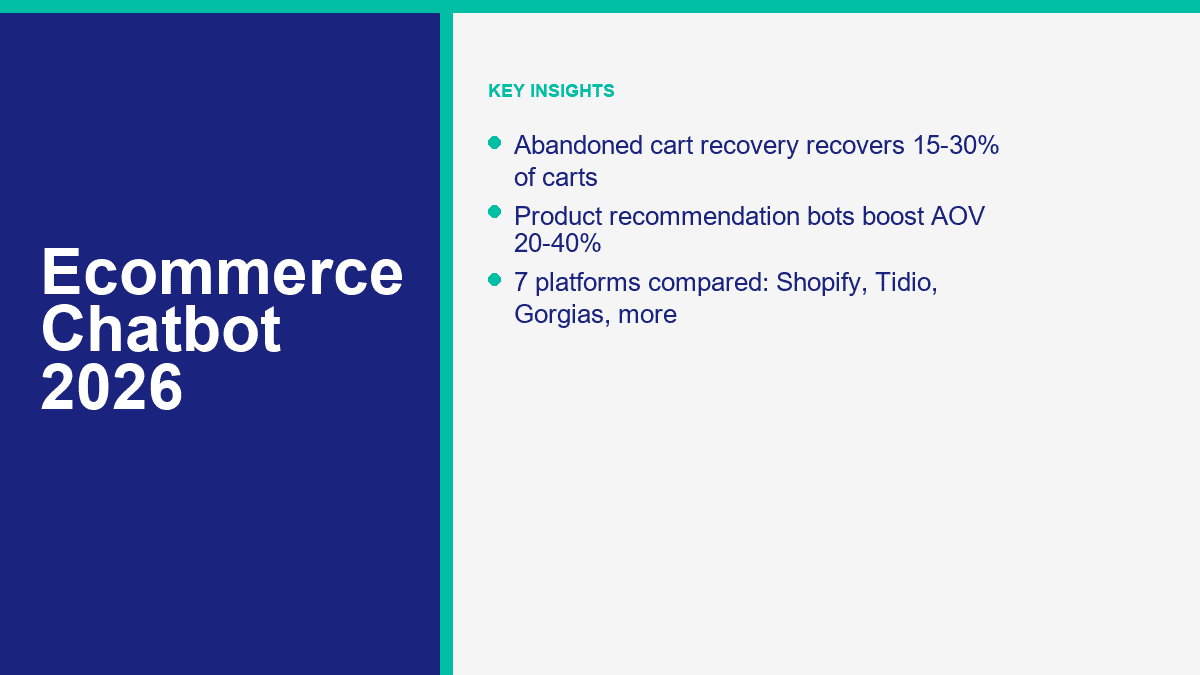
| Abandoned cart recovery | Recovers otherwise lost checkouts | 15% to 30% of reachable abandoned carts | You are monetizing traffic you already bought |
| Product recommendation flows | Raises assisted order value | 20% to 40% AOV lift on chatbot-assisted orders | Bigger baskets increase revenue without more sessions |
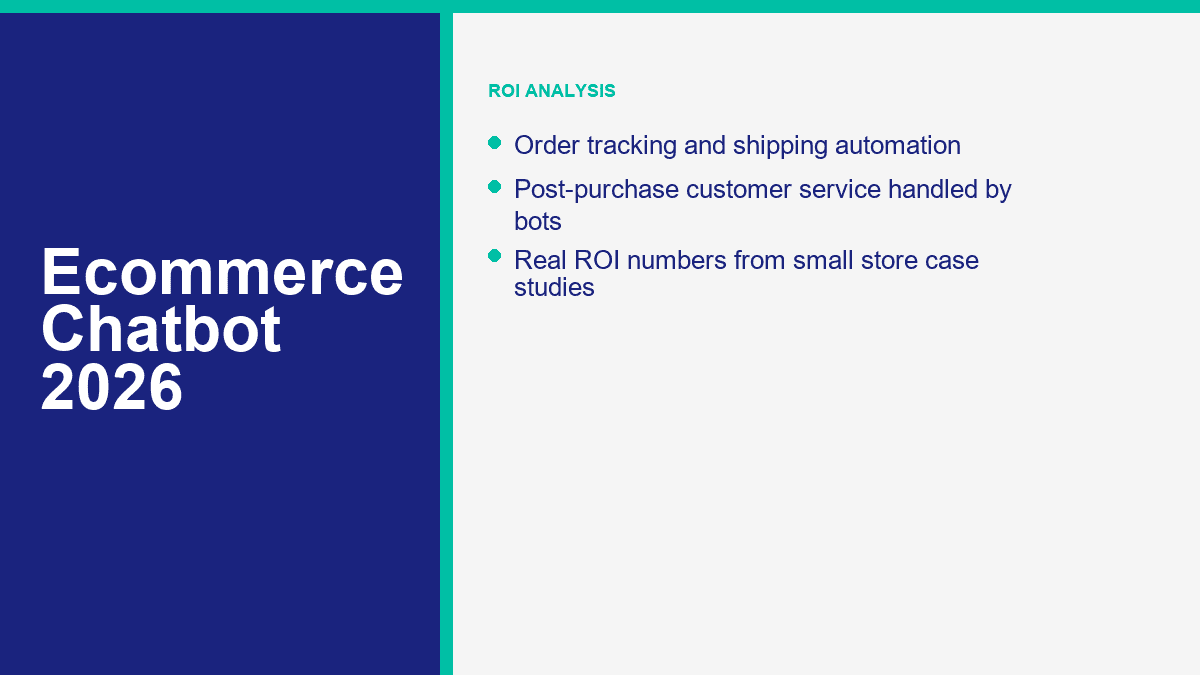
| Order tracking automation | Deflects “where is my order?” tickets | 40% to 70% automation on repetitive post-purchase questions | Your team spends less time copying tracking links |
| Post-purchase service flows | Speeds up returns, exchanges, and address changes | Lower handle time and faster first response | Support stops being a drag on margin and repeat purchase |
That second line needs one clarification because a lot of articles blur the numbers. When people say recommendation bots can increase AOV by 20% to 40%, they are usually talking about orders touched by recommendation flows, not your entire store average overnight. That is still a strong result. If your bot reliably bundles accessories, pushes shoppers over a free-shipping threshold, or helps them choose the higher-fit product instead of abandoning the page, the lift is real.
The other thing most guides skip is this: there is no serious ecommerce chatbot category where “no sign up required” is the deciding feature. Production bots need catalog access, customer identity, order data, and channel permissions. The free options that matter are the ones that let you test live workflows without enterprise pricing. In this market, that usually means Shopify Inbox for native Shopify chat, Tidio’s free entry plan, and ManyChat’s free starting tier. Everything else is a trial, a paid plan, or a sales-led setup.
The practical question is not whether chatbots work. It is whether your store has enough cart volume, enough product complexity, or enough repetitive support to justify automating the conversation. For most established stores, the answer is yes long before they realize it.
The 7 Ecommerce Chatbot Platforms Worth Testing Before You Commit
Pricing and plan details below were checked against public product pages on April 10, 2026. I am not ranking these as abstract AI tools. I am ranking them for ecommerce jobs: cart recovery, product discovery, order tracking, support deflection, and cross-channel selling.
| Platform | Starting price | Best platform fit | What it does best | Main tradeoff |
|---|---|---|---|---|
| MessengerBot.app | Premium $19.99 per 30 days | Best for Messenger-first stores; public page clearly advertises WooCommerce sync | Messenger automation, website chat, abandoned cart tools, flat plan pricing | Less ecommerce-native than Tidio or Gorgias for website-first support teams |
| Shopify Inbox | Free | Shopify only | Native Shopify chat, product links, discounts, FAQs, order updates | No WooCommerce or BigCommerce path, and automation depth is lighter |
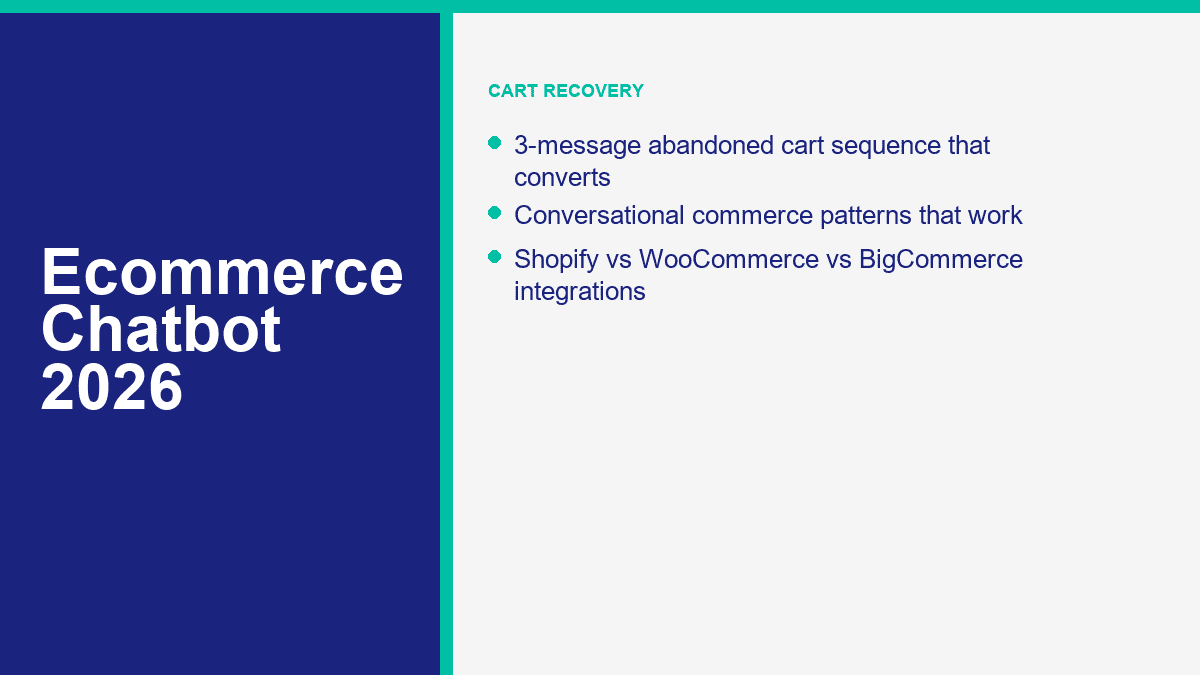
| Tidio | Free; Starter $24.17 per month; Lyro AI from $32.50 | Strong on Shopify, WooCommerce, and BigCommerce | Website chat, AI support, product recommendations, cart-recovery flows | You need to watch plan stacking as support and AI usage grow |
| Gorgias | Starter $10 per month; Basic $50 yearly or $60 monthly; AI Agent extra | Best for scaled Shopify; also strong on WooCommerce and BigCommerce | Post-purchase support, order edits, AI shopping assistant, revenue attribution | It is support-led software first, not the cheapest starter bot |
| ManyChat | Free; Essential $17 per month; Pro $39 per month | Best when Shopify is paired with Messenger, Instagram, SMS, or WhatsApp | Social DM funnels, abandoned cart reminders, product catalog messaging | Not a full ecommerce help desk and pricing grows with active contacts |
| Chatfuel | Business from $23.99 per month plus overages | Best for Shopify plus WhatsApp or Instagram selling | WhatsApp-first cart recovery, support replies, product recommendations | Conversation-based pricing and weaker website-helpdesk depth |
| Drift | Custom pricing | Best for high-ticket or B2B commerce sites | Pre-sales qualification, meeting booking, revenue-team routing | Usually the wrong choice for routine order tracking and DTC support |
MessengerBot.app Fits Stores That Actually Sell Through Messenger
MessengerBot makes the most sense when Facebook Messenger is not an afterthought but a real sales and support channel. Its public pricing page is unusually direct about what ecommerce owners care about: abandoned cart recovery tools, website chat, payment integrations, JSON API plus Zapier, and a one-click WooCommerce sync. That is why I would put it near the top for WooCommerce brands and service-heavy stores that already live in Facebook Page conversations. If you want the cleanest breakdown of where the plan tiers split, View MessengerBot Pricing.
Shopify Inbox Is the Best Free Shopify Starting Point
For merchants who want a native Shopify tool before they buy anything else, Shopify Inbox is still the obvious first install. It is free, lets you send product links and discount codes in chat, supports FAQs and instant answers, and includes order-update workflows like “Track my order.” The catch is just as obvious: it is a Shopify-only answer, and it will not give you the deeper cross-channel automation that larger stores eventually want.
Tidio Is the Strongest All-Around Pick for Website Chat Plus Ecommerce Automation
Tidio has become one of the easiest recommendations because it works across Shopify, WooCommerce, and BigCommerce without pretending every store wants the same thing. Its Shopify pages emphasize order management, cart previews, refunds, and shipping-address edits. Its WooCommerce integration pulls product cards into chat. Its BigCommerce integration focuses on cart recovery, product suggestions, and support automation. If your main storefront is your website rather than Messenger or Instagram, Tidio is usually the most balanced option in this list.
Gorgias Wins When Support and Revenue Need to Share One System
Gorgias is what ecommerce operators buy when they are tired of flipping between a storefront, shipping dashboard, and help desk all day. Its Shopify, WooCommerce, and BigCommerce pages all lean into the same value: order context inside the ticket, real-time sync, AI handling for repetitive support, and revenue tracking from conversations. That makes it one of the few chatbot-adjacent tools that can honestly justify a higher price with workflow savings.
ManyChat Still Owns Social DM Selling Better Than Most Support Suites
ManyChat is not the best website-support chatbot here. It is the best social-conversation seller for brands running Instagram, Messenger, SMS, and WhatsApp campaigns that tie directly into Shopify activity. The product is excellent for cart reminders, click-to-message ads, product catalog nudges, and subscriber capture. If your bigger problem is acquiring and nurturing leads before checkout rather than handling complex support after purchase, read our lead generation chatbot guide after this one.
Chatfuel Is a Practical WhatsApp-First Ecommerce Option
Chatfuel deserves more attention from ecommerce teams running WhatsApp. Its Shopify integration page is unusually blunt about the outcomes it is chasing: abandoned cart recovery, personalized notifications, shipping updates, live chat, and product recommendations in a back-and-forth conversation. If WhatsApp is already a meaningful customer channel, Chatfuel can be a simpler revenue play than buying a bigger support suite too early.
Drift Is Best for High-Intent Buying Journeys, Not Routine Order Questions
Drift still belongs in the comparison because some ecommerce businesses are really selling consultations, demos, custom quotes, or higher-ticket products where the chat job is qualification, not support. That is where Drift is strong. If your customers mostly ask about sizing, shipping, returns, or order status, it is too sales-shaped for the average direct-to-consumer store.
If you want the shortest buying advice possible, use this rule. Choose Shopify Inbox for a free native Shopify baseline. Choose Tidio when your website is the main selling surface. Choose Gorgias when support complexity is already real. Choose MessengerBot when Messenger is the core channel. Choose ManyChat or Chatfuel when DM selling is the growth engine. Choose Drift only when the bot is really part of a sales team.
The 3-Message Abandoned Cart Sequence That Brings Back Shoppers Without Feeling Pushy
The highest-return ecommerce chatbot flow is still abandoned cart recovery, but most stores get it wrong by firing one generic reminder and calling it automation. The better approach is a short sequence tied to intent, friction, and timing.
This is the framework I would start with for Shopify, WooCommerce, and BigCommerce stores that have consent, channel permission, and an identifiable shopper:
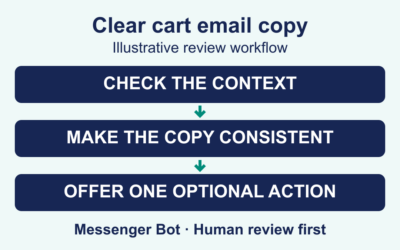
- Message 1 at 1 hour: remind, do not discount. Show the product image, price, and a single button back to checkout. This catches distraction, not resistance.
- Message 2 at 24 hours: reduce hesitation. Answer the most likely objection with shipping clarity, social proof, or product-fit help. Only use an offer if margin allows it.
- Message 3 at 72 hours: create a final decision point. Add urgency, a small incentive, or a support handoff so the shopper can finish or ask a question.
That sequence works because it mirrors the real reasons people abandon. At one hour, many shoppers were interrupted. At twenty-four hours, they are comparing alternatives or thinking about total cost. At seventy-two hours, they are either gone or waiting for a reason to act.
| Timing | Goal | What to include | What to avoid |
|---|---|---|---|
| 1 hour | Recover distracted shoppers | Product image, checkout link, short reminder | Discounting too early |
| 24 hours | Handle objections | Shipping clarity, review snippet, product-fit help | Walls of copy |
| 72 hours | Force a decision | Time-bound incentive, low-stock note, human help | Another generic “you forgot something” message |
Here is what that looks like in plain English:
The First Message Should Feel Helpful, Not Desperate
A good first message sounds like a quiet nudge: “You left this in your cart. Want to pick up where you stopped?” That is enough. If you teach customers that a coupon always lands in the first follow-up, you train them to abandon on purpose.
The Second Message Should Answer the Thing That Blocks Checkout
This is where the chatbot earns its keep. For apparel, the blocker might be sizing. For beauty, it might be product fit. For home goods, it might be shipping cost or delivery timing. The best second reminder does not shout harder. It resolves the friction that made the shopper pause.
The Third Message Should Either Close the Sale or Open a Human Conversation
If the shopper still has not bought after three days, stop pretending one more reminder will magically do it. Give them a clear final reason to act or a direct path to ask a question. Stores often recover 15% to 30% of reachable abandoned carts when this sequence is live, but only if the messages are tied to real checkout friction and sent through a channel the shopper actually checks.
A quick checklist before you launch the flow:
- Use product images and direct checkout links in every reminder.
- Segment by cart value so you do not hand out the same discount to everyone.
- Suppress buyers instantly once the order completes.
- Test one offer variable at a time: free shipping, 10% off, or urgency copy.
- Track recovered revenue, not just clicks.
How Product Recommendation Bots Turn Browsers Into Bigger Baskets
Most stores say they have product recommendations when what they really have is a generic “You may also like” widget showing the same products to everybody. A recommendation chatbot is different because it can ask, compare, explain, and narrow the catalog in real time.
That matters most when your shopper is thinking one of these thoughts: “Which one fits me?”, “What goes with this?”, “What do I buy if the thing I wanted is out of stock?”, or “How much more do I need for free shipping?” Those are conversation problems, not just merchandising problems.
The integration side is straightforward now. Shopify-native tools can pull products, cart contents, and order context directly. WooCommerce bots usually connect through a plugin, API, or one-click sync. BigCommerce bots lean heavily on open integrations and order data access. The stronger the product data, the better the bot gets at upselling without sounding random.
| Recommendation pattern | Where it works best | Why it lifts AOV |
|---|---|---|
| Guided product finder | Homepage, category pages, landing pages | Shortens time to the right product and reduces drop-off |
| Bundle completion | Product page and cart | Adds natural accessories instead of forcing unrelated upsells |
| Alternative recommendation | Out-of-stock or low-stock moments | Saves the order instead of losing the shopper |
| Free-shipping threshold nudge | Cart and checkout | Pushes shoppers to add one more item profitably |
| Post-purchase cross-sell | Order confirmation and follow-up chat | Monetizes the highest-intent moment after trust is established |
The stores that get the best AOV lift do not ask the bot to “sell more.” They give it a concrete job. Here is a better way to set it up:
- Ask two or three qualification questions before recommending anything.
- Show no more than three products at once.
- Explain why each product was suggested.
- Use accessories, refills, and bundles that actually belong together.
- Keep free-shipping thresholds visible during the conversation.
That is how recommendation bots produce the 20% to 40% AOV lifts store owners like to talk about. Not by flooding the shopper with inventory, but by acting more like a competent in-store associate. On many stores, the lift shows up most clearly in assisted orders, not across every transaction. That is still an excellent result because it compounds on traffic you already have.
The other quiet benefit is zero-party data. When the bot asks whether the shopper wants dry-skin skincare, wide-fit shoes, vegan protein, or a gift under $50, it is not just helping the current order. It is learning how to sell the next one better.
Why Order Tracking Bots Pay for Themselves Faster Than Almost Any Other Flow
If your support inbox is full of “Where is my order?” messages, you do not have a customer-service quality problem. You have a self-service gap. Order tracking is the most obvious chatbot use case in ecommerce because customers want the answer immediately, the data already exists, and human empathy is usually not required.
Shopify Inbox includes a native “Track my order” instant answer. Tidio positions order-status, shipping, and return questions as one of its main ecommerce automation jobs. Gorgias goes further by letting support teams pull order context and handle edits inside the help desk. Chatfuel pushes the same workflow into WhatsApp, which is useful for customers who would rather follow delivery updates there than by email.
Here is the simple math. Suppose your store handles 900 post-purchase tickets a month, and 55% of them are order-status requests. That is 495 tickets that mostly ask for the same answer. If your blended cost to handle a chat or email ticket is $4, that slice of the queue costs about $1,980 a month.
Now automate 60% of those order-status tickets. You have just removed 297 manual touches, or about $1,188 in monthly handling cost, before you count faster response times or the fact that your team can now focus on refunds, exchanges, and pre-sale questions that actually need a person.
That is why order tracking is usually the first support automation I would ship after cart recovery. It is easy for customers to understand, easy for staff to measure, and hard to argue against once the ticket queue gets quieter. If support cost is the bigger pain point in your business, read our customer service chatbot guide next, because that is where the operational savings get even clearer.
Post-Purchase Automation Is Where Good Stores Protect Margin
A lot of ecommerce brands still think of chatbots as pre-sale widgets. That is too narrow. Post-purchase automation is where you protect margin, customer trust, and repeat-purchase behavior all at once.
The smartest post-purchase flows usually handle five jobs:
- Order tracking and delivery updates
- Address changes before fulfillment locks
- Return and exchange routing
- Proactive delay communication
- Replenishment or complementary product follow-up
That first group lowers cost. The second group prevents avoidable mistakes. The last one creates revenue. Put together, they are why post-purchase automation matters more than a clever homepage chatbot greeting.
There is also a customer-experience reason to prioritize this stage. Buyers are most emotionally exposed right after they pay. If shipping slips, the package goes missing, or the wrong item arrives, silence feels expensive. A chatbot that can immediately confirm status, collect the missing detail, or escalate with the full order context does not just save agent time. It stops uncertainty from turning into distrust.
For subscription, refill, and repeat-purchase businesses, post-purchase automation also doubles as retention. A bot can remind a customer when it is time to reorder, offer a complementary product based on the last basket, or direct VIP buyers into a faster support lane. Those are not “support” conversations in the narrow sense. They are revenue preservation conversations.
Real Ecommerce Chatbot ROI Numbers: What a 30% Revenue Lift Actually Looks Like
The title number only makes sense if you understand what is being stacked together. Stores do not usually get a 30% lift from a single FAQ bot sitting on the homepage. They get it from multiple small gains working at once: recovered carts, higher assisted AOV, better pre-sale conversion, and lower post-purchase support drag.
Here is a realistic planning example for a mid-sized store:
| Baseline | Monthly result |
|---|---|
| Completed orders | 500 |
| Average order value | $70 |
| Current monthly revenue | $35,000 |
Now layer in chatbot-driven improvements:
| Automation gain | Assumption | Monthly impact |
|---|---|---|
| Abandoned cart recovery | 347 reachable abandoned carts, 23% recovered, $70 AOV | $5,600 |
| Recommendation bot lift | 150 assisted orders, 30% AOV lift | $3,150 |
| Post-purchase repeat purchase lift | 25 extra repeat orders at $72 AOV | $1,800 |
| Support savings | 300 repetitive tickets automated at $4 each | $1,200 |
| Total monthly gain | Revenue plus cost impact | $11,750 |
Against a $35,000 monthly revenue baseline, that is a combined lift of roughly 33.6%. Even if you haircut the model aggressively, you are still in the zone where a bot stack can justify itself quickly.
Here is a second example for a support-heavy store that already converts well but drowns in post-purchase tickets:
- 1,200 monthly support conversations
- 65% repetitive questions about tracking, shipping, returns, and policy
- $4.50 average handling cost per conversation
- 60% automation rate on repetitive volume
The repetitive slice of that queue is 780 tickets. At $4.50 each, that is $3,510 in monthly handling cost. Automating 60% of it saves about $2,106 a month. If the store also recovers just 40 abandoned orders at $82 AOV, that adds another $3,280 in revenue. Suddenly the same chatbot is contributing over $5,000 in monthly value before you count faster response time or better customer retention.
This is also where platform choice matters. A Shopify store with simple workflows can do a lot with Shopify Inbox plus one additional sales bot. A WooCommerce brand that relies on Messenger can justify MessengerBot quickly because the setup is direct and the pricing is easy to understand. A support-heavy BigCommerce store may get more net value from Tidio or Gorgias because the order context and help-desk workflows are deeper.
The honest version of ROI is not hard. Use this formula:
Monthly chatbot ROI =
+(Recovered revenue from abandoned carts)
+(Incremental revenue from assisted recommendations)
+(Incremental revenue from repeat purchases or retained buyers)
+(Support cost avoided)
- (Software cost + message fees + setup time)
If you run that math using your own order count, AOV, cart volume, and ticket volume, the answer becomes obvious fast. The stores that struggle to prove ROI usually are not tracking the right events, not using the catalog well, or not separating chatbot-assisted revenue from general store revenue.
What Most Ecommerce Stores Should Do Next
Start with one revenue job, not ten. If your store is leaking checkouts, build abandoned cart recovery first. If shoppers ask product-fit questions all day, launch a recommendation flow. If your inbox is buried in delivery questions, automate order tracking before anything else. For Messenger-first stores that want flat pricing and strong Facebook workflow depth, compare MessengerBot Pro Features with View MessengerBot Pricing and launch the narrowest workflow that solves a real bottleneck. That is the fastest path to measurable ROI.
Frequently Asked Questions
How much revenue can an ecommerce chatbot generate?
It depends on your traffic, order value, and how many repetitive conversations you automate, but the numbers can move quickly. A store doing $35,000 a month can realistically add $5,000 to $10,000 in monthly value by combining cart recovery, recommendation-assisted AOV lift, and post-purchase automation. The biggest mistake is expecting one generic website bot to do all of that by itself. Revenue gains usually come from stacking several focused flows.
What is the best chatbot for Shopify stores?
If you want a free native starting point, Shopify Inbox is the easiest first install. If you need broader ecommerce automation on your website, Tidio is usually the strongest all-around option. If post-purchase support and order operations are already complex, Gorgias is stronger. If Facebook Messenger or social DMs drive a large share of sales, ManyChat, Chatfuel, or MessengerBot can be the better fit depending on your channel mix.
Can a chatbot really recover abandoned carts?
Yes, when the shopper is reachable and the sequence is built well. Strong abandoned-cart chatbot flows regularly recover 15% to 30% of reachable abandoned carts by sending a reminder at one hour, handling objections at twenty-four hours, and creating a final decision point at seventy-two hours. Recovery rates drop fast when the messages are generic or sent through a channel the shopper does not use.
How do I connect a chatbot to my WooCommerce store?
The cleanest route is to choose a tool with a WooCommerce plugin, one-click sync, or official integration path. MessengerBot publicly advertises one-click WooCommerce sync, Tidio has an official WooCommerce integration for product sharing, and Gorgias offers WooCommerce order and customer sync inside the help desk. In practice, setup usually means installing the plugin, authorizing store access, syncing your catalog, and testing one live workflow such as cart recovery or order tracking.
Do customers trust chatbots for shopping?
They trust useful chatbots far more than gimmicky ones. Customers are generally happy to use a bot for product discovery, order tracking, shipping updates, store policy questions, and simple recommendations. Trust falls apart when the bot hides the human option, gives vague answers, or pushes discounts without understanding the shopper’s question. The best ecommerce bots feel like fast assistance, not a barrier.
 English
  Tagalog
  简体中文
简体中文  العربية
  हिन्दी
  Português do Brasil
  Español de México
  Français
  বাংলা
বাংলা  香港中文
香港中文  繁體中文
繁體中文  Nederlands
  Deutsch
  Bahasa Indonesia
  日本語
日本語  한국어
한국어  Polski
  Русский
  Español
  Tiếng Việt